

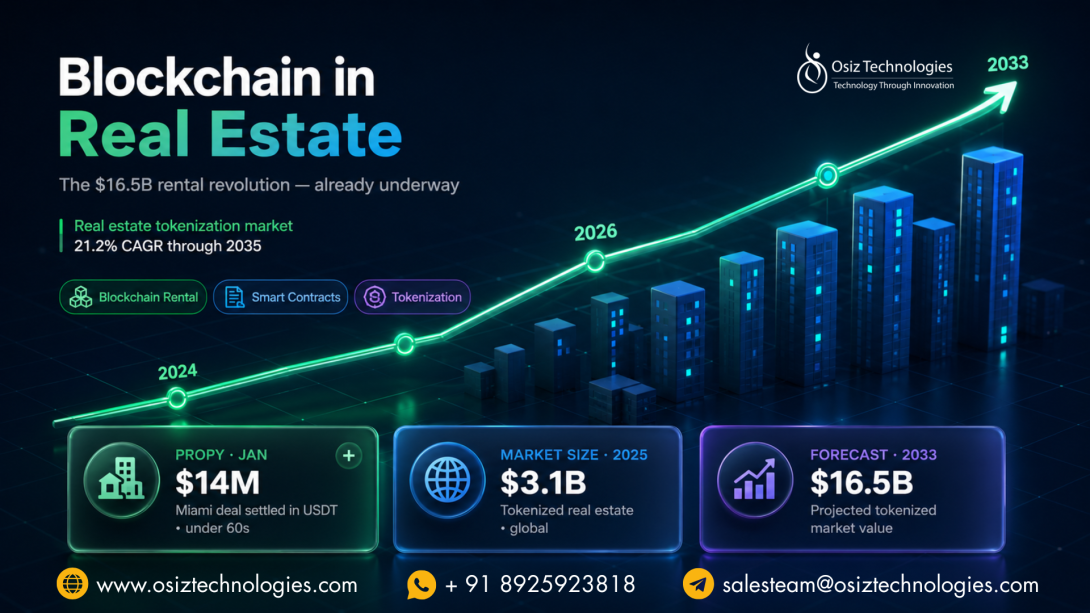
In January 2026, Propy settled a $14 million commercial real estate transaction in Miami's Wynwood district entirely in USDT - each payment cleared in under 60 seconds. For an industry accustomed to multi-week wire transfers and manual title filing, it was a landmark signal: blockchain is no longer a pilot experiment in property markets. It is operational infrastructure.
The global real estate tokenization market, valued at approximately $3.1 billion in 2025, is projected to expand at a 21.2% CAGR through 2035. Institutional players including REITs and pension funds are actively allocating capital to blockchain-native property assets. For rental platforms specifically, this convergence of regulatory clarity, mature smart contract tooling, and investor demand has opened an entirely new operating model.
What Is a Blockchain Real Estate Rental Platform?
A blockchain real estate rental platform is a digital marketplace that records lease agreements, rental payments, and ownership data on a distributed ledger - eliminating the need for traditional intermediaries such as banks, notaries, and manual escrow services.
Unlike conventional platforms, these systems offer:
- Immutable, tamper-proof property and tenancy records
- Transparent ownership verification accessible to all parties
- Cross-border rental transactions without currency conversion delays
- Token-based fractional ownership of income-producing rental assets
Platforms built on Ethereum, Polygon, or similar Layer-2 networks can process rental transactions globally at a fraction of legacy costs. Specialist Blockchain Development Services now deliver fully white-labeled rental marketplace solutions for proptech startups and established real estate firms alike.
How Smart Contract Rent Payment Works
A smart contract rent payment system automates the entire lease payment lifecycle through self-executing code deployed on-chain. When a tenant pays rent, the contract automatically:
- Verifies the payment amount and due date
- Releases funds to the landlord's wallet (or distributes fractional shares to multiple token holders)
- Updates the on-chain tenancy record
- Triggers penalty clauses or lease renewals based on pre-agreed terms
There is no manual reconciliation, no delayed bank clearance, and no dispute over receipt. Propy's current infrastructure demonstrates this at scale - its AI escrow agent, Avery, automates data population, contract initiation, and payment routing, cutting manual closing workload by an estimated 40%.
Key Benefits for Investors, Landlords, and Tenants
For Investors
Tokenized rental assets generate passive income starting at $500 per position, with platforms like Binaryx reporting 30%+ APR yields and daily smart contract distributions.
For Landlords
Near-instant settlement and an immutable audit trail reduce operating costs and eliminate payment disputes - two of the most cited advantages of blockchain in real estate property management.
For Tenants
On-chain lease terms eliminate hidden fee clauses, and escrow deposits release automatically upon verified move-out - not at a landlord's discretion.
The Rise of the Decentralized Property Rental App
The decentralized property rental app model takes this further by removing the central platform operator entirely. Built on protocols like IPFS for storage and Ethereum for transaction logic, these applications allow landlords and tenants to transact peer-to-peer with no company holding their data or funds.
Leading Blockchain Development firms build these protocols with integrated KYC compliance, multi-signature escrow, and DAO-governed maintenance funds - making the model viable for both crypto-native users and mainstream institutional landlords.
As regulatory frameworks like the EU's MiCA and UAE's VARA provide legal clarity, adoption is accelerating across these key markets.
Final Thoughts: The Future of Property Rentals on the convergence
The convergence of mature Blockchain Development Services, regulatory clarity, and real-world performance - from Propy's $14M Miami transaction to Binaryx's tokenized Bali villas - confirms that decentralized rental infrastructure is graduating from concept to standard practice.
Platforms that integrate smart contract automation, transparent on-chain records, and decentralized governance today are positioning themselves at the forefront of a property market projected to exceed $16.5 billion in tokenized value by 2033. The future of renting is transparent, automated, and borderless - and it is already live.