

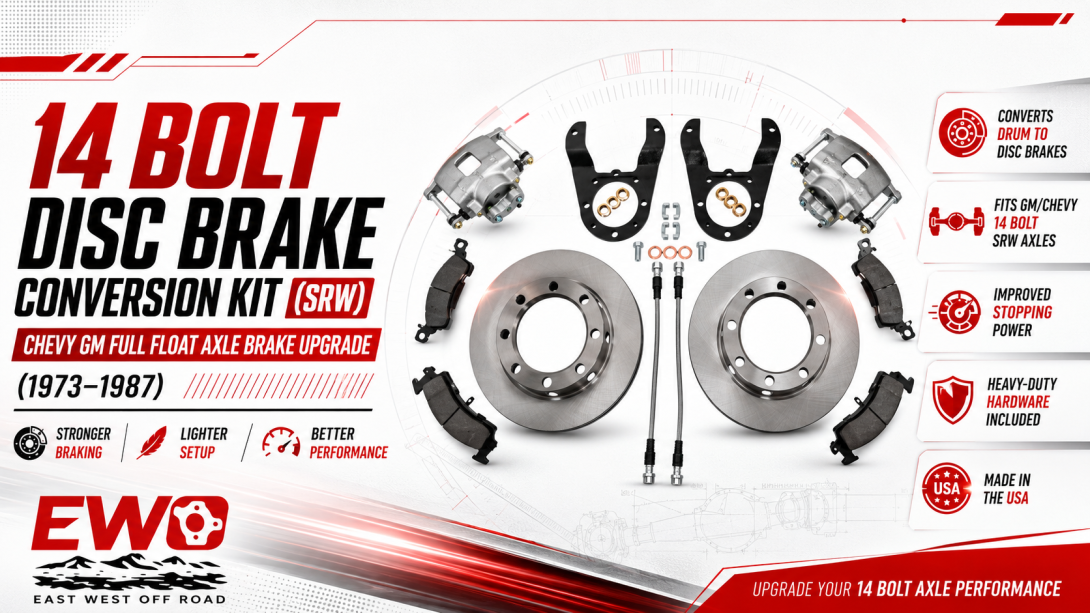
A gm axle disc brake kit can be a valuable upgrade for Chevy and GMC truck owners looking to modernize an older braking system, simplify maintenance, or convert a heavy-duty rear axle from drums to discs. Whether you're restoring a classic square-body pickup, building an off-road truck, or installing a GM 14-bolt axle in a custom 4x4, choosing the correct brake conversion components is essential for dependable braking performance.
The challenge is that not every GM rear axle uses the same brake mounting arrangement.
A half-ton Chevy pickup may use an axle completely different from the full-floating 14-bolt found under certain 3/4-ton and 1-ton trucks. Even within the GM 14-bolt axle family, variations in wheel hubs, drum mounting positions, and axle construction can affect conversion-kit compatibility.
Buying a disc brake kit based solely on the vehicle's model year or differential cover can lead to incorrect parts, installation delays, and unnecessary expenses.
A successful conversion begins with identifying the axle itself.
For owners of compatible 1973–1987 Chevy and GMC trucks equipped with a single-rear-wheel (SRW), full-floating 14-bolt rear axle, East West Off Road offers its 14 Bolt Disc Brake Conversion Kit (SRW), item number E1877.
This Made-in-USA kit includes heavy-duty caliper brackets, rotors, calipers, brake pads, hydraulic hoses, and mounting hardware for converting the intended rear drum brake system to discs.
In this comprehensive guide, we'll explain the different types of GM axle brake conversions, how to identify the correct rear axle, what a complete disc conversion includes, and how to plan your upgrade around wheel clearance, parking-brake requirements, and hydraulic brake balance.
What Is a GM Axle Disc Brake Kit?
A GM axle disc brake kit is a collection of components designed to replace an existing brake arrangement on a compatible General Motors axle with a disc brake system.
For many older Chevrolet and GMC trucks, the most common project involves converting rear drum brakes to disc brakes.
Traditional drum brakes operate by pushing brake shoes outward against the inside of a rotating brake drum.
Disc brakes work differently.
Hydraulic pressure moves pistons inside a brake caliper, causing brake pads to clamp against a rotating rotor.
Both systems create friction to slow the vehicle, but their component arrangements and service requirements differ.
What Does a Disc Brake Conversion Kit Replace?
A typical rear drum-to-disc conversion involves replacing the original drum friction components with compatible disc-brake hardware.
The main components usually include:
- Brake caliper mounting brackets.
- Brake rotors.
- Hydraulic brake calipers.
- Brake pads.
- Flexible hydraulic hoses.
- Mounting bolts and related hardware.
The axle housing, wheel hubs, hydraulic brake system, and parking-brake requirements still play important roles.
Depending on the vehicle, additional modifications may be necessary.
Are GM Axle Disc Brake Kits Universal?
No.
GM has used several rear axle designs across Chevrolet and GMC trucks.
These include different 10-bolt, 12-bolt, 14-bolt, semi-floating, and full-floating configurations.
The mounting dimensions and brake hardware are not universally interchangeable.
A conversion kit for a particular 14-bolt full-float axle should not automatically be installed on a GM 10-bolt axle or another 14-bolt configuration.
Which GM Rear Axle Do You Have?
Identifying the axle is the most important step in selecting the correct conversion kit.
Truck model names provide clues, but they do not establish exact axle fitment.
GM 10-Bolt Rear Axle
The GM 10-bolt rear axle appears in several Chevrolet and GMC applications.
Its wheel-end design and brake mounting dimensions differ from those of the full-floating 14-bolt axle.
A 14-bolt full-float conversion kit is not a universal replacement for 10-bolt brake hardware.
GM 12-Bolt Rear Axle
The GM 12-bolt is another well-known axle used in various older Chevrolet vehicles.
It has different mechanical characteristics and brake mounting arrangements from a 14-bolt full-float axle.
Owners of 12-bolt-equipped trucks should look for a conversion specifically designed for their axle configuration.
GM 14-Bolt Semi-Float Axle
A semi-floating axle uses an axle shaft that participates in supporting wheel loads.
The wheel-end and brake mounting design differ from those of a full-floating axle.
The EWO E1877 kit is not designed for semi-float applications.
GM 14-Bolt Full-Float Axle
A full-floating rear axle uses a hub-and-bearing arrangement that supports the wheel load independently of the axle shaft's primary torque-transmitting function.
This axle design is common in heavy-duty truck applications.
The full-floating GM 14-bolt is also popular in axle-swapped off-road builds.
However, full-float construction alone does not guarantee compatibility with EWO E1877.
GM Axle Identification Comparison
Axle Type
Common Application
Brake Conversion Consideration
GM 10-bolt
Various light-duty trucks
Requires 10-bolt-compatible kit
GM 12-bolt
Older Chevy trucks and other applications
Requires specific 12-bolt fitment
GM 14-bolt semi-float
Certain truck applications
Different wheel-end mounting arrangement
GM 14-bolt full-float SRW
Compatible heavy-duty trucks
Candidate for axle-specific SRW kit
GM 14-bolt full-float DRW
Dual-rear-wheel trucks
Requires matching dually hub configuration
Modified GM axle
Custom trucks and axle swaps
Identify actual installed components
The correct disc brake conversion follows the axle's physical specifications rather than its name alone.
Why Chevy and GMC Owners Upgrade Rear Drum Brakes
Rear disc brake conversions are popular among truck restoration enthusiasts and off-road builders for several reasons.
Easier Brake Maintenance
Drum brake systems contain multiple internal components, including shoes, springs, adjusters, and wheel cylinders.
Routine service may involve removing the drum and disassembling several internal parts.
With a properly installed disc system, the pads and rotor surfaces are generally easier to inspect.
For owners who maintain their trucks regularly, this can be a meaningful advantage.
Reduced Service Complexity
A disc brake system uses a different mechanical arrangement from traditional drum brakes.
While calipers and rotors still require maintenance, servicing the friction components can be more straightforward.
This is particularly attractive when replacing aging drum assemblies on older trucks.
Potential Brake Weight Savings
Certain older heavy-duty drum brake assemblies are substantial.
Replacing these components with a disc system may reduce brake-assembly weight.
The actual reduction depends on the original drums and the replacement rotors, brackets, and calipers.
Weight savings should not be treated as a guaranteed fixed amount.
Braking Consistency
A properly engineered disc system can offer favorable heat-management characteristics under repeated braking.
However, actual braking performance depends on the complete hydraulic system, friction materials, tires, and vehicle load.
A disc conversion does not automatically guarantee shorter stopping distances.
Easier Inspection After Off-Road Driving
Mud, water, dust, and debris can affect braking components.
Disc brake systems often provide better visual access for inspecting certain parts.
However, exposure to harsh conditions can still cause corrosion, contamination, and premature wear.
Regular inspection remains important.
East West Off Road GM 14-Bolt Disc Brake Conversion Kit
East West Off Road offers the 14 Bolt Disc Brake Conversion Kit (SRW) for Chevy/GM Full Float Axles (1973–1987), product number E1877.
The kit is designed for compatible older GM full-floating, single-rear-wheel 14-bolt rear axles originally equipped with behind-the-hub drum brakes.
Product Specifications
Product Feature
EWO E1877 Details
Brand
East West Off Road
Product Number
E1877
Product Category
Rear disc brake conversion
Axle Application
GM/Chevy 14-bolt full-float
Wheel Configuration
Single rear wheel (SRW)
Intended Axle Years
1973–1987
Original Brake Setup
Behind-the-hub drums
Conversion Type
Rear drum to disc
Caliper Brackets
Two 3/8-inch-thick brackets
Hardware
Grade 8 mounting hardware
Hydraulic Caliper Connection
10 mm banjo
Hydraulic Hose Connection
3/8"-24 inverted flare
Optional Parking-Brake Calipers
Available
Optional Steel-Braided Hoses
Available
Manufacturing
Made in the USA
This product is intended for a specific mechanical configuration.
It is not a universal conversion for all GM axles or all 14-bolt rear ends.
Why Consider a Complete Kit?
A complete conversion package simplifies the process of sourcing the major brake components.
Rather than purchasing only brackets and researching compatible rotors, calipers, pads, and hoses separately, buyers receive a package designed for the intended axle application.
However, vehicle-specific changes may still be required.
For a compatible older Chevy or GMC rear axle, the GM axle disc brake kit offered by East West Off Road provides a coordinated starting point for a rear drum-to-disc conversion.
What's Included in the EWO Brake Conversion Kit?
Understanding the exact package contents helps you compare complete kits against bracket-only packages.
The supplied EWO specifications identify the main components needed for both sides of the intended rear axle.
Complete Kit Contents
Component
Quantity
Details
Brake caliper brackets
2
Heavy-duty 3/8-inch construction
Bracket hardware
Set
Grade 8 mounting hardware
Brake calipers
2
Configuration selected by buyer
Brake rotors
2
Designed for compatible behind-the-hub mounting
Brake pads
4
Two per caliper
Hydraulic hoses
2
3/8"-24 inverted-flare connections
Brake line clips
2
For securing appropriate hose routing
Caliper and hose upgrades
As selected
Available product options
The current product configuration should be reviewed before ordering.
Heavy-Duty Mounting Brackets
The brackets position the brake calipers relative to the rotors.
Their geometry is critical because incorrect caliper positioning can cause clearance problems or improper pad contact.
The supplied EWO details identify two 3/8-inch-thick brackets with Grade 8 mounting hardware.
Rear Disc Brake Rotors
Two rotors are included.
They are intended for the specified behind-the-hub conversion arrangement.
This is different from later axle designs that may use slip-over brake components.
Brake Calipers
The kit includes two calipers in the selected configuration.
The specified caliper hydraulic connection uses 10 mm banjo hardware.
Caliper selection may also affect parking-brake functionality.
Brake Pads
Four pads are included for both rear calipers.
Future replacement pads should be selected using the exact caliper specifications rather than assuming all GM calipers use the same friction materials.
Hydraulic Hoses
The kit includes two hydraulic hoses with the specified 3/8"-24 inverted-flare connections.
Their length, fittings, and routing must be compatible with the installed axle and vehicle.
How to Confirm Your 14-Bolt Axle Is Compatible
The most common conversion-kit mistakes begin with incomplete axle identification.
A compatible EWO E1877 installation requires several specific characteristics.
Requirement 1: Full-Float Axle Construction
The axle must be the intended full-floating GM 14-bolt design.
The kit is not compatible with semi-floating axles.
Requirement 2: Single-Rear-Wheel Hubs
The axle must use the specified SRW hub configuration.
The kit does not fit dually hubs.
If a truck has received an axle swap or hub conversion, verify the actual hardware.
Requirement 3: Correct Original Drum Arrangement
The intended original brake drum mounts behind the wheel hub.
The kit is not designed for slip-over drum applications.
Requirement 4: Correct Mounting Measurement
EWO specifies approximately 4-11/16 inches between the relevant four-bolt caliper bracket mounting flange and the hub face.
This dimension helps establish whether the bracket will position the caliper correctly relative to the rotor.
Requirement 5: Compatible Wheels
The kit specifies 15-inch steel wheels with no more than 4 inches of backspacing, or larger aluminum wheels with verified clearance.
EWO E1877 Compatibility Matrix
Axle Configuration
Compatibility
1973–1987 GM 14-bolt full-float SRW with behind-the-hub drums
Intended application
Correct approximately 4-11/16-inch mounting measurement
Required fitment check
GM 14-bolt semi-float
Not compatible
Dually hubs
Not compatible
Later slip-over drum configuration
Not compatible
Cab-and-chassis hub arrangement
Must be evaluated separately
Modified full-float axle
Verify actual components
GM 10-bolt or 12-bolt axle
Requires a different kit
If your axle does not match these specifications, do not assume the EWO kit will fit.
SRW vs. DRW vs. Cab-and-Chassis: Understanding GM Hub Differences
The term "14-bolt full-float" describes the axle's general construction, not every detail of the wheel hubs.
Standard SRW Hubs
Single-rear-wheel hubs are designed for vehicles using one rear wheel on each side.
The EWO E1877 is intended for the specified older SRW arrangement.
Dual-Rear-Wheel Hubs
Dually trucks use hub arrangements designed for dual rear wheels.
Their mounting offsets can differ from standard SRW hubs.
The EWO product explicitly excludes dually hubs.
Cab-and-Chassis Hubs
Cab-and-chassis trucks can use hub configurations different from those of conventional pickup trucks.
Some off-road builders use cab-and-chassis axles with single wheels.
That does not automatically make their brake components compatible with a standard SRW conversion.
Why Wheel Configuration Can Be Misleading
A modified truck may run single rear wheels on hubs originally designed for another application.
The actual hub offset and mounting measurements determine compatibility.
Choosing the Correct Kit
Your Setup
Recommended Action
Original SRW full-float axle
Verify year, drums, and dimensions
Dually axle
Find a dually-compatible conversion
Cab-and-chassis axle
Identify exact hub arrangement
Converted dually-to-SRW build
Measure the installed hubs
Unknown salvage-yard axle
Identify before ordering
Semi-float axle
Select a semi-float-specific system
Do not select a brake conversion solely by counting the rear wheels currently installed.
Why Behind-the-Hub vs. Slip-Over Drums Matters
The original drum position is one of the most important differences between GM 14-bolt brake configurations.
Behind-the-Hub Drum Design
In the intended older application, the original brake drum mounts behind the wheel hub.
This determines the relationship among the hub, brake mounting flange, and rotor location.
The EWO E1877 is designed around this arrangement.
Slip-Over Drum Design
A slip-over drum fits over the wheel studs from the outside of the hub.
These applications may use different brake mounting dimensions.
Why the Conversion Brackets Differ
A bracket must position the caliper precisely around the rotor.
If the rotor sits in a different location because of another hub or drum design, the caliper bracket may not align.
That can cause improper pad contact, interference, or unsafe operation.
Before You Order
Determine whether your axle originally used behind-the-hub or slip-over drums.
If the configuration is unclear, consult the manufacturer's fitment guidance or a qualified axle technician.
Understanding the 4-11/16-Inch Axle Measurement
A key EWO E1877 fitment specification is approximately 4-11/16 inches from the appropriate caliper bracket mounting flange to the hub face.
Why Is This Measurement Important?
The mounting distance affects where the rotor sits relative to the caliper bracket.
A mismatched dimension can prevent correct rotor and caliper alignment.
What Happens if the Measurement Is Different?
The axle may use a different hub or brake mounting configuration.
Do not attempt to compensate for an incorrect mounting dimension with improvised spacers or modified brackets.
Should You Measure Before Ordering?
Yes.
This is especially important for axle swaps, older trucks with unknown service histories, or vehicles that have received replacement hubs.
The correct reference surfaces should be confirmed in the manufacturer's instructions before measuring.
Wheel Requirements for a GM Rear Disc Brake Conversion
A rear disc conversion changes the brake components occupying space behind the wheel.
The original drums may have cleared a wheel that does not clear the new calipers.
15-Inch Steel Wheel Requirements
The EWO kit specifies 15-inch steel wheels with a maximum of 4 inches of backspacing.
The actual wheel still requires adequate clearance.
Larger Aluminum Wheels
Larger aluminum wheels are listed as another option.
However, inner wheel-barrel shape and backspacing vary among designs.
A larger nominal diameter does not automatically guarantee caliper clearance.
Why Backspacing Matters
Backspacing is the distance from the wheel mounting surface to its inner edge.
More backspacing typically places more of the wheel inward toward the axle.
Depending on caliper dimensions, that can create interference.
What Should Be Checked?
Inspect clearance around the caliper body, bracket bolts, hydraulic connections, wheel barrel, and nearby components.
If the fitment cannot be confirmed, consult the wheel and brake manufacturers.
Wheel Stud and Rotor Fitment Requirements
Rotor and stud compatibility is especially important on behind-the-hub conversions.
Wheel Studs Must Fit Freely Through Rotors
EWO specifies that the wheel studs should pass freely through the rotor holes.
Do not press-fit the rotor onto the studs.
What If the Studs Are Oversized?
The supplied product information notes that oversized studs may require appropriately specified drilling of the rotor holes.
Any machining should follow the relevant manufacturer's instructions and approved dimensions.
Minimum Lug Nut Engagement
The EWO installation specifications require at least 5/8 inch of lug nut engagement.
The completed wheel assembly must also meet any additional applicable wheel and fastener requirements.
Inspect Existing Wheel Studs
Older studs may be damaged or unsuitable for the final rotor and wheel combination.
Replace worn or incompatible studs with correctly specified components.
Do not reuse damaged mounting hardware.
Parking Brake Options for a GM Axle Disc Conversion
Parking-brake planning is often overlooked when converting rear drums to discs.
Many drum brake assemblies include the original mechanical parking-brake mechanism.
When the drums are removed, that mechanism may no longer be available.
Standard Disc Brake Calipers
Standard hydraulic disc calipers do not necessarily include a mechanical parking brake.
Hydraulic service brakes should not be assumed to provide a suitable parking-brake function.
Parking-Brake Caliper Option
The EWO E1877 product page offers an upgrade to parking-brake calipers.
This is worth considering for owners who need to retain a functional mechanical parking brake.
However, the caliper selection alone does not guarantee compatibility with the truck's existing cables.
Additional Parking-Brake Components
Some installations may require different cables, mounting brackets, or adjustment hardware.
These components should be identified before disassembling the original rear brakes.
Why It Matters for Street Use
A functioning parking brake helps secure a stationary vehicle independently of the hydraulic service brakes.
It may also be required under applicable vehicle laws or inspection rules.
A complete conversion should include a properly functioning parking-brake arrangement.
Brake Proportioning and Front-to-Rear Balance
Changing rear drum brakes to discs can alter the braking characteristics of the truck.
This is one reason brake-system planning must extend beyond mechanical rotor and caliper installation.
What Is Brake Bias?
Brake bias describes the distribution of braking force between the front and rear wheels.
The appropriate balance depends on the vehicle, brake components, load, and tire traction.
Why Rear Disc Brakes Can Change Brake Balance
Disc calipers and drum wheel cylinders have different mechanical and hydraulic characteristics.
Caliper piston area, pad friction, rotor dimensions, and hydraulic pressure influence braking force.
Installing rear discs without evaluating these factors can create an unsuitable front-to-rear balance.
Manual Proportioning Valve Recommendation
EWO recommends a manual proportioning valve for managing brake balance after the conversion.
An appropriate adjustable valve can help reduce rear brake pressure when required.
However, it must be selected and adjusted as part of the complete braking system.
A qualified brake technician should perform this evaluation.
Why Incorrect Brake Balance Is Dangerous
Excessive rear braking can contribute to premature rear-wheel lockup.
Insufficient rear braking can reduce the rear axle's contribution to stopping the vehicle.
A properly matched system should be inspected and tested under controlled conditions before regular road use.
Residual Pressure Valves and Brake Drag
Older hydraulic systems may contain residual-pressure valves associated with their original brake configuration.
These need to be evaluated during a disc conversion.
What Is a Residual Pressure Valve?
A residual-pressure valve maintains a specified pressure in part of a hydraulic brake circuit.
Different systems use different valve configurations.
Why Can Drum-Brake Residual Pressure Cause Problems?
An incompatible drum-specific residual-pressure arrangement can maintain unwanted pressure at the new rear calipers.
This may cause brake drag or excessive heat.
Should Every Residual Valve Be Removed?
No universal instruction applies to every system.
EWO's product guidance calls for addressing residual pressure that could cause the new rear discs to drag.
A qualified technician should identify the existing valve arrangement and determine the correct configuration for the converted system.
Do not remove unrelated hydraulic components without understanding their function.
Does a GM Axle Disc Conversion Require a New Master Cylinder?
A rear disc conversion does not automatically require replacing the master cylinder.
However, the existing master cylinder must be suitable for the new brake configuration.
Why Master Cylinder Compatibility Matters
The master cylinder supplies hydraulic pressure and fluid displacement.
Its characteristics influence pedal travel and the operation of the complete braking system.
Why Caliper Selection Matters
Different calipers can have different hydraulic piston sizes and fluid-volume requirements.
These need to be compatible with the rest of the system.
When Should Additional Hydraulic Components Be Replaced?
A master cylinder, booster, valve, or brake line may need replacement if defective or incompatible with the completed configuration.
The correct decision should follow a system-level inspection.
Standard vs. Steel-Braided Hydraulic Brake Hoses
The EWO kit offers standard hydraulic hoses and an optional steel-braided hose upgrade.
Standard Hydraulic Hoses
The product specifications include two hydraulic hoses with 3/8"-24 inverted-flare connections.
The specified caliper setup uses 10 mm banjo connections.
Steel-Braided Brake Hoses
Steel-braided hoses can offer different expansion and durability characteristics depending on construction.
However, correctly matched fittings and proper hose routing are essential regardless of hose type.
Brake Hose Routing
Hoses should remain clear of rotating wheels, sharp edges, moving suspension parts, and excessive heat.
They must also accommodate the vehicle's intended axle movement without stretching or kinking.
Full Hydraulic System Bleeding
The EWO installation requirements specify a complete brake-system re-bleed.
Afterward, the system should be checked for leaks and correct pedal function.
Air or leaks in the brake hydraulic circuit can compromise braking performance.
Installation Overview: GM 14-Bolt Rear Disc Brake Conversion
A conversion requires both mechanical and hydraulic work.
The following overview is intended for project planning.
Use the manufacturer's complete installation instructions and seek qualified professional assistance when necessary.
Step 1: Verify Axle Fitment
Confirm the full-float SRW axle, correct year configuration, behind-the-hub drums, and required mounting measurement.
Do not begin with unresolved compatibility questions.
Step 2: Inspect Existing Components
Examine the wheel hubs, bearings, seals, studs, brake lines, and mounting hardware.
Identify worn or damaged parts that need replacement.
Step 3: Remove the Original Drum Assemblies
Follow the service procedure for the exact axle.
The behind-the-hub arrangement may require hub-related service.
Step 4: Verify Rotor and Stud Compatibility
Check that the rotor matches the intended mounting position.
The studs must pass freely through the rotor holes as specified.
Step 5: Install the Caliper Brackets
Use the supplied mounting hardware and correct manufacturer procedures.
Verify the brackets align with the rotors.
Step 6: Install Rotors, Calipers, and Pads
Fit the mechanical brake components according to their specific instructions.
Check component positioning and clearance.
Step 7: Connect the Hydraulic Hoses
Use the specified fittings and secure hose routing.
Inspect the connections and nearby moving components.
Step 8: Address Parking-Brake Requirements
Install or adapt the selected parking-brake arrangement.
Verify correct mechanical operation.
Step 9: Evaluate Hydraulic Brake Balance
Review the proportioning valve, residual-pressure configuration, and master cylinder compatibility.
Make changes only according to the requirements of the complete system.
Step 10: Bleed, Inspect, and Verify
Perform the required hydraulic bleed.
Check for leaks, verify wheel clearance and fastener security, and have the completed braking system professionally evaluated before ordinary road use.
Choosing a Complete Kit vs. Bracket-Only Conversion
GM axle disc brake products vary in their package contents.
A lower initial price may not reflect the complete cost of the project.
Complete Conversion Kit
A complete conversion kit includes the primary mechanical brake components.
For the EWO E1877, this includes brackets, calipers, rotors, pads, hoses, and hardware.
Bracket-Only Kit
A bracket-only kit supplies the caliper mounting brackets.
The builder must then purchase compatible rotors, calipers, pads, hoses, and other required components separately.
Which Option Makes More Sense?
Buying Factor
Complete Kit
Bracket-Only Kit
Caliper brackets
Included
Included
Brake rotors
Included
Separate purchase
Calipers
Included
Separate purchase
Brake pads
Included
Separate purchase
Hydraulic hoses
Included
Separate purchase
Parts sourcing
More coordinated
More individual research
Custom component selection
Limited to available options
More flexibility
Best suited for
Compatible complete conversion
Experienced custom builders
For truck owners who want a coordinated package, a 14 bolt rotor caliper kit can reduce the need to source the primary components independently.
However, the package still needs to match the exact axle.
GM Axle Disc Brake Kits for Different Truck Builds
The ideal brake conversion depends on how the vehicle will be used.
Classic Chevy Square-Body Restoration
A restoration may prioritize reliable service, convenient maintenance, and compatibility with the truck's existing wheels.
For a compatible 14-bolt axle, a rear disc conversion can be considered as part of a broader brake-system refresh.
Owners pursuing a factory-original restoration may instead prefer rebuilding the existing drums.
Daily-Driven Chevy or GMC Truck
Daily-driven vehicles require predictable braking, appropriate pedal feel, and a functioning parking brake.
Correct hydraulic balance and professional verification are especially important.
Rock-Crawling 4x4
An off-road vehicle may benefit from easier visual brake inspection after trail use.
However, caliper clearance, hose routing, and protection from impacts must also be considered.
Axle-Swapped Truck
A GM 14-bolt axle may be installed under a vehicle that originally used a different rear axle.
The mechanical conversion must match the donor axle.
At the same time, the recipient vehicle's hydraulic braking system and parking brake need to be compatible with the completed setup.
Towing and Work Trucks
Trucks used for towing or carrying heavy loads require careful brake-system evaluation.
A disc conversion does not increase the manufacturer's certified towing capacity, payload rating, or axle rating.
Appropriate braking performance must be established for the intended vehicle and load configuration.
Is a GM Rear Disc Conversion Worth the Cost?
The value of a brake conversion depends on the condition of the original system and the owner's goals.
When a Disc Conversion Makes Sense
A conversion may be attractive when the existing drum brakes require extensive rebuilding, the owner wants easier future service, or the truck is already undergoing a major axle or brake-system project.
When Keeping Drum Brakes May Be Reasonable
A properly maintained drum brake system can remain suitable for many vehicles.
If the drums are in good condition and the owner prioritizes factory originality, conversion may not be necessary.
Consider the Full Project Cost
Possible additional expenses include:
- Parking-brake calipers and related hardware.
- Hydraulic valve modifications.
- Replacement wheel studs.
- Hub bearings and seals.
- Brake-line work.
- Brake fluid.
- Professional installation.
- Final brake-system inspection.
Total Cost Comparison
Expense
Drum Brake Rebuild
Disc Brake Conversion
Friction components
Drum shoes
Disc pads
Main friction surface
Drums
Rotors
Hydraulic components
Wheel cylinders
Calipers
Springs and adjusters
Often serviced
Replaced by different disc arrangement
Mounting brackets
Existing backing plates
Conversion brackets
Brake hoses
Condition-dependent
Compatible conversion hoses
Parking brake
Existing mechanical system
Compatible replacement arrangement needed
Brake-bias review
Based on repairs
Important due to system change
Labor
Depends on condition
Depends on axle and conversion complexity
A disc conversion may simplify future maintenance, but it is not automatically less expensive than every drum-brake repair.
Common GM Axle Disc Conversion Problems
Even correctly selected components require careful installation and inspection.
Symptom
Possible Issue
Soft brake pedal
Air, leaks, or hydraulic incompatibility
Excessive pedal travel
Air, fluid-displacement mismatch, other brake faults
Rear brake drag
Residual pressure or caliper release problem
Rear wheels lock too early
Brake bias or traction concerns
Rotor rubs caliper bracket
Incorrect alignment or mounting
Wheel contacts caliper
Inadequate wheel clearance
Hydraulic leak
Hose, fitting, line, or caliper problem
Parking brake will not hold
Incorrect cable or caliper setup
Excessive brake heat
Dragging brakes or mechanical interference
Uneven pad wear
Caliper movement, mounting, or other brake faults
These symptoms should be diagnosed before the vehicle returns to regular driving.
A vehicle with compromised braking performance should not be operated until the problem is corrected.
Common Mistakes When Buying a GM Axle Disc Brake Kit
Mistake 1: Assuming Every GM Axle Uses the Same Brake Components
GM axle families include different designs.
The exact axle determines conversion compatibility.
Mistake 2: Confusing Full-Float and Semi-Float Axles
These designs use different wheel-end arrangements and require suitable conversion parts.
Mistake 3: Assuming Single Rear Wheels Guarantee SRW Hub Fitment
A modified truck may have nonstandard hubs while running single rear wheels.
Mistake 4: Ignoring the Original Drum Mounting Position
Behind-the-hub and slip-over arrangements require different fitment considerations.
Mistake 5: Skipping the Mounting Measurement
The approximately 4-11/16-inch dimension is an important EWO E1877 fitment check.
Mistake 6: Overlooking Wheel Backspacing
Correct wheel diameter does not guarantee caliper clearance.
Mistake 7: Press-Fitting Rotors onto Wheel Studs
The EWO instructions specify that studs must pass freely through rotor holes.
Mistake 8: Insufficient Lug Nut Engagement
The EWO product specifies at least 5/8 inch of engagement.
Mistake 9: Forgetting Parking-Brake Function
A rear drum conversion must account for the original mechanical parking brake.
Mistake 10: Ignoring Brake Bias
The front and rear braking systems need to work together properly.
Mistake 11: Overlooking Residual Pressure
An incompatible hydraulic valve arrangement may cause rear brake drag.
Mistake 12: Skipping Hydraulic Bleeding and Final Testing
A complete brake-system bleed, leak inspection, and professional verification are necessary.
Where to Buy a GM Axle Disc Brake Kit
If you're shopping for a gm axle disc brake kit for sale, begin by identifying the rear axle and confirming its brake mounting arrangement.
For the specified 1973–1987 Chevy/GM 14-bolt SRW full-float axle, East West Off Road offers its E1877 Disc Brake Conversion Kit.
The package includes the main components required to convert the intended rear drum system to discs.
Buyers can also review available parking-brake caliper and steel-braided hose options.
Before placing an order, verify the axle's construction, hub type, original drum position, flange measurement, wheel requirements, and hydraulic compatibility.
You can explore the 14 bolt rear disc brakes conversion package through East West Off Road and review the available product selections.
Choosing the correct parts before disassembling the existing brakes is the best way to avoid unnecessary delays and incompatible components.
Final Thoughts: Choose a Disc Brake Conversion That Matches Your GM Axle
A gm axle disc brake kit can be a worthwhile investment for owners restoring older Chevrolet and GMC trucks or modifying heavy-duty rear axles.
A properly matched rear disc conversion can simplify brake maintenance and provide a modern alternative to the original drum arrangement.
However, compatibility is the most important consideration.
Different GM axles require different brake components, and not every 14-bolt full-float axle uses the same hubs or rotor mounting position.
For the intended older SRW configuration, East West Off Road offers a complete conversion kit through its E1877 product.
Before purchasing, confirm the axle type, wheel hub arrangement, behind-the-hub drum design, required mounting measurement, and wheel clearance.
The completed conversion must also provide a suitable parking brake, proper hydraulic balance, adequate wheel-stud engagement, and correct service-brake operation.
Whether you're restoring a Chevy square-body pickup, building a trail truck, or completing an axle swap, the best results come from careful parts selection and professional brake-system verification.
Frequently Asked Questions (FAQs)
1. What is a GM axle disc brake kit?
A GM axle disc brake kit provides components for converting a compatible General Motors axle from drum brakes to disc brakes. The exact components depend on the axle and mounting configuration.
2. Can I convert my Chevy truck's rear drum brakes to discs?
Yes. Rear disc brake conversion kits are available for many compatible Chevy and GMC axle applications. The correct kit must match the installed axle.
3. Do all GM rear axles use the same disc brake conversion kit?
No. GM 10-bolt, 12-bolt, 14-bolt semi-float, and 14-bolt full-float axles can have different mounting requirements.
4. What vehicles does the EWO E1877 fit?
It is intended for compatible 1973–1987 Chevy/GM trucks equipped with the specified 14-bolt SRW full-float axle.
5. Will the EWO kit fit a Chevy C10?
Not automatically. A typical C10 may use a different rear axle. Fitment requires the specific compatible 14-bolt full-float SRW arrangement.
6. Will it fit a Chevy K20?
It may fit if the truck has the correct 1973–1987 full-float SRW 14-bolt axle and meets all mounting requirements.
7. Can I use this kit on a Chevy K30?
Possibly, if the K30 has the correct SRW full-float axle. Dually hubs are not compatible with EWO E1877.
8. Does this kit fit GMC trucks?
It is intended for compatible GM/Chevy axle applications, which may include GMC trucks equipped with the specified axle configuration.
9. What is the difference between full-float and semi-float axles?
A full-float axle supports the wheel through a hub-and-bearing arrangement. A semi-float axle uses a different design where the axle shaft also participates in supporting wheel loads.
10. Does EWO E1877 fit semi-float axles?
No. The supplied fitment specifications explicitly exclude semi-float axles.
11. What does SRW mean?
SRW stands for single rear wheel, meaning the vehicle uses one rear wheel on each side.
12. Will the EWO kit fit dually hubs?
No. The product is not compatible with dually hubs.
13. Are cab-and-chassis hubs compatible?
Compatibility should not be assumed. Cab-and-chassis configurations may use different hub offsets and mounting dimensions.
14. What is a behind-the-hub drum?
It is a drum brake arrangement where the original drum mounts behind the wheel hub instead of slipping over the studs from the outside.
15. Does EWO E1877 fit slip-over drum axles?
No. The kit is designed for the specified behind-the-hub drum configuration.
16. What does the 4-11/16-inch measurement mean?
It is the approximate required distance from the relevant four-bolt caliper bracket mounting flange to the hub face.
17. What if my axle measurement is different?
Contact the manufacturer before ordering. A different measurement may indicate an incompatible hub or brake mounting arrangement.
18. What is included in the EWO disc brake kit?
The supplied specifications include two brackets, two rotors, two calipers, four brake pads, two hydraulic hoses, brake line clips, and mounting hardware.
19. Does the kit include caliper mounting brackets?
Yes. The kit specifies two heavy-duty 3/8-inch brackets with Grade 8 hardware.
20. Does the kit include brake rotors?
Yes. The advertised package includes two brake rotors for the intended rear disc conversion.
21. Are brake calipers and pads included?
Yes. The supplied kit includes two calipers and four brake pads.
22. Are hydraulic brake hoses included?
Yes. The kit includes two hydraulic hoses with the specified 3/8"-24 inverted-flare connections.
23. What size banjo bolts do the calipers use?
The supplied standard caliper specification identifies 10 mm banjo connections.
24. Can I upgrade to steel-braided brake hoses?
Yes. The EWO product listing offers a steel-braided hose upgrade selection.
25. Does the kit include a parking-brake option?
EWO offers a parking-brake caliper selection. Buyers should verify the chosen configuration and any additional cable or hardware requirements.
26. Do I need a functioning parking brake after conversion?
A functioning parking brake is important for safety and may be required under applicable regulations. The completed conversion should include an appropriate parking-brake solution.
27. What wheels fit the EWO GM disc brake kit?
The supplied specifications allow 15-inch steel wheels with no more than 4 inches of backspacing, or larger aluminum wheels with verified clearance.
28. Will my existing wheels clear the calipers?
Not necessarily. Actual fitment depends on wheel diameter, inner-barrel shape, backspacing, and caliper dimensions.
29. Can I press-fit the brake rotors onto the wheel studs?
No. EWO specifies that the studs must pass freely through the rotor holes.
30. What if my wheel studs are oversized?
The product notes indicate that correctly specified rotor-hole drilling may be necessary. Follow the manufacturer's instructions before modifying any components.
31. How much lug nut engagement is required?
The EWO specifications require at least 5/8 inch of engagement, along with any additional applicable wheel and fastener requirements.
32. Do I need a proportioning valve?
EWO recommends a manual proportioning valve to help establish proper brake balance. A qualified technician should evaluate the complete hydraulic system.
33. Can a residual-pressure valve cause brake drag?
Yes. An incompatible drum-specific residual-pressure arrangement may maintain unwanted pressure at rear disc calipers.
34. Should I remove every residual-pressure valve?
No. The correct valve arrangement depends on the entire hydraulic system. A qualified technician should determine any required changes.
35. Will I need a different master cylinder?
Not automatically. The master cylinder must be evaluated for compatibility with the selected calipers and final brake arrangement.
36. Do I need to bleed the brake system after conversion?
Yes. EWO specifies a full system re-bleed after installation.
37. Will rear disc brakes improve stopping performance?
A properly engineered conversion may provide braking-performance and consistency benefits. Actual stopping distance depends on the complete braking system, tires, load, and road conditions.
38. Can a GM axle disc conversion reduce weight?
Replacing certain heavy drum assemblies with discs may reduce brake-assembly weight. The exact difference depends on the components.
39. Is a GM rear disc conversion suitable for off-road trucks?
It can be suitable for compatible off-road builds when the axle, brake hardware, hydraulic system, and wheels are correctly matched.
40. Does a disc brake conversion increase towing capacity?
No. A conversion does not increase the manufacturer's certified towing, payload, or axle ratings.
41. Can I use EWO E1877 on an axle-swapped vehicle?
Potentially, if the axle itself matches the required configuration. The recipient vehicle's hydraulic and parking-brake systems must also be compatible.
42. Is the EWO E1877 made in the USA?
Yes. The supplied product specifications identify the kit as Made in the USA.
43. Is a complete conversion kit better than brackets alone?
A complete kit simplifies major component sourcing. A bracket-only package may suit experienced builders who want to select individual components.
44. How much does a GM axle disc brake kit cost?
Pricing depends on the product, axle application, included components, and selected options. Check the current EWO product listing for pricing.
45. Where can I buy a GM axle disc brake conversion kit?
East West Off Road offers its E1877 rear disc conversion kit for compatible 1973–1987 Chevy/GM 14-bolt SRW full-float axles. Verify all fitment and hydraulic requirements before ordering.