

Buy Now: https://www.eastwestoffroad.com/shop?category=dom-tubes
Drawn over mandrel tubing, commonly called DOM tubing, is widely used in automotive fabrication, mechanical components, and custom off-road suspension projects. However, many buyers misunderstand what the DOM manufacturing process actually means, especially when comparing it with seamless steel tubing or conventional electric-resistance-welded (ERW) tubing.
For off-road enthusiasts building custom suspension links, understanding these differences helps prevent incorrect material assumptions and purchasing mistakes.
DOM describes a manufacturing process, not a specific steel alloy, universal strength rating, or finished suspension application.
This guide explains how DOM tubing is manufactured, why it is not technically seamless, how it compares with ERW products, and what to consider before purchasing DOM tubing for a custom 3-link or 4-link suspension project.
What Is Drawn Over Mandrel Tubing?
Drawn over mandrel tubing is mechanical tubing processed through a cold-drawing operation using an external die and an internal mandrel.
In the commonly used manufacturing process, the starting material is electric-resistance-welded steel tubing.
The additional drawing process helps refine the tube's dimensions, surface characteristics, and consistency.
The key difference is simple: DOM normally starts as welded tubing, while seamless tubing is produced without an initial longitudinal welded joint.
This distinction does not automatically make one product better than the other.
The appropriate choice depends on the required manufacturing specification, material grade, dimensions, and intended mechanical application.
What Does DOM Stand For?
DOM stands for Drawn Over Mandrel.
It describes how the tubing is finished during production.
The term does not identify a particular vehicle, steel grade, wall thickness, or approved load capacity.
Is DOM a Type of Steel?
DOM is not a steel alloy designation.
Different steel materials can be processed using the DOM manufacturing method.
For example, an alloy specification and a DOM processing description communicate different information.
Buyers should not assume that a tube advertised as DOM is automatically chromoly or has any particular chemical composition.
How Is DOM Tubing Manufactured?
The DOM manufacturing process typically begins with flat steel strip that is formed into a round tubular shape.
The edges are joined using electric resistance welding.
The tube then undergoes additional processing, including cold drawing through a die and over an internal mandrel.
Electric Resistance Welding
ERW manufacturing joins the edges of formed steel strip to produce a tubular product.
This creates a longitudinal welded region along the tube.
Before subsequent DOM processing, manufacturers prepare the tube according to the intended production requirements.
Cold Drawing Over a Mandrel
The tube is drawn through tooling that controls its final geometry.
The external die helps determine the outside diameter, while the internal mandrel helps control the inside diameter and wall thickness.
The process can improve dimensional consistency and surface finish compared with the starting welded tube.
Why Does Dimensional Control Matter?
Dimensional consistency is useful in mechanical applications where components must be manufactured to specified measurements.
For a suspension tube buyer, however, manufacturing precision does not eliminate the need to verify the actual supplied tube dimensions.
The nominal outside diameter, inside diameter, wall thickness, and applicable tolerances remain important.
DOM Tubing vs. Seamless Tubing: What's the Difference?
One of the most frequently asked questions is whether DOM tubing is the same as seamless steel tubing.
The answer is no.
Although the finished products can look similar, their manufacturing routes are different.
How Seamless Tubing Is Made
Seamless tubing is manufactured without joining the edges of a formed steel strip using a longitudinal weld.
A typical seamless production route begins with a solid steel billet that is pierced to create a hollow section.
Further processing establishes the finished dimensions and mechanical properties.
Does DOM Tubing Have a Weld Seam?
DOM tubing normally originates from welded tube.
The subsequent drawing process changes the appearance and characteristics of the original welded region.
As a result, the seam may not be visually obvious.
However, a smooth surface does not mean the material was manufactured through a seamless process.
Is Seamless Tubing Always Stronger?
Not necessarily.
Strength depends on several variables, including material grade, processing condition, tube dimensions, and the applicable testing requirements.
A seamless designation does not guarantee that a particular tube is suitable for every demanding application.
Likewise, a DOM designation does not establish an approved strength rating for a custom suspension link.
The correct comparison must use the actual product specifications.
DOM vs. ERW Tubing: Understanding the Main Differences
The phrase DOM vs ERW tubing can be confusing because the manufacturing processes are related.
Conventional DOM mechanical tubing normally begins as ERW tubing.
The principal distinction is the additional cold-drawing operation used to produce the DOM product.
What Does ERW Mean?
ERW stands for Electric Resistance Welded.
It describes the process used to create a welded tube from formed steel strip.
ERW tubing may be supplied in different manufacturing and finishing conditions.
What Changes With DOM Processing?
DOM processing provides additional control over the finished tube's dimensions and surface characteristics.
However, not every DOM product has the same tolerances or mechanical properties.
Those details depend on the manufacturer's specifications.
Comparison Table: DOM, ERW, and Seamless Tubing
Tubing Type
Manufacturing Description
Important Buying Consideration
ERW tubing
Steel strip formed and welded longitudinally
Confirm dimensions, material grade, and supplied condition
DOM tubing
Typically ERW tubing cold-drawn through tooling and over a mandrel
Verify finished dimensions, tolerances, and material documentation
Seamless tubing
Produced without an initial longitudinal welded-strip joint
Confirm the specified seamless grade and applicable requirements
This comparison explains manufacturing terminology, not universal performance rankings.
A qualified fabricator should determine which material specification is appropriate for the intended application.
Why Do Off-Road Fabricators Consider DOM Tubing?
Round DOM tubing is commonly considered when purchasing steel material for custom mechanical fabrication.
In off-road projects, builders may encounter it while sourcing raw tubing for suspension links and axle-location components.
The primary purchasing advantage is having a clearly described material process and dimensional specification to compare against a professional materials list.
DOM Tubing for Custom Suspension
Products described as DOM tubing for link suspension provide raw material for projects that require fabricated suspension members.
However, the tube does not include the engineering decisions necessary to create a complete link assembly.
Those decisions involve the surrounding components, expected loads, and vehicle-specific suspension design.
Steel Suspension Link Tubing
Buyers researching steel suspension link tubing should evaluate more than the advertised manufacturing method.
A complete material description may require the outside diameter, inside diameter, wall thickness, supplied length, and material documentation.
The finished suspension application must be assessed independently.
DOM Tubing for Rock Crawlers
Rock-crawling vehicles can operate under demanding suspension conditions.
However, a catalog label such as off-road, heavy-duty, or rock crawler does not establish that a specific tube is suitable for a particular vehicle.
Professional engineering and fabrication remain essential.
East West Off Road DOM Tube Kits for 3-Link and 4-Link Projects
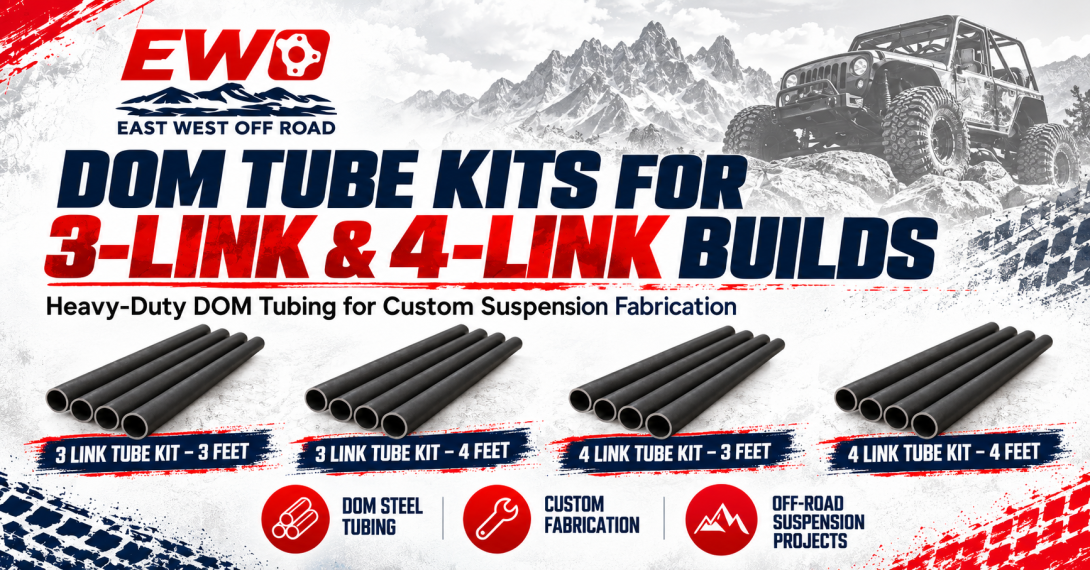
East West Off Road offers four DOM tube packages in its suspension tubing category.
These packages provide tube material for custom projects rather than complete suspension systems.
E90627: 3-Link Tube Kit — Nominal 3 Feet
This package lists three main tubes with the following dimensions:
- 2.00-inch outside diameter
- 1.50-inch inside diameter
- .250-inch wall thickness
It also includes a separate 43-inch panhard tube with 1.50-inch OD, 1.00-inch ID, and .250-inch wall thickness.
The exact supplied main-tube cut length should be confirmed before ordering.
The EWO 3-link DOM tube package is an option to review when sourcing material for a compatible project.
E90626: 3-Link Tube Kit — 4 Feet
This package lists three 48-inch main tubes using the same 2.00-inch OD, 1.50-inch ID, and .250-inch wall dimensions.
It also lists one separate 43-inch panhard tube.
E90625: 4-Link Tube Kit — Nominal 3 Feet
This product lists four main tubes with 2.00-inch OD, 1.50-inch ID, and .250-inch wall thickness.
Buyers should confirm the exact supplied cut length before ordering.
A separate panhard tube is not listed as part of this package.
E90624: 4-Link Tube Kit — 4 Feet
This package lists four 48-inch DOM tubes with 2.00-inch OD, 1.50-inch ID, and .250-inch wall thickness.
It is described for a triangulated 4-link project.
Are These Complete Suspension Kits?
No.
These are tube-only packages.
Their listed contents do not include finished rod ends, joints, brackets, shocks, or complete vehicle-specific suspension assemblies.
Additional components must be selected according to the engineered project requirements.
What Should You Check Before Buying Drawn Over Mandrel Tubing?
Before ordering, compare the supplier's product description with a professional materials list.
The most useful checks include the complete dimensional specification, tube quantity, and confirmed supplied length.
Confirm the Material Description
DOM identifies the manufacturing process.
If the project requires a particular steel grade, material certification, or production condition, request the appropriate supplier documentation.
Confirm Outside Diameter and Wall Thickness
These measurements help identify the tube's cross section.
Do not select tubing based only on the outside diameter.
Verify Inside Diameter
Inside diameter can be relevant to connection-component compatibility.
However, nominal ID alone does not guarantee compatibility with a threaded adapter or finished joint assembly.
Check Product Quantity and Length
EWO's 3-link and 4-link products contain different combinations of tubes.
Confirm the appropriate SKU and delivered lengths before purchasing for a measured project.
Confirm the Project's Engineering Requirements
Tube dimensions do not independently establish a suitable suspension design.
A qualified fabrication professional should determine the required material, connections, and complete mechanical application.
Frequently Asked Questions
What Is Drawn Over Mandrel Tubing?
Drawn over mandrel tubing is mechanical tubing processed through a cold-drawing operation using an external die and internal mandrel. Conventional DOM steel tubing begins as electric-resistance-welded tube before undergoing further processing. The process can improve dimensional consistency and surface characteristics. However, it does not identify a particular steel grade, load rating, or approved suspension application.
Is Drawn Over Mandrel Tubing Seamless?
No. DOM mechanical steel tubing commonly begins as welded tube. The subsequent cold-drawing operation refines the tube's dimensions and surface, making the original welded region less visible. Seamless tubing follows a different manufacturing route without an initial longitudinal welded-strip joint. If a project explicitly requires seamless material, buyers should verify the correct product specification with their supplier.
Is DOM Tubing Better Than ERW Tubing?
DOM includes additional manufacturing processing compared with conventional as-welded ERW tubing. This can provide improved dimensional control and surface characteristics. However, the correct material depends on the actual engineering requirements. It is not accurate to assume every DOM tube outperforms every ERW tube. Buyers should compare material grades, manufacturing conditions, dimensions, and verified specifications.
Is DOM Tubing the Same as Chromoly Tubing?
No. DOM describes how a tube is processed, while chromoly refers to a family of alloy steels containing chromium and molybdenum. These terms describe different properties of a material. A product may have both an alloy designation and a manufacturing-process description, but the DOM label alone does not establish that a tube is chromoly. Check product-specific documentation.
Can I Use Drawn Over Mandrel Tubing for Suspension Links?
DOM tubing is considered in various custom suspension fabrication projects, but its suitability depends on the complete engineering design. The manufacturing process alone does not establish acceptable loads, joint compatibility, or vehicle fitment. East West Off Road's DOM products supply tube material rather than complete suspension systems. A qualified fabricator should verify the intended material requirements before the project proceeds.
Final Thoughts
Understanding drawn over mandrel tubing starts with recognizing the difference between a manufacturing process and a material specification.
DOM tubing normally begins as welded mechanical tubing and undergoes additional cold drawing to refine its dimensions and surface characteristics.
That makes it different from seamless tubing, but neither designation independently determines suitability for every off-road suspension application.
For builders planning custom 3-link or 4-link projects, East West Off Road offers four DOM tube packages with defined tube quantities and dimensional descriptions.
Before purchasing, verify the exact SKU, supplied lengths, and compatibility with the professionally approved materials list.
Shop East West Off Road DOM Tubing to compare the available tube packages.