

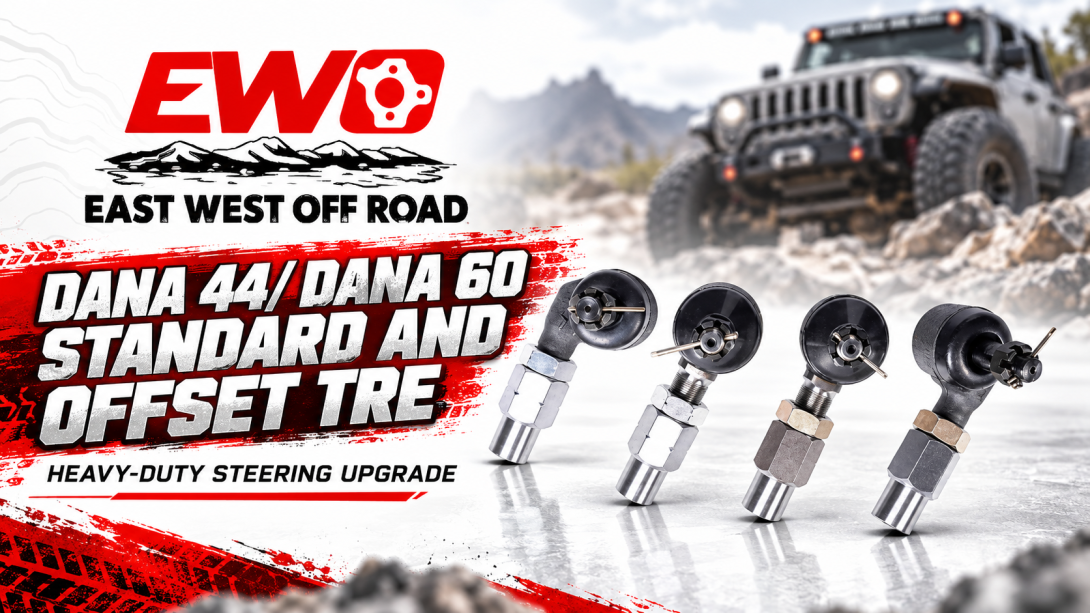
Buy Now: https://www.eastwestoffroad.com/product/dana-44-dana-60-standard-and-offset-tre
Dana 44 tie rod ends are essential steering components for trucks, Jeeps, and custom off-road vehicles equipped with a Dana 44 front axle. Whether you're replacing worn factory steering joints, upgrading to heavy-duty GM 1-ton steering components, or building a crossover or high-steer system, selecting the right tie rod ends is critical for dependable steering performance and proper front-end alignment.
The Dana 44 axle has been used in numerous vehicle platforms, including older Chevrolet and GMC trucks, Ford 4x4s, Jeep Wranglers, and custom solid-axle builds. Its popularity in the off-road aftermarket has created a wide range of steering replacement parts and upgrade options.
However, not every Dana 44 axle uses the same steering knuckles, tie rod ends, or mounting configuration.
A factory Jeep Dana 44 steering system may have different requirements from a classic Chevy Dana 44 or a heavily modified axle with aftermarket high-steer arms.
That's why choosing the correct tie rod ends involves more than identifying the axle.
You also need to consider thread dimensions, ball-stud taper, steering-link configuration, joint articulation, and clearance around surrounding components.
For builders looking for heavy-duty steering options, East West Off Road offers the Dana 44 / Dana 60 Standard and Offset TRE, item number E90063.
In this comprehensive guide, we'll explain how Dana 44 tie rod ends work, when replacement is necessary, how standard and offset joints compare, and what to check before buying components for your next steering upgrade.
What Are Dana 44 Tie Rod Ends?
Tie rod ends are articulated steering joints that connect the steering linkage to the front steering knuckles or other compatible steering components.
Their primary purpose is to transfer steering movement while allowing the angular motion required as the wheels turn and the suspension operates.
In a conventional solid-front-axle steering arrangement, the tie rod helps coordinate the movement of the left and right front wheels.
Its effective length also influences front-wheel toe alignment.
How Do Tie Rod Ends Work?
A typical tie rod end contains a ball stud housed within an articulated joint.
The stud connects to a compatible steering knuckle or steering arm, while the threaded portion connects to the steering bar or adjustment assembly.
When the driver turns the steering wheel, movement travels through the steering linkage and causes the front wheels to change direction.
The joint must remain securely mounted while providing sufficient articulation.
Why Are Tie Rod Ends Important?
A properly functioning tie rod end helps maintain:
- Secure steering-linkage connections.
- Coordinated front-wheel movement.
- Correct steering articulation.
- Stable front-wheel toe adjustment.
- Predictable steering response.
- Proper operation through suspension movement.
Worn, damaged, or incorrectly installed tie rod ends can create steering problems and compromise vehicle control.
Are Dana 44 Tie Rod Ends Universal?
No.
The Dana 44 designation identifies an axle family, not a single steering-end specification.
Different Dana 44 applications can use different knuckles, mounting tapers, steering-link arrangements, and threaded components.
Before buying replacement tie rod ends, identify the exact axle and steering system installed on your vehicle.
Signs Your Dana 44 Tie Rod Ends Need Replacement
Steering joints experience wear over time, especially on vehicles used in muddy, rocky, or demanding off-road conditions.
Recognizing potential problems early can help prevent further steering damage.
1. Excessive Steering Play
If your steering wheel moves noticeably before the front wheels respond, looseness may be present in the steering linkage.
Worn tie rod ends are one possible cause.
However, similar symptoms can result from damaged drag link ends, track bar connections, steering-box components, or other suspension parts.
2. Wandering or Unstable Steering
A vehicle that requires constant steering correction may have worn steering joints or incorrect wheel alignment.
The entire front end should be inspected before replacing parts.
3. Uneven Front-Tire Wear
The tie rod influences front-wheel toe alignment.
If a steering joint develops excessive play or the tie rod becomes damaged, the front wheels may no longer maintain the intended alignment.
Incorrect toe can contribute to rapid or uneven tire wear.
4. Clunking or Knocking Sounds
Unusual noises during steering movement can indicate loose or damaged front-end connections.
A qualified technician can inspect the steering joints and mounting points to identify the source.
5. Damaged Dust Boots
Many tie rod ends use protective boots to reduce contamination.
A torn boot can allow moisture, dirt, and abrasive material into the joint.
Over time, this can accelerate wear.
6. Visible Damage After Off-Road Driving
Hard contact with rocks or other obstacles can damage the steering linkage.
After a significant impact, inspect the tie rod, ends, mounting points, and wheel alignment.
If the steering system has been compromised, it should be repaired before normal driving continues.
Types of Dana 44 Tie Rod Ends
Different steering applications require different joint designs.
The most common buying categories include factory-style replacements, heavy-duty GM-style steering ends, and standard or offset aftermarket designs.
Factory-Style Replacement Tie Rod Ends
Factory-style tie rod ends are intended to restore the steering system's original configuration.
They may be appropriate for a vehicle that retains stock steering knuckles and linkage.
However, a replacement must match the exact vehicle and axle application.
Heavy-Duty GM 1-Ton Tie Rod Ends
GM 1-ton-style steering ends are commonly used in aftermarket steering upgrades for compatible solid-front-axle vehicles.
These products often feature larger threaded shanks and joint designs intended for heavy-duty steering systems.
The term "1-ton" describes a common aftermarket component category rather than a standardized strength rating.
Standard Tie Rod Ends
Standard ends use conventional joint and threaded-shank geometry.
They are suitable when the intended steering-link position provides adequate clearance and the connection matches the vehicle.
Offset Tie Rod Ends
Offset ends position the threaded steering-link connection away from the conventional joint centerline.
This changes the location of the connected steering bar.
Offset designs may help provide clearance around differential covers, axle brackets, or other nearby components.
Which Type Should You Choose?
Steering Application
Type to Evaluate
Main Consideration
Stock Dana 44 steering repair
Factory-style replacement
Exact vehicle and knuckle fitment
Heavy-duty custom tie rod
Compatible GM-style steering ends
Threads, taper, and construction
Conventional steering layout
Standard tie rod ends
Correct linkage positioning
Limited differential-cover clearance
Offset tie rod ends
Required bar displacement
Dana 44 crossover steering
Application-specific steering ends
Linkage and steering-arm configuration
High-steer conversion
Compatible ends for the high-steer system
Mounting, articulation, and geometry
A properly chosen Dana 44 tie rod end kit should be evaluated against your exact steering arrangement rather than the axle name alone.
East West Off Road Dana 44 / Dana 60 Standard and Offset TRE
East West Off Road offers the Dana 44 / Dana 60 Standard and Offset TRE, product number E90063.
The product is listed in EWO's tie rod end category and is relevant to builders sourcing standard and offset steering-end components for compatible Dana axle applications.
Product Overview
Product Detail
Information
Product Name
Dana 44 / Dana 60 Standard and Offset TRE
Brand
East West Off Road
Item Number
E90063
Product Category
Tie Rod Ends
Axle Categories
Dana 44 and Dana 60
Steering-End Styles
Standard and offset
Relevant Applications
Compatible heavy-duty and custom steering systems
The product is an option for customers working on steering-linkage replacements and custom Dana axle builds.
The accessible E90063 listing does not provide a complete breakdown of every included component or all individual steering-end specifications.
Before ordering, confirm the exact package contents, thread direction, stud taper, offset measurement, and hardware requirements.
Why Consider Standard and Offset Options?
A custom steering system may need different joint geometry at different mounting points.
For example, one side of a tie rod may already have adequate clearance, while the opposite side needs a displaced steering-link connection.
Having standard and offset designs available can help builders evaluate those requirements.
The correct arrangement must be determined from actual component measurements and steering-system geometry.
How Does E90063 Compare With Individual Replacement Ends?
East West Off Road also lists individual GM 1-ton-style offset steering ends.
Certain individual EWO listings advertise 7/8"-18 threads and a 1-inch offset.
Those details are useful when comparing parts in the EWO product family, but they should not automatically be assumed to describe every component included with E90063.
Confirm the specific parts supplied with your selected product before purchasing.
Standard vs. Offset Dana 44 Tie Rod Ends
The difference between standard and offset tie rod ends is especially important when modifying the steering system on a Dana 44 axle.
Standard Dana 44 Tie Rod Ends
A standard steering end positions the threaded connection in a conventional arrangement relative to the joint.
This may be suitable for a stock steering system or an aftermarket configuration that already provides sufficient clearance.
Offset Dana 44 Tie Rod Ends
An offset design changes where the connected steering bar sits relative to the ball stud.
This can be useful when nearby components interfere with the normal tie rod position.
For example, a larger differential cover may occupy space close to the steering tube.
An appropriately selected offset end can help reposition the bar.
Standard vs. Offset Comparison
Feature
Standard TRE
Offset TRE
Threaded-shank geometry
Conventional
Displaced from conventional centerline
Steering-bar position
Standard connection layout
Repositioned by offset
Main reason to choose
Existing clearance is adequate
Specific clearance requirement
Differential-cover clearance
Layout-dependent
May improve clearance
Thread size
Product-specific
Product-specific
Thread direction
RH or LH options
RH or LH options
Mounting taper
Must match steering arm
Must match steering arm
Dana 44 compatibility
Application-specific
Application-specific
Dana 60 compatibility
Application-specific
Application-specific
Does an Offset Tie Rod End Make Steering Stronger?
Not automatically.
Offset describes the component's geometry.
Actual joint strength depends on the materials, dimensions, manufacturing process, and overall design.
A standard heavy-duty joint may be entirely appropriate for a particular build.
Can You Mix Standard and Offset Ends?
Some custom steering assemblies may use one standard end and one offset end.
However, the combination must be compatible with the steering bar, mounting points, adjustment range, and required articulation.
A mixed arrangement should never be installed simply because the threaded dimensions match.
GM 1-Ton Tie Rod Ends for Dana 44 Steering Upgrades
GM 1-ton-style steering components are commonly used in aftermarket steering systems for classic trucks and custom off-road builds.
For Dana 44 owners, these components are particularly relevant to certain Chevy/GMC applications and compatible steering conversions.
What Does GM 1-Ton Mean?
The term describes a commonly recognized family of heavy-duty steering components.
It does not provide a universal load rating or certify that every joint carrying the designation has identical dimensions.
Why Builders Choose GM-Style Steering Ends
Common reasons include:
- Replacing worn components in an existing heavy-duty steering system.
- Building a compatible custom tie rod.
- Upgrading steering linkage for demanding off-road use.
- Creating a crossover steering arrangement.
- Installing compatible high-steer hardware.
- Sourcing service parts for a previously modified axle.
However, the selected ends must match the steering arms and threaded linkage.
What About GM 1-Ton Offset Tie Rod Ends?
GM 1 ton offset tie rod ends combine the GM-style steering-end category with an offset geometry.
They may be useful where a conventional steering bar needs additional clearance.
When comparing standard and offset tie rod ends, focus on the exact offset measurement, mounting taper, and thread specifications.
These details matter more than the "1-ton" label alone.
Dana 44 Tie Rod End Thread Sizes Explained
Thread specifications are among the most important details to verify before purchasing heavy-duty steering ends.
A correctly matched joint must connect securely to the intended steering bar or threaded adapter.
What Are 7/8"-18 Tie Rod Ends?
The 7/8"-18 specification is common in aftermarket GM-style heavy-duty steering components.
It means:
- 7/8 inch: Nominal threaded-shank diameter.
- 18: Number of threads per inch.
This specification is frequently associated with fabricated steering links using compatible threaded tube adapters.
However, it is not a universal specification for every Dana 44 tie rod end.
Right-Hand vs. Left-Hand Threads
Some steering assemblies use right-hand and left-hand threaded ends.
These thread directions allow compatible adjustment systems to change effective steering-link length through rotation of the appropriate component.
The correct thread direction must match the steering bar or tube adapter.
Why RH and LH Matter
An RH-threaded end cannot directly replace an LH-threaded end simply because its diameter and pitch appear identical.
The matching threaded adapter and jam nut must also have the correct thread direction.
Thread Specification Checklist
Measurement
Why It Matters
Thread diameter
Must match the steering bar or adapter
Thread pitch
Must match the mating threads
RH or LH direction
Determines connection compatibility
Thread engagement
Must satisfy manufacturer requirements
Jam nut specification
Must match thread size and direction
Joint overall length
Affects steering-link adjustment range
Does 7/8"-18 Mean It Fits Every Dana 44?
No.
Two steering ends can have identical threaded shanks but different ball-stud tapers, lengths, offsets, and articulation requirements.
Every relevant dimension must match the intended installation.
Why Tie Rod End Taper Is Critical
The tapered ball-stud connection is one of the most important safety-related interfaces in a steering system.
The stud must seat securely in a compatible tapered mounting hole.
Understanding Steering-End Tapers
Certain GM-style heavy-duty steering ends use a taper commonly described as 1.5 inches per foot.
However, the exact taper must be confirmed for the specific part being installed.
Do not assume that every Dana 44 knuckle or steering arm uses that taper.
Why Taper Compatibility Matters
An incorrect taper may prevent proper joint seating.
That can cause unwanted movement, damage to the mounting surface, or loss of secure joint retention.
Matching the threaded shank without checking the stud taper is a common purchasing mistake.
Can the Steering Knuckle Be Reamed?
Some aftermarket steering conversions require a compatible mounting point to be machined with a tapered reamer.
However, not every steering knuckle or steering arm is suitable for modification.
Any machining must follow the instructions for the specific components and be performed by a qualified person.
An incorrectly machined steering interface can create serious safety hazards.
What About Worn Tapered Mounting Holes?
A tapered mounting hole can become damaged through wear, improper installation, or loose hardware.
If the mounting interface is distorted or worn, replacing the tie rod end alone may not provide a secure repair.
The mounting component and new joint should be inspected together.
Dana 44 Tie Rod Ends for Chevy and GMC Trucks
Older Chevy and GMC solid-front-axle trucks are popular platforms for Dana 44 steering upgrades.
These vehicles are frequently modified with larger tires, lifted suspensions, crossover steering, and heavy-duty linkage.
Classic Chevy Dana 44 Applications
Some classic Chevrolet and GMC 4x4 builds use Dana 44 front axles with steering configurations that differ from modern Jeep setups.
For a factory-style replacement, identify the original vehicle application and existing steering-end part numbers.
For a modified truck, inspect the actual installed steering components.
Crossover Steering Conversions
Crossover steering systems change how steering input travels from the steering box toward the front axle.
Certain Chevy Dana 44 conversions use GM-style steering ends, custom drag links, and aftermarket steering arms.
The correct joints depend on the specific conversion.
High-Steer Conversions
Some Dana 44 builds use flat-top steering knuckles and compatible high-steer arms to change the location of steering connections.
These systems may use heavy-duty tie rod ends with threaded steering links.
The exact end selection depends on the steering-arm geometry and mounting specifications.
Why Original Vehicle Year Still Matters
Even within older GM Dana 44 applications, parts and mounting arrangements can vary by model year and previous modifications.
Before purchasing, identify the exact axle, knuckles, and linkage rather than relying only on a broad vehicle-year range.
Dana 44 Tie Rod Ends for Jeep Wranglers
Jeep Dana 44 applications require their own compatibility checks.
A Jeep Wrangler equipped with a Dana 44 front axle does not automatically use the same steering-end specifications as a classic GM truck.
Jeep TJ and LJ Dana 44 Steering
Some Jeep Wrangler TJ and LJ models use front-axle steering arrangements that differ from later Wrangler generations.
Aftermarket high-steer systems may require specific steering ends and tapered adapters.
A replacement intended for a GM Dana 44 should not be assumed to fit a TJ Rubicon Dana 44.
Jeep Wrangler JK and JKU Dana 44 Steering
Jeep Wrangler JK and JKU applications may use different steering ends, knuckles, and linkage geometry from older TJ-based systems.
A custom steering upgrade must be designed around the specific axle and vehicle configuration.
Jeep JL Dana 44 Steering
Later-generation Wranglers use different steering architecture and mounting details.
Parts intended for older GM or Jeep Dana 44 systems should not be treated as universal JL replacements.
Dana 44 Jeep Fitment Comparison
Application
Important Considerations
Jeep TJ/LJ Dana 44
Original or aftermarket knuckle design
Jeep JK/JKU Dana 44
JK-specific mounting and steering layout
Jeep JL Dana 44
JL-specific linkage and knuckle requirements
Aftermarket Jeep Dana 44
Manufacturer-specific steering-end fitment
Custom axle swap
Actual knuckles, mounts, and steering configuration
Always purchase steering components based on the exact installed system.
Dana 44 vs. Dana 60 Tie Rod Ends
Dana 44 and Dana 60 axles are both popular in the off-road aftermarket.
However, their steering components should not be assumed interchangeable.
Dana 44 Steering Applications
Dana 44 axles are used in a variety of Jeep, truck, and custom off-road configurations.
Tie rod end requirements depend on the axle version and steering knuckles.
Dana 60 Steering Applications
Dana 60 front axles are common in heavy-duty trucks and demanding off-road builds.
Different versions use different knuckles and steering arrangements.
Can the Same Tie Rod Ends Work on Both?
Some aftermarket GM-style steering components may be used in compatible steering systems built around either axle.
However, the exact threads, mounting tapers, offsets, and joint articulation requirements must match.
Factor
Dana 44
Dana 60
Steering configuration
Varies by vehicle
Varies by vehicle
Factory TRE design
Application-specific
Application-specific
GM-style conversion
Possible on compatible builds
Possible on compatible builds
Standard TRE option
Depends on mounting
Depends on mounting
Offset TRE option
Depends on clearance
Depends on clearance
Thread specification
Must be verified
Must be verified
Stud taper
Must match knuckle
Must match knuckle
Interchangeability
Not universal
Not universal
The EWO E90063 product is relevant to customers working with standard and offset steering ends for these axle categories, subject to exact component compatibility.
Dana 44 Crossover Steering and High-Steer Tie Rod Ends
Crossover steering and high-steer are common subjects when upgrading classic trucks and solid-axle off-road vehicles.
Although related, they are not identical modifications.
What Is Crossover Steering?
Crossover steering describes a steering-linkage arrangement that transfers steering input across the axle through a drag link.
The specific configuration depends on the steering box, pitman arm, knuckles, and steering arms.
What Is High-Steer?
High-steer refers to a steering arrangement that relocates certain steering-link connections to higher mounting positions.
Compatible steering arms and knuckles are often required.
Why Tie Rod End Selection Matters
A crossover or high-steer build may require joints with specific stud tapers, threaded shanks, and articulation ranges.
In some cases, a drag link may need a high-angle end rather than a conventional tie rod end.
These components are not always interchangeable.
What About Offset Ends?
Offset steering ends may help address interference created by the custom steering layout.
For example, an offset can reposition a tie rod near an aftermarket differential cover.
However, offset geometry is not a substitute for correctly engineered steering arms or suspension geometry.
Does High-Steer Automatically Improve Handling?
No.
Correct steering operation depends on the complete relationship between the steering linkage and suspension.
Improper geometry can introduce bump steer, binding, or other undesirable behavior.
Every conversion should be evaluated as a complete system.
How to Choose the Correct Dana 44 Tie Rod Ends
Selecting the right steering ends requires identifying the actual vehicle and steering components before ordering.
Step 1: Identify the Dana 44 Axle
Determine the axle's original application, current steering knuckles, and any aftermarket modifications.
Do not assume that all Dana 44 assemblies use identical parts.
Step 2: Identify the Steering Layout
Determine whether your vehicle uses factory-style steering, crossover steering, high-steer, or a custom linkage arrangement.
This will affect which steering ends are appropriate.
Step 3: Inspect the Existing Tie Rod Ends
Check for stamped part numbers, thread direction, shank dimensions, joint damage, and other identifying details.
Record the exact installed component when possible.
Step 4: Verify the Thread Specifications
Measure or confirm the required shank diameter, thread pitch, and RH/LH thread direction.
For a custom steering system, also confirm the tube adapters and jam nuts.
Step 5: Check the Ball-Stud Taper
Confirm the tapered stud fits the intended steering arm or knuckle.
Do not rely solely on the axle name.
Step 6: Determine Whether Offset Is Needed
Inspect the available space around the differential cover, suspension brackets, and other axle components.
If a standard end does not provide adequate clearance, determine whether an appropriate offset design is compatible with the system.
Step 7: Confirm Articulation
Check that the joint can move through the required steering and suspension range without binding.
Step 8: Verify Included Parts
Confirm whether the product includes one end, multiple ends, jam nuts, adapters, boots, or additional installation hardware.
Complete Dana 44 TRE Buying Checklist
Buying Question
What to Confirm
Which Dana 44 axle do I have?
Exact application and configuration
Are the knuckles stock?
Factory or aftermarket mounting
What steering layout is installed?
Standard, crossover, or high-steer
Do I need standard or offset ends?
Required steering-bar position
What thread size is used?
Correct shank diameter
What thread pitch is used?
Correct threads per inch
Is the thread RH or LH?
Compatible adapter and jam nut
What taper is required?
Secure stud seating
How much offset is needed?
Actual clearance requirement
Is the joint articulation sufficient?
No binding during movement
Is the steering bar compatible?
Correct length and threaded connection
What hardware is included?
Proper installation planning
How to Replace Dana 44 Tie Rod Ends
Tie rod end replacement directly affects steering control and front-wheel alignment.
The correct procedure depends on the vehicle and steering system.
Qualified professional installation is recommended when the vehicle has custom steering components or the work involves unfamiliar mounting requirements.
Inspect Before Removing Components
Check the tie rod, drag link, steering knuckles, steering arms, and related suspension connections.
If other components are worn or damaged, they may also require repair.
Confirm Replacement Compatibility
Before installation, compare the existing and new steering ends.
Check the threads, stud taper, overall dimensions, and intended mounting position.
Do not force an incompatible part into place.
Follow Manufacturer Instructions
Use the installation procedures, hardware, and fastening specifications appropriate for the exact components.
Do not borrow torque specifications or machining instructions from a different steering system.
Verify Mounting and Articulation
The steering ends must seat securely and articulate correctly.
Check the entire steering system for binding or interference.
Check Clearance Through Steering Travel
Inspect clearance around:
- Differential covers.
- Steering arms.
- Suspension brackets.
- Track bars.
- Wheels and brake components.
- Steering stabilizer hardware.
- Other nearby front-axle parts.
Perform a Professional Alignment
Tie rod end replacement can change the tie rod's effective length and front-wheel toe.
After installation, the vehicle should receive an appropriate alignment and steering-system inspection.
Reinspect After Driving
Follow the manufacturer's recommendations for post-installation inspections.
Off-road vehicles should receive additional checks after significant steering impacts or demanding trail use.
Heavy-Duty Dana 44 Tie Rod Ends vs. Factory Replacements
A common purchasing decision is whether to install factory-style replacements or upgrade to a heavier aftermarket steering system.
When Factory-Style Ends Make Sense
A factory-style replacement may be appropriate when the vehicle retains its original steering arrangement and only worn joints require replacement.
Correct fitment and quality are more important than selecting a larger part simply for appearance.
When Heavy-Duty Ends Make Sense
Heavy-duty steering ends may be worth considering when the vehicle has been modified with larger tires, custom linkage, aftermarket knuckles, or a steering conversion designed around larger components.
Comparison
Consideration
Factory-Style TRE
Heavy-Duty Aftermarket TRE
Main purpose
Restore original steering
Support compatible upgraded steering
Thread size
OEM application-specific
Product-specific
Mounting taper
Original-style fitment
Must match conversion
Steering bars
Factory-style
May require custom bars or adapters
Installation
Factory replacement procedure
May involve additional work
Clearance
Original layout
Depends on upgraded geometry
Best choice
Mostly stock steering systems
Compatible modified steering builds
A heavy-duty product is not automatically the better choice if it does not fit the existing steering system.
How Much Do Dana 44 Tie Rod Ends Cost?
The cost of Dana 44 steering-end replacement or upgrading depends on the parts selected and the work required.
A single factory-style replacement end may cost less than a complete heavy-duty steering conversion.
However, buying price alone does not reflect the total project cost.
What Affects Pricing?
The main factors include:
- Steering-end manufacturer.
- Joint design and materials.
- Standard or offset configuration.
- Number of steering ends.
- Included jam nuts and adapters.
- Steering-bar modifications.
- Replacement hardware.
- Installation labor.
- Required machining.
- Wheel alignment.
Is a Complete Kit Better Value?
A complete kit may be more convenient when multiple steering ends need replacing or when building a new steering-linkage assembly.
However, verify what is included.
A product described as a tie rod end kit may not include the steering tube, high-steer arms, or other parts required for a full conversion.
Check Current Product Pricing
East West Off Road lists E90063 on its product page.
For the latest price, stock information, package contents, and configuration availability, review the current listing before ordering.
Common Mistakes When Buying Dana 44 Tie Rod Ends
Avoiding a few common mistakes can save time and prevent fitment problems.
Assuming Every Dana 44 Uses the Same Tie Rod Ends
Different vehicle platforms and steering knuckles require different components.
Choosing the Wrong Thread Direction
Right-hand and left-hand threads must match the steering assembly.
Ignoring Stud Taper
A matching threaded shank does not guarantee that the ball stud will fit the steering arm.
Buying Offset Ends Without Measuring Clearance
Offset parts should solve a specific positioning requirement.
Incorrect offset geometry can introduce new interference.
Confusing Tie Rod Ends With Drag Link Ends
Certain custom steering systems use different joint types or articulation requirements for the drag link.
The correct component must be selected for each connection.
Mixing Incompatible Parts
A steering assembly must use compatible ends, bars, threaded adapters, and mounting hardware.
Skipping Alignment
Replacing steering ends can change toe alignment.
A final alignment is an important part of completing the work.
Ignoring Related Front-End Wear
New tie rod ends will not repair a damaged steering box, worn track bar, or loose suspension connections.
Where to Buy Dana 44 Tie Rod Ends
If you're shopping for Dana 44 tie rod ends for sale, start by identifying whether you need a factory-style replacement, a GM 1-ton-style heavy-duty end, or an offset joint for a custom steering arrangement.
For compatible Dana axle steering projects, East West Off Road offers its Dana 44 / Dana 60 Standard and Offset TRE (E90063).
Before placing your order, confirm the axle and knuckle configuration, mounting taper, thread size, RH/LH direction, joint articulation, and any required offset.
You can explore the Dana 44 / Dana 60 steering ends at East West Off Road and review the product listing for your intended application.
Taking the time to verify fitment can help you avoid ordering incompatible steering components and simplify the installation process.
Final Thoughts: Choosing the Right Dana 44 Steering Components
Dana 44 tie rod ends play a critical role in keeping the steering system properly connected, adjustable, and responsive.
Whether you're servicing a classic Chevy truck, maintaining a Jeep Wrangler, or building a Dana 44 crossover steering system, the right steering joints must match your vehicle's actual configuration.
Factory-style, GM 1-ton, standard, and offset tie rod ends each have applications where they may be appropriate.
The best choice depends on the axle, steering knuckles, mounting taper, thread specifications, available clearance, and intended steering geometry.
East West Off Road's Dana 44 / Dana 60 Standard and Offset TRE (E90063) is a product option to consider when sourcing compatible heavy-duty steering-end components.
Before ordering, verify the exact included parts and all relevant fitment details.
Correct component selection, professional installation, alignment, and regular maintenance are essential to dependable on-road and off-road steering performance.
Frequently Asked Questions (FAQs)
1. What are Dana 44 tie rod ends?
Dana 44 tie rod ends are articulated steering joints used in compatible steering systems on vehicles equipped with Dana 44 front axles. They connect the tie rod to steering knuckles or other intended mounting points.
2. Are all Dana 44 tie rod ends the same?
No. Dana 44 axles appear in many different vehicle applications with different knuckles, steering layouts, threads, and stud tapers. Exact fitment must be verified.
3. How do I know if my Dana 44 tie rod ends are worn?
Common warning signs include excessive joint play, damaged dust boots, unusual steering noises, or steering that feels loose. A complete front-end inspection is necessary because other components can create similar symptoms.
4. Can worn tie rod ends cause uneven tire wear?
Yes. Excessive joint movement or incorrect tie rod adjustment can affect front-wheel toe and contribute to irregular tire wear.
5. What is the difference between standard and offset tie rod ends?
Standard ends use conventional joint geometry. Offset ends position the threaded steering-link connection away from the normal centerline to change the location of the connected bar.
6. Why would I use offset Dana 44 tie rod ends?
An offset end may help provide clearance around a differential cover, suspension bracket, or nearby steering component when the steering system is designed for that arrangement.
7. Are offset tie rod ends stronger than standard tie rod ends?
Not automatically. Offset describes geometry rather than a standardized strength increase. Actual strength depends on materials, construction, and design.
8. What are GM 1-ton tie rod ends?
GM 1-ton-style tie rod ends are a common category of heavy-duty aftermarket steering components frequently used in compatible custom steering systems.
9. Can GM 1-ton tie rod ends fit a Dana 44 axle?
They can fit certain compatible Dana 44 steering conversions, but the threads, stud taper, and mounting arrangement must match. They are not universal direct replacements.
10. What does 7/8"-18 mean?
It identifies a threaded shank with a nominal 7/8-inch diameter and 18 threads per inch.
11. Do all Dana 44 tie rod ends use 7/8"-18 threads?
No. The 7/8"-18 specification is common in certain GM-style aftermarket steering systems, but factory and other aftermarket Dana 44 applications may use different dimensions.
12. What is the difference between right-hand and left-hand threads?
RH and LH describe the direction of the threads. Each end must connect to a matching steering bar or adapter.
13. Does RH mean the tie rod end fits the passenger side?
Not necessarily. In many aftermarket steering-end listings, RH refers to right-hand thread direction rather than vehicle position.
14. Can I use a standard end on one side and an offset end on the other?
Some custom steering assemblies may use that combination, provided the complete linkage is designed for the correct geometry, threads, mounting positions, and articulation.
15. Do Dana 44 and Dana 60 axles use the same tie rod ends?
Not universally. Some aftermarket parts may be compatible with specific steering systems built around either axle, but exact fitment must be verified.
16. Will these tie rod ends fit my Chevy Dana 44?
Compatibility depends on the truck's year, steering knuckles, existing linkage, and modifications. Confirm the exact part specifications before ordering.
17. Will GM-style Dana 44 tie rod ends fit a Jeep Wrangler?
Not automatically. Jeep Dana 44 steering systems differ by Wrangler generation and axle configuration. A GM-style end must be verified against the actual steering mounts.
18. What is a Dana 44 crossover steering kit?
A crossover steering kit changes the steering-linkage arrangement using compatible steering arms, drag links, and other components. Its tie rod ends must match the system's mounting and adjustment requirements.
19. Can I use offset tie rod ends with high-steer arms?
They may be suitable for certain high-steer systems, but the exact mounting taper, thread specifications, clearance, and geometry must be compatible.
20. Do tie rod ends require a specific stud taper?
Yes. The ball stud must seat correctly in the intended tapered mounting hole. An incorrect taper can create unsafe steering conditions.
21. Do I need to ream my Dana 44 steering knuckles?
Not always. Some steering conversions require manufacturer-approved machining, while others use compatible existing mounting points. Do not modify steering components without the correct specifications.
22. What is included in East West Off Road E90063?
E90063 is listed as the Dana 44 / Dana 60 Standard and Offset TRE. Confirm the exact number of steering ends, thread directions, and included hardware directly with EWO before ordering.
23. Are EWO's individual GM offset tie rod ends 7/8"-18?
Certain individual EWO offset GM 1-ton listings advertise 7/8"-18 threads. Verify the specifications of the exact product or package you intend to purchase.
24. How much offset do I need?
The correct offset depends on the actual clearance problem and the steering-system design. Measure the relevant components before selecting an offset end.
25. Do tie rod ends require grease?
Maintenance depends on the joint design. Greaseable ends should be lubricated according to the manufacturer's instructions. All ends should be inspected for wear and boot damage.
26. Can I replace Dana 44 tie rod ends myself?
Experienced mechanics may be familiar with steering-end replacement, but correct mounting, hardware, joint fitment, and alignment are essential. Professional installation is recommended when the system is unfamiliar or modified.
27. Do I need an alignment after replacing Dana 44 tie rod ends?
Yes. Replacing tie rod ends can affect front-wheel toe. A professional alignment and steering inspection are recommended after installation.
28. Can worn Dana 44 tie rod ends cause death wobble?
Worn steering joints may contribute to severe front-end oscillation, but the condition can involve other steering, suspension, alignment, or tire problems. A complete diagnosis is necessary.
29. Are heavy-duty tie rod ends necessary for 35-inch or 37-inch tires?
Not automatically. Tire size is only one factor. The vehicle's existing steering condition, axle configuration, wheel offset, and intended off-road use also matter.
30. Where can I buy heavy-duty Dana 44 tie rod ends?
East West Off Road offers its Dana 44 / Dana 60 Standard and Offset TRE, item E90063. Confirm the exact steering configuration and required specifications before purchasing.