

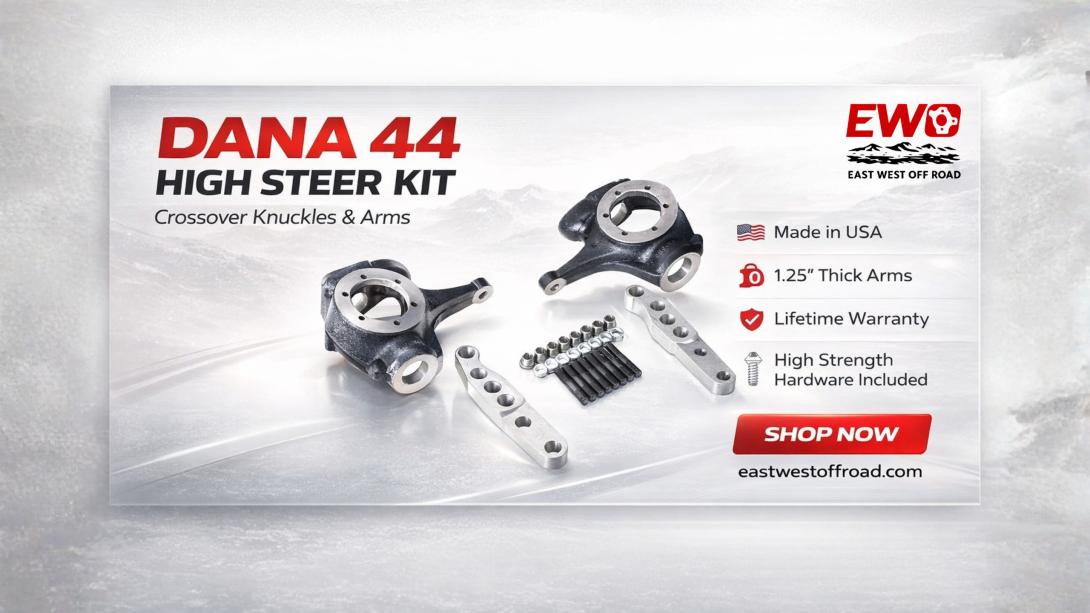
Buy Now: https://www.eastwestoffroad.com/product/dana-44-high-steer-crossover-knuckles-and-arms-kit
A Dana 44 Flat Top Knuckles Pair is one of the most important component choices when planning a high-steer or crossover steering upgrade for a classic Chevy K10, K20, K5 Blazer, GMC Jimmy, or custom solid-axle off-road vehicle. Whether you're replacing worn factory knuckles, converting an older Dana 44 axle, or building a high-clearance steering system, the correct driver-side and passenger-side knuckles provide the mounting foundation for the steering components.
However, not every Dana 44 knuckle is interchangeable.
Factory knuckle designs, spindle interfaces, brake mounting patterns, steering-arm holes, and tie rod tapers can vary by axle application. Some original equipment knuckles require machining before they can accept high-steer arms, while certain aftermarket products are supplied with prepared mounting surfaces.
That difference can affect fabrication time, installation cost, and the number of additional parts required.
Buying matching flat-top knuckles also requires understanding whether your project needs crossover steering only or a complete high-steer conversion.
In this guide, we'll explain how Dana 44 flat-top knuckles work, the differences between driver-side and passenger-side components, how to compare aftermarket options, and what to verify before purchasing the East West Off Road Dana 44 High Steer Crossover Knuckles and Arms Kit.
What Are Dana 44 Flat Top Knuckles?
Steering knuckles are structural components that connect the front axle's steering and wheel-end assemblies.
On a solid-front-axle Dana 44, each knuckle supports the wheel-end components and allows the front wheels to turn through the steering linkage.
A flat-top steering knuckle includes an upper mounting area that can accommodate a compatible high-steer arm when properly designed and prepared.
That upper mounting area is what makes certain knuckles useful for aftermarket high-steer and crossover steering conversions.
What Makes a Flat-Top Knuckle Different?
A conventional steering knuckle provides the mounting interfaces needed for its original steering arrangement.
A flat-top configuration offers an additional mounting location that may be used for an aftermarket steering arm.
However, the presence of a relatively flat casting surface does not necessarily mean the knuckle is ready for installation.
The surface may need machining, and the correct mounting holes must be present.
Why Do High-Steer Systems Need Flat-Top Knuckles?
High-steer arms attach to compatible knuckle mounting surfaces and provide elevated connections for steering components.
Depending on the steering layout, these arms may carry the drag link, tie rod, or both.
Moving the linkage connections can change their clearance and operating geometry.
The complete system must still be engineered to work with the vehicle's steering box, axle, suspension, and wheel-end components.
Driver-Side vs. Passenger-Side Dana 44 Flat-Top Knuckles
One of the biggest sources of confusion is the difference between the driver-side and passenger-side knuckles.
A matched pair means more than purchasing two components that look similar.
The knuckles must have the correct orientation and interfaces for their respective sides of the axle.
Driver-Side Flat-Top Knuckles
On certain older Chevy Dana 44 configurations, the driver-side knuckle was factory-equipped with an upper steering-arm mounting arrangement.
This is why builders sometimes find a driver-side knuckle that already has a machined mounting surface and threaded holes.
However, that does not mean every factory driver-side Dana 44 knuckle is compatible with every aftermarket high-steer arm.
The mounting pattern, fasteners, and axle interfaces still require verification.
Passenger-Side Flat-Top Knuckles
The passenger-side knuckle is often a more complicated part of a classic GM crossover steering conversion.
Certain original equipment passenger-side knuckles have the appropriate flat-top casting but require machining before accepting an aftermarket steering arm.
Traditionally, builders could source a suitable passenger-side casting and have the upper area machined, drilled, and tapped.
Aftermarket machined knuckles provide an alternative to that process.
Why Buying a Pair Can Be Convenient
A compatible driver and passenger knuckle package may help builders avoid combining unrelated steering components.
It can also be useful when both original knuckles are worn, damaged, unsuitable, or missing the required high-steer mounting arrangements.
However, a paired purchase should be evaluated according to the complete axle design.
Two compatible flat-top knuckles do not automatically make every steering arm or tie rod end compatible.
Driver vs. Passenger Comparison
Feature
Driver-Side Knuckle
Passenger-Side Knuckle
Axle location
Left side
Right side
Factory high-steer preparation
Present on some older GM applications
Often requires additional machining on certain factory castings
Aftermarket options
Available for selected axles
Available for selected axles
Main compatibility checks
Spindle, brakes, ball joints, steering arm
Spindle, brakes, ball joints, steering arm
Typical role in high steer
Compatible steering-arm mounting
Compatible steering-arm mounting
Pair selection
Must match intended axle configuration
Must match intended axle configuration
Always verify the actual axle components rather than relying on the vehicle's original model year.
Factory Dana 44 Knuckles vs. Aftermarket Flat-Top Knuckles
Off-road builders generally encounter two purchasing approaches: modify suitable factory knuckles or buy compatible aftermarket replacements.
Each option has advantages and limitations.
Reusing Factory Flat-Top Knuckles
Some factory knuckles can be professionally machined to accept a compatible high-steer arm.
The work may include preparing the mounting surface and drilling and tapping the required holes.
This route can be practical if a suitable factory casting is already available.
However, the work must be performed to the correct specifications.
Not every original knuckle is suitable for conversion.
Buying Machined Aftermarket Knuckles
Certain aftermarket Dana 44 knuckles are sold with prepared flat-top mounting surfaces.
Depending on the manufacturer, they may also feature different construction, mounting patterns, or steering-stop arrangements.
This can reduce the need for separate machining operations.
However, buyers must still confirm whether the knuckles are supplied individually or as a pair.
Which Approach Costs Less?
The answer depends on more than the initial parts price.
A factory-knuckle conversion may involve:
- Sourcing usable castings
- Shipping parts to a machine shop
- Professional machining
- Inspection and preparation
- Purchasing high-steer arms
- Mounting studs and related hardware
- Ball-joint or wheel-end service
- Installation labor
An aftermarket package may combine some of these requirements, but its exact contents must be checked.
The best comparison is the total cost of obtaining two properly compatible, installation-ready steering-knuckle assemblies, not simply the advertised price of one casting.
How to Identify the Correct Chevy Dana 44 Knuckles
Before purchasing a replacement pair, identify the actual axle installed on the truck.
This is particularly important for older 4x4 vehicles.
Over several decades, many Chevy and GMC trucks have received replacement axles, hubs, spindles, brakes, or other modifications.
Check the Axle Type
Begin by distinguishing between a Chevy Dana 44 and a GM Corporate 10-bolt front axle.
These axle families share some aftermarket steering applications but should not be treated as identical.
The EWO E90178 product listing identifies compatible applications involving both axle families.
Final fitment still depends on the exact configuration.
Inspect the Existing Knuckles
Look at the driver and passenger knuckles and document their existing mounting arrangements.
Determine whether the upper mounting surfaces are machined and whether compatible threaded holes are present.
Do not assume a previous owner installed factory-original parts.
Verify Spindle Compatibility
The spindle-to-knuckle interface is an important fitment requirement.
If the spindle bolt pattern or related dimensions do not match, the knuckle may not be compatible with the existing wheel-end assembly.
Verify Brake Components
Check caliper brackets, brake mounting interfaces, and related hardware.
A knuckle designed for one brake arrangement may not work with another without approved modifications.
Check Ball Joints
The replacement knuckles must accept the correct ball joints and fit the intended axle housing.
If ball joints are supplied separately, their part numbers and installation requirements must be confirmed.
Confirm Steering Taper Orientation
Tie rod end mounting holes may have different taper orientations depending on the application.
The correct steering-end stud must match the intended taper and installation direction.
A visually similar knuckle can still be incompatible with the selected steering linkage.
Dana 44 Flat-Top Knuckles for Chevy and GM 10-Bolt Axles
Chevy Dana 44 and GM Corporate 10-bolt front axles are frequently grouped together in aftermarket steering catalogs.
That's because certain parts and conversion approaches overlap.
However, identifying the actual wheel-end configuration remains essential.
Chevy K10 and K20 Trucks
Classic K-series trucks are popular candidates for high-steer conversions, especially when modified for increased suspension travel or larger tires.
If your K10 or K20 has an aftermarket axle swap, the original factory application chart may no longer describe its installed components accurately.
Chevy K5 Blazer
A lifted K5 Blazer may benefit from a properly engineered crossover steering system when the original steering geometry is poorly matched to the modified suspension.
The correct knuckles are one part of the conversion, but they do not independently eliminate bump steer.
GMC Jimmy and Suburban Builds
Some GMC Jimmy and Chevy/GMC Suburban applications use compatible GM front-axle components.
Fitment should be verified using the axle, not simply the body style.
Jeep, Dodge, and Toyota Axle Swaps
Some custom Jeeps, Dodges, and Toyotas use Chevy Dana 44 front axles.
In these cases, a Chevy-pattern knuckle package may be relevant.
However, the vehicle's steering box, suspension geometry, brakes, and other modified parts must also be considered.
EWO Product Applications
East West Off Road's E90178 product page lists classic Chevy and GMC 4WD applications, including K5 Blazer, K10, K20, Jimmy, and Suburban configurations.
The listing also references suitable Chevy Dana 44 axles used in other vehicle platforms.
Buyers comparing a Dana 44 Flat Top Knuckles Pair should confirm whether the exact E90178 package includes the required driver and passenger knuckles and whether it matches their axle.
Understanding High-Steer Arm Mounting Patterns
A flat-top knuckle is only useful for a high-steer conversion when it can properly accept the selected steering arm.
Different aftermarket systems use different mounting arrangements.
Three-Hole vs. Four-Hole Steering Arms
Some Dana 44 steering-arm systems use three mounting positions.
Others use a four-hole design.
A four-hole aftermarket knuckle and arm arrangement may have additional mounting provisions compared with traditional three-hole configurations.
However, a four-hole description does not guarantee compatibility with every steering arm.
The mounting pattern, surface geometry, stud dimensions, and required hardware must match.
1.25-Inch Billet High-Steer Arms
Buyers may encounter products described as 1.25 Inch Billet High Steer Arms.
Arm thickness and manufacturing method are useful product details, but they do not independently establish the arm's strength or suitability.
The complete connection includes the arm, studs, washers, knuckle, and steering-linkage mounting points.
Before purchasing, confirm the specifications of the exact arms provided.
Why Arm Height Matters
High-steer arm geometry affects steering-linkage positioning and clearance.
A taller or thicker arm is not automatically better for every vehicle.
The correct arrangement depends on surrounding components, suspension movement, and steering-system requirements.
Can You Mix Different Brands?
Some aftermarket parts may share mounting patterns.
However, a shared pattern does not establish that every arm, knuckle, or fastener arrangement is interchangeable.
Use documented compatibility information for the exact components.
Reid Racing Knuckles vs. Other Dana 44 Flat-Top Options
Reid Racing is one of the brands buyers commonly research when shopping for aftermarket Dana 44 knuckles.
Its Chevy Dana 44 flat-top product family includes separate driver-side and passenger-side offerings.
That makes the product relevant to buyers comparing individual knuckle purchases with packaged component kits.
Compare What Is Actually Included
An individually priced knuckle is not the same thing as a complete pair.
Likewise, a knuckles-and-arms kit should not automatically be treated as a full steering conversion package.
Confirm component quantities before comparing prices.
Compare Mounting Patterns
Check the high-steer arm mounting configuration and the manufacturer's approved hardware.
If your existing steering arms use a different pattern, additional components may be necessary.
Compare Steering-Stop Designs
Steering-stop arrangements vary by knuckle design.
The correct stops must accommodate the intended steering geometry and prevent interference.
Compare Taper Orientation
A Reid Racing Knuckles Alternative must have the correct steering-end interfaces for the build.
For example, some aftermarket knuckle families offer taper arrangements that differ between product variants.
Always verify the selected part number.
Compare Manufacturing Claims
If you specifically want a USA Made Dana 44 Steering Kit, check the manufacturer's country-of-origin information for the actual knuckles, steering arms, and supplied components.
Do not assume all similarly advertised products have identical manufacturing origins.
Compare Total Installation Requirements
One knuckle may require additional machining or separate hardware.
Another may be supplied with a prepared high-steer mounting surface.
What matters is the entire installation plan.
Dana 44 High Steer vs. Crossover Steering: Why the Knuckle Pair Matters
The terms high steer and crossover steering are often used together, but they describe different mechanical features.
Understanding that difference helps determine whether you need one knuckle, a pair, or additional linkage components.
Crossover Steering
Crossover steering changes the drag-link arrangement so that steering input reaches a compatible connection toward the passenger side of the axle.
Some crossover conversions retain the existing tie rod location.
The components required depend on the selected system.
High Steer
High steer refers to elevated steering-linkage connections mounted through compatible steering arms and knuckles.
A full high-steer arrangement may reposition the tie rod higher than its original location.
When Might You Need Both Knuckles?
If the intended configuration uses elevated steering arms on both sides, suitable driver and passenger knuckles may be necessary.
A pair can be relevant when both sides need matching mounting interfaces.
However, a different crossover-only arrangement may have different requirements.
What Does a Knuckle Pair Not Include?
A pair of steering knuckles is not automatically a complete crossover steering system.
Depending on the project, additional parts may include a steering box, pitman arm, drag link, tie rod, steering ends, mounting hardware, and related components.
Before purchasing the EWO Dana 44 high steer crossover knuckles and arms kit, establish which steering layout you're building and which components the package actually supplies.
Steering Tapers: An Important Knuckle Buying Detail
One of the most expensive fitment mistakes is ordering a knuckle with the wrong steering taper.
A tie rod end or drag-link end uses a specific tapered stud.
The mounting hole must have the correct corresponding interface.
Top-Down vs. Bottom-Up Tapers
Depending on the original axle configuration and aftermarket component, steering-end studs may enter their mounting holes from different directions.
A product described as a Dana 44 bottom-down taper knuckle should be evaluated using its exact technical specifications.
Do not assume that the same steering end can be installed from either direction.
Why Different GM Axle Configurations Matter
Some aftermarket Chevy Dana 44 and GM 10-bolt knuckles have different taper arrangements.
The correct choice depends on the specific steering joint and wheel-end configuration.
Does a 7/8-Inch Steering End Automatically Fit?
No.
The 7/8-inch measurement commonly refers to the threaded shank of certain GM-style steering ends.
That does not establish the taper size or direction.
Both the thread specification and mounting interface must be compatible.
Avoid Unverified Taper Modifications
Improperly modifying a tapered steering hole can create an unsafe connection.
Any approved machining or conversion procedure must follow the requirements of the exact steering components.
Steering Arm Studs, Conical Washers, and Mounting Hardware
High-steer arms must be mounted correctly to their compatible knuckles.
The connection depends on more than the arm and mounting holes.
High-Strength Steering Arm Studs
Some aftermarket Dana 44 systems use high-strength 9/16-inch mounting studs.
However, Dana 44 high strength 9/16 studs are not automatically compatible with every knuckle and arm.
The correct stud length, threads, and installation method must match the manufacturer specifications.
The Role of Conical Washers
Conical washers are used in certain high-steer mounting systems.
They provide a specifically shaped interface within the mounting assembly.
They should not be replaced with unrelated flat washers without manufacturer approval.
Correct Hardware Installation
Mounting studs, nuts, and washers must be installed using the proper specifications.
Generic torque values from unrelated high-steer products should not be substituted.
Verify the Package Contents
For EWO E90178, confirm which studs, washers, nuts, and related components are included in the selected configuration.
Also confirm whether ball joints are included or require a separate purchase.
What Does a Pair of Dana 44 Flat-Top Knuckles Cost to Install?
The purchase price is only one part of the expense.
For a complete Chevy steering knuckle upgrade, installation costs depend on the condition of the existing axle and the final steering layout.
Knuckle Replacement Labor
Replacing steering knuckles may require disassembly of wheel-end components, brakes, and ball-joint connections.
The exact procedure depends on the axle configuration.
Machining Costs
If the project uses suitable unmachined factory knuckles, professional machining may be required.
This can involve additional labor, shipping, and downtime.
Steering Arms and Hardware
High-steer arms, mounting studs, conical washers, and locking hardware can contribute to the overall cost.
Related Wheel-End Repairs
Worn ball joints, wheel bearings, damaged brakes, or other problems may become apparent during disassembly.
These repairs should be addressed before completing the conversion.
Steering Linkage Requirements
If the project involves crossover steering, the knuckles may represent only part of the required purchase.
A compatible pitman arm, steering box, drag link, tie rod, or steering ends may also be necessary.
Alignment and Final Inspection
The completed steering system should receive appropriate professional inspection and alignment.
Budgeting for that work is part of planning a safe conversion.
Dana 44 Flat-Top Knuckle Pair Buying Checklist
Use this comparison before placing an order.
Item to Check
What You Need to Confirm
Axle type
Actual Dana 44 or compatible GM 10-bolt configuration
Knuckle sides
Driver, passenger, or verified matching pair
Spindle interface
Correct fit with existing or planned spindle
Brake mounting
Compatible caliper and brake arrangement
Ball joints
Correct joint design and fitment
Flat-top preparation
Machined and drilled, or professional machining required
Steering-arm pattern
Correct three-hole or four-hole configuration
Arm hardware
Compatible studs, washers, and locking components
Tie rod taper
Correct dimensions and insertion direction
Steering stops
Suitable design and operating clearance
Linkage layout
Crossover-only or full high steer
Kit contents
Exact included components and quantities
Installation
Qualified technician and applicable procedures
This checklist can help prevent a common situation: purchasing expensive high-steer knuckles and discovering afterward that the existing steering arms, brakes, or linkage do not fit.
Common Mistakes When Buying Dana 44 Flat-Top Knuckles
Assuming a Single Knuckle Listing Includes a Pair
Some manufacturers sell driver and passenger knuckles individually.
Check the package quantity before comparing prices.
Buying Based Only on the Dana 44 Name
Dana 44 axles appear in several vehicle platforms.
Knuckle and wheel-end specifications can differ.
Forgetting the Passenger-Side Machining Requirement
Some factory passenger-side flat-top castings are not prepared for direct high-steer arm installation.
Mixing Incompatible Steering Arms
Mounting patterns, arm heights, and hardware requirements may vary.
Ignoring the Steering Taper
The correct steering-end taper and installation orientation must match the knuckle.
Assuming All Four-Hole Arms Are Identical
A four-hole pattern does not guarantee universal compatibility.
Overlooking Brake Fitment
Spindle and caliper mounting requirements must be checked.
Treating New Knuckles as a Complete Steering Upgrade
Knuckles alone do not correct every steering geometry issue or replace the need for other linkage components.
Ignoring Suspension Clearance
Steering arms, tie rods, drag links, springs, wheels, and tires must remain clear of one another throughout the required operating range.
Skipping Professional Inspection
Steering knuckles and arm connections are safety-critical.
Unverified installation procedures or improperly matched hardware create serious risks.
How to Prepare for a Dana 44 Knuckle Upgrade
A good installation plan begins before the old parts come off the vehicle.
Step 1: Identify the Existing Axle Assembly
Document the axle type, knuckles, brakes, hubs, and steering linkage.
Step 2: Decide on the Final Steering Layout
Determine whether you're retaining the factory linkage, installing crossover steering, or completing a full high-steer conversion.
Step 3: Confirm the Knuckle Pair
Verify the driver and passenger part numbers and their fitment requirements.
Step 4: Select Compatible High-Steer Arms
Check mounting surfaces, hole patterns, tapers, and required hardware.
Step 5: Plan Wheel-End Service
Identify any ball joints, bearings, seals, or brake components that will need inspection or replacement.
Step 6: Have Qualified Professionals Perform the Work
Follow product-specific procedures for installation and mounting hardware.
Where machining or structural modifications are needed, qualified specialists should perform the work.
Step 7: Verify Steering Movement
Check the completed system for binding, interference, and proper operation throughout the required steering and suspension ranges.
Step 8: Complete Alignment and Inspection
The system must be properly aligned and inspected before the vehicle is returned to service.
Why Consider East West Off Road Dana 44 Knuckles and Arms?
East West Off Road offers the Dana 44 High Steer Crossover Knuckles and Arms Kit for Chevy GM Axles, product number E90178.
The listing identifies compatible Chevy Dana 44 and GM Corporate 10-bolt front-axle applications.
For a builder planning a high-steer conversion, a knuckle-and-arm-focused package is worth evaluating because the two component categories must be mechanically compatible.
What Buyers Should Verify
Before ordering E90178, confirm:
- Driver-side and passenger-side knuckle quantities
- Knuckle mounting and spindle specifications
- Exact high-steer arm design and quantities
- Included mounting studs and related hardware
- Ball-joint inclusion or separate requirements
- Steering taper configuration
- Any additional steering components needed
A product intended for Chevy Dana 44 axles should not automatically be treated as universal across every Dana 44 front axle.
Planning Your Purchase
If you're comparing a GM Chevy Dana 44 high steer set with individual aftermarket knuckles, evaluate the total package contents and final installation requirements.
The East West Off Road steering kit with Dana 44 knuckles and arms is a relevant option to review when sourcing high-steer foundation components for compatible GM axle builds.
Final Thoughts: Choose Compatibility Over Appearance
A Dana 44 Flat Top Knuckles Pair can be the foundation of a successful Chevy or GM high-steer conversion.
However, purchasing the correct pair requires more than matching the axle name.
Driver-side and passenger-side orientation, spindle interfaces, brake compatibility, steering tapers, high-steer arm mounting patterns, and supplied hardware all matter.
For some projects, machining suitable factory knuckles may be an option.
For others, compatible aftermarket knuckles can simplify component sourcing and reduce the need for separate machining work.
East West Off Road's E90178 knuckles-and-arms package provides a product option for buyers planning a compatible Chevy Dana 44 or GM Corporate 10-bolt steering upgrade.
Before checkout, confirm the exact components supplied and whether the complete steering conversion requires additional parts.
The right knuckle pair is the one that matches the entire engineered axle and steering system—not simply the one with the thickest arms or most aggressive appearance.
Frequently Asked Questions (FAQs)
What Is a Dana 44 Flat Top Knuckles Pair?
A Dana 44 flat-top knuckles pair generally refers to compatible driver-side and passenger-side steering knuckles with upper mounting provisions for high-steer arms.
However, manufacturers may sell the knuckles individually or as part of a larger kit.
Confirm the quantities and specifications before ordering.
Do I Need Both Driver and Passenger Flat-Top Knuckles?
It depends on the intended steering configuration.
A complete high-steer setup with elevated steering-arm mounting points on both sides may require both.
Certain crossover-only conversions have different component requirements.
Follow the design and parts list for the specific steering system.
Are All Dana 44 Flat-Top Knuckles Interchangeable?
No.
Different Dana 44 axle applications may use different spindle patterns, brake configurations, steering stops, and mounting arrangements.
A knuckle intended for one axle application should not automatically be considered compatible with another.
Which Factory Chevy Dana 44 Knuckles Have Flat Tops?
Certain older GM Dana 44 front axles used flat-top knuckle configurations.
Specific driver-side and passenger-side castings are associated with classic 1970s GM truck applications.
However, the exact factory preparation can differ by side.
Identify the actual casting and mounting interfaces before using it for a high-steer conversion.
Does a Factory Passenger-Side Flat-Top Knuckle Need Machining?
Certain factory passenger-side flat-top castings require the upper mounting surface to be machined and the appropriate holes drilled and tapped.
Some aftermarket replacements are supplied with prepared mounting surfaces.
Check the selected part before installation.
What Is the Difference Between Three-Hole and Four-Hole High-Steer Knuckles?
These terms describe the mounting provisions used by different aftermarket steering-arm systems.
The correct knuckle and arm must have compatible geometry and hardware requirements.
Four-hole and three-hole parts should not be assumed interchangeable without manufacturer confirmation.
Are Reid Racing Dana 44 Knuckles Sold as a Pair?
Reid Racing lists its Chevy heavy-duty Dana 44 flat-top knuckles as individual driver-side and passenger-side products.
Buyers needing both sides should verify the correct quantities and part numbers before ordering.
Can Dana 44 Flat-Top Knuckles Fit a Chevy 10-Bolt Axle?
Certain aftermarket flat-top knuckle products are offered for compatible Chevy Dana 44 and GM Corporate 10-bolt axle applications.
However, final fitment depends on the specific axle, spindle, brakes, and steering components.
The axle designation alone does not establish compatibility.
Do Flat-Top Knuckles Improve Steering by Themselves?
Not necessarily.
Flat-top knuckles provide mounting options for compatible steering arms.
The actual steering behavior depends on the full system, including the steering box, drag link, tie rod, joint geometry, and suspension.
What Are 1.25-Inch Billet High-Steer Arms?
They are aftermarket high-steer arms described as having a specified 1.25-inch thickness and billet-style construction.
Their suitability depends on the manufacturer's material, dimensions, mounting interfaces, and intended application.
Thickness alone does not establish a specific strength rating.
Do I Need 9/16-Inch High-Steer Arm Studs?
Some Dana 44 high-steer systems use 9/16-inch studs, while other configurations may have different requirements.
Use the hardware specified for the exact arms and knuckles.
Do not substitute generic studs without approval.
Why Does Steering Taper Direction Matter?
The steering-end stud must seat correctly in the matching tapered opening.
An incompatible taper or incorrect insertion direction can prevent proper assembly.
Confirm the exact taper specifications before installation.
Can I Use Dana 44 Flat-Top Knuckles on a K5 Blazer?
Compatible Chevy Dana 44 and GM axle configurations are used in certain K5 Blazer steering conversions.
However, final fitment depends on the installed front axle, wheel-end components, and steering system.
Previous modifications may affect compatibility.
Is a Knuckles-and-Arms Kit a Complete Crossover Steering Kit?
Not automatically.
A knuckles-and-arms package may provide the mounting foundation while requiring a separate drag link, tie rod, pitman arm, steering box, or other components.
Check the actual product contents.
Does the EWO E90178 Product Include a Driver and Passenger Knuckle Pair?
The EWO E90178 product is titled Dana 44 High Steer Crossover Knuckles and Arms Kit for Chevy GM Axles.
The exact quantities of driver-side and passenger-side knuckles should be confirmed from the current product configuration before ordering.
Can Flat-Top Knuckles Eliminate Bump Steer on a K5 Blazer?
Flat-top knuckles alone do not eliminate bump steer.
A properly engineered crossover or high-steer arrangement may improve certain steering-geometry problems, but the complete suspension and steering system must be evaluated.
Where Can I Buy Dana 44 Flat-Top Knuckles for Chevy High Steer?
East West Off Road offers its E90178 Dana 44 High Steer Crossover Knuckles and Arms Kit for compatible Chevy GM axle applications.
Review the current listing, verify the exact components supplied, and confirm fitment with the intended steering system.