

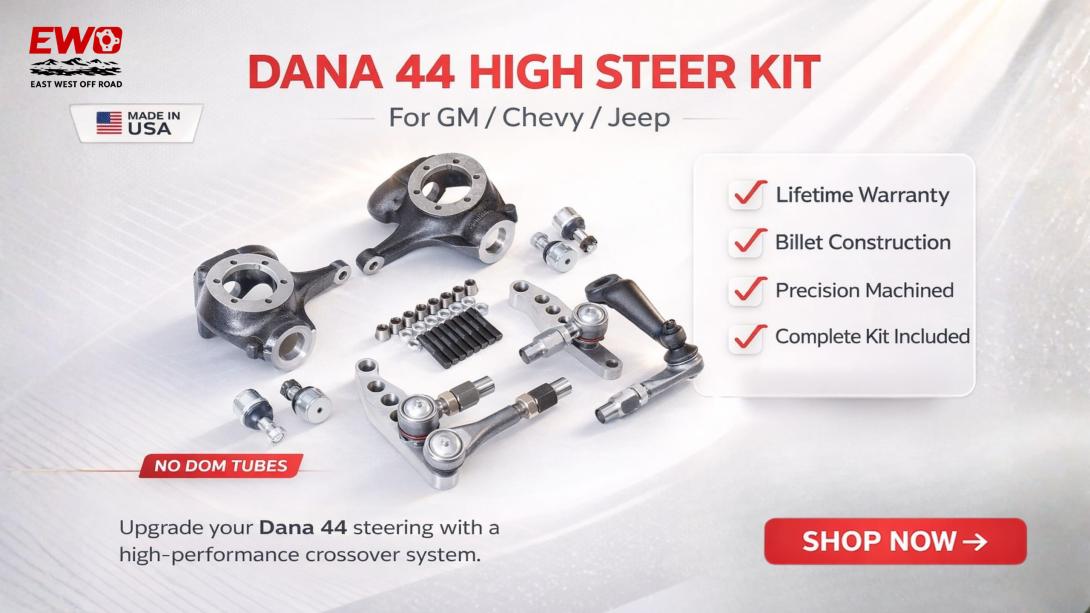
Dana 44 Flat Top Knuckles are one of the most important components in a properly planned high-steer or crossover steering conversion. On lifted GM, Chevy, Jeep, and custom Dana 44 builds, a flat-top knuckle provides the mounting surface needed for an aftermarket steering arm, allowing the drag link, tie rod, or both to be positioned higher than many factory steering layouts.
For builders working on Square Body trucks, rock crawlers, custom axle swaps, or GM 1-ton steering conversions, understanding the knuckle itself is essential. Not every Dana 44 uses the same outer components, not every factory flat top is already machined for a steering arm, and the steering arm, ball joints, spindle, brakes, taper, and steering ends all need to work together.
What Are Dana 44 Flat Top Knuckles?
A flat-top knuckle is a steering knuckle with a broad upper casting area that can support a bolt-on steering arm.
Traditional lower steering connections place the tie rod and drag link closer to the axle centerline.
A high-steer arrangement can move those connections upward by mounting steering arms on top of compatible knuckles.
The basic concept includes:
- Dana 44 steering knuckle
- Machined upper mounting surface
- High-steer arm
- Steering-arm studs or bolts
- Tie rod or drag link connection
- Compatible steering-end taper
The flat top itself is only the foundation.
The complete assembly needs to be designed as a steering system.
Why Flat Top Knuckles Matter for High Steer
The passenger-side flat-top knuckle is widely considered the cornerstone of a traditional Dana 44 crossover high-steer conversion.
A crossover drag link runs from the steering box toward the passenger-side steering arm.
Without a proper mounting surface on that knuckle, there is nowhere to securely attach the crossover steering arm.
Historic Dana 44 high-steer builds often started with a factory flat-top passenger knuckle that then had to be machined, drilled, and tapped before an aftermarket arm could be installed. Modern aftermarket knuckles can eliminate part of that fabrication by providing a machined flat top from the start. MotorTrend
Which Factory Dana 44 Knuckles Were Flat Tops?
Factory availability varied by vehicle and year.
Commonly referenced applications include:
- 1973–1977 Chevy/GM 1/2-ton Dana 44 passenger-side flat tops
- 1973–1987 Chevy/GM Dana 44 driver-side flat tops
- 1974–1977 full-size Jeep Dana 44 driver and passenger flat tops
These are useful historical identification ranges, but they should not replace inspection of the actual axle. Blue Oval Trucks
Older 4x4s are frequently modified, and the knuckles or entire axle may have been swapped at some point.
How Do You Identify a Flat Top Dana 44 Knuckle?
A flat-top knuckle typically has a broad cast area above the ball-joint region.
Compared with a round-top knuckle, the upper surface provides enough material for machining and steering-arm attachment.
Useful inspection points include:
- Large flat casting area near the upper ball joint
- Cast bosses underneath where steering-arm threads may be placed
- Existing steering-arm studs on some driver-side Chevy knuckles
- Passenger-side geometry that mirrors the driver-side flat-top form
Blue Oval Trucks and The Ranger Station both describe the visible upper flat area and cast-in bosses as key identifying features. Blue Oval Trucks
Factory Flat Top vs. Machined Flat Top
Finding a factory flat-top casting does not automatically mean it is ready for a high-steer arm.
Some factory passenger-side knuckles have the necessary casting shape but still require:
- Surface machining
- Drilling
- Tapping
before a steering arm can be installed.
This distinction is extremely important.
A raw factory flat-top casting and a ready-to-use aftermarket high-steer knuckle are not necessarily the same thing.
Why Machining Accuracy Matters
The steering arm needs to sit squarely and securely on the knuckle.
Poor machining can affect:
- Arm seating
- Fastener load
- Steering geometry
- Component alignment
The upper surface needs to be machined using the correct reference geometry.
The steering-arm holes then need to match the intended arm and hardware.
Because steering is safety-critical, machining should be performed by a shop familiar with Dana 44 high-steer conversions.
Aftermarket Dana 44 Flat Top Knuckles
Modern aftermarket knuckles can simplify the project.
Some are produced with:
- Machined flat tops
- High-steer mounting holes
- Heavy-duty castings
- Additional steering-arm bolt locations
- Specific spindle patterns
For example, Reid Racing has offered heavy-duty Dana 44 knuckles with raised flat-top surfaces and an additional fourth high-steer mounting hole on some designs. ManualsDir
That type of product can remove the need to locate and machine an old factory passenger knuckle.
Why Driver and Passenger Flat Top Knuckles Are Useful
A Dana 44 driver passenger flat top knuckles setup gives the builder more steering-layout flexibility.
A single passenger-side flat top may be enough for basic crossover steering.
Using both sides can allow:
- Tie rod mounted on high-steer arms
- Drag link mounted on passenger-side arm
- More flexible link placement
- Higher steering linkage
- Improved obstacle clearance
The final arrangement depends on the steering arms and suspension.
Dana 44 Flat Tops for Crossover Steering
Crossover steering routes the drag link across the axle instead of using the traditional short push-pull arrangement found on many older Chevy trucks.
A Chevy Dana 44 Crossover Steering Kit typically relies on a passenger-side flat-top knuckle to mount the crossover steering arm.
This arrangement is commonly used on:
- K10
- K20
- K5 Blazer
- GMC K-series trucks
- Square Body builds
- Rock crawlers
- Custom Dana 44 swaps
Crossover Steering vs. Full High Steer
These terms are often used together, but they describe different things.
Crossover Steering
Crossover steering changes the drag-link routing.
The drag link runs from the pitman arm toward the passenger-side knuckle.
Full High Steer
Full high steer generally places the tie rod and drag link higher by using steering arms on top of the knuckles.
A truck can use crossover steering without moving every steering link to a high-steer position.
Why Lifted Chevy Trucks Use Flat Top Knuckles
Suspension lifts change steering angles.
The original push-pull steering on older Chevy trucks can become less favorable as lift height increases.
A Square Body Crossover Steering Conversion can use a passenger flat-top knuckle and high-steer arm to create a longer, more direct drag-link path.
This can help the builder design steering geometry around the lifted suspension rather than simply extending the original arrangement.
Flat Top Knuckles and GM 1-Ton Steering
A GM 1 Ton Steering Upgrade commonly uses larger GM-style tie rod and drag link ends.
The knuckles and high-steer arms must be machined for the correct taper and installation direction.
A Dana 44 High Steer Kit can combine flat-top knuckles with heavy-duty arms and 1-ton-style steering components to create a complete crossover architecture.
The “1-ton” terminology describes the steering component family. It does not increase the truck's GVWR or axle capacity.
Steering-End Taper Matters
The steering-end stud has a tapered shape.
The matching hole in the steering arm or knuckle must have the correct:
- Taper angle
- Taper size
- Installation direction
Incorrect taper engagement can prevent the stud from seating properly.
That is why terms such as bottom down taper knuckle Dana 44 matter when planning the system.
Bottom-Down vs. Top-Down Steering Ends
A bottom-down or top-down description refers to the direction the steering-end stud enters its tapered hole.
The orientation affects linkage height.
It can also influence:
- Tie rod clearance
- Spring clearance
- Wheel clearance
- Drag-link position
Do not reverse a tapered steering-end connection unless the component is specifically machined for that orientation.
High Steer Arms for Flat Top Knuckles
The flat-top knuckle creates a platform.
The high-steer arm creates the actual steering attachment point.
When selecting 1 Ton High Steer Arms Dana 44, verify:
- Knuckle bolt pattern
- Arm material
- Arm thickness
- Steering-end taper
- Tie rod location
- Drag-link location
- Hardware type
A steering arm should be treated as a structural component, not merely a spacer.
1.25-Inch Thick Billet Steering Arms
The phrase 1.25 inch thick billet steering arms appears frequently in heavy-duty high-steer products.
Thick billet arms can provide a substantial mounting structure.
However, thickness alone does not determine quality.
Also evaluate:
- Material specification
- Machining
- Hole spacing
- Taper
- Fasteners
- Knuckle compatibility
Three-Hole vs. Four-Hole High Steer Arms
Some Dana 44 aftermarket knuckles use a traditional three-fastener high-steer arm pattern.
Others provide an additional fourth hole.
A fourth mounting location can provide another mechanical connection between the arm and knuckle, but the arm and knuckle must be designed to work together.
Do not drill an additional hole without the manufacturer’s approved dimensions and procedure.
Flat Top Knuckles and Steering Arm Hardware
Steering-arm fasteners see continuous steering loads and vibration.
Use only the specified:
- Studs or bolts
- Conical washers
- Nuts
- Thread-locking procedure
- Torque values
Recheck the hardware according to the manufacturer’s installation guidance.
Ball Joint Compatibility
The steering knuckle pivots around the ball joints.
That makes Dana 44 upper lower ball joints part of the knuckle-selection process.
When changing knuckles, verify:
- Upper ball-joint fit
- Lower ball-joint fit
- Ball-joint bore condition
- Installation procedure
If the axle is already disassembled, inspect the ball joints before reusing them.
Why Spindle Compatibility Matters
The spindle mounts to the steering knuckle and supports the hub and wheel-bearing assembly.
Dana 44 knuckles can have different spindle patterns depending on application.
For example, some aftermarket GM-style Dana 44 knuckles are designed around Chevy/Jeep outer components, while Scout-specific versions may use a different spindle pattern. ManualsDir
Confirm the spindle pattern before buying knuckles.
What Are “Outers”?
In Dana 44 terminology, “outers” often refers to components outside the inner axle housing, including:
- Spindles
- Hubs
- Wheel bearings
- Rotors
- Calipers
- Caliper brackets
- Outer axle shafts
When swapping knuckles between Ford, Chevy, Jeep, or Scout-based configurations, outer-component compatibility becomes critical.
Brake Compatibility With Dana 44 Knuckles
A knuckle change can affect brake fitment.
Check:
- Caliper bracket
- Rotor
- Spindle
- Hub
- Wheel bearings
- Outer axle shaft
Do not assume a new flat-top knuckle automatically accepts every brake setup previously used on the axle.
Chevy/Jeep Spindle Pattern
Some aftermarket GM Dana 44 flat-top knuckles are specifically machined for Chevy/Jeep outer components.
Reid's GM Dana 44 high-steer knuckle, for example, is designed around a Chevy/Jeep spindle bolt pattern and accepts compatible open-knuckle Chevy and full-size Jeep outer assemblies in its listed applications. jackit.com
That does not mean every aftermarket Dana 44 knuckle follows the same pattern.
Always check the exact product.
Can Ford Dana 44 Axles Use Chevy Flat Top Knuckles?
In certain custom Dana 44 builds, builders combine components from different vehicle families.
However, this is not a simple universal interchange.
A Ford axle may require compatible Chevy or Jeep outer components if a GM-pattern knuckle is used.
The complete package must be checked for:
- Ball joints
- Spindles
- hubs
- Rotors
- Calipers
- stub shafts
- wheel pattern
Jeep Dana 44 and Flat Top Knuckles
Full-size Jeep Dana 44 axles are also common in high-steer builds.
Some older full-size Jeep Dana 44s came with flat-top knuckles on both sides, which made them popular donor components for custom steering conversions. MotorTrend
Again, year and axle identification are essential.
Why Axle Identification Comes First
“Dana 44” describes an axle family, not one universal steering configuration.
Before purchasing flat-top knuckles, identify:
- Vehicle origin
- Axle year
- Open-knuckle design
- Ball joints
- Spindle pattern
- Brake setup
- Hub configuration
- Existing steering layout
This prevents one of the most common mistakes in custom Dana 44 builds: purchasing parts based only on the axle name.
Flat Top Knuckles and DOM Steering Tubes
The knuckles determine where the steering links connect.
The DOM tubes determine how those points are connected.
For a custom no-DOM high-steer kit, final tie rod and drag link lengths can be fabricated after the knuckles and steering arms are positioned on the vehicle.
This is one reason an EWO complete high steer kit without DOM can make sense for custom builds.
Why a No-DOM Kit Works Well With Flat Top Knuckles
Final steering link length depends on:
- Axle width
- Knuckle position
- High-steer arm geometry
- Steering box location
- Pitman arm
- Suspension layout
With 1 ton steering without DOM tubing, the builder can measure the completed steering points instead of trying to adapt a generic tube length.
Flat Top Knuckles and ES2026R / ES2027L
ES2026R ES2027L drag link ends are commonly referenced in GM-style crossover steering packages.
The high-steer arm needs the correct taper for the intended steering end.
Thread direction also matters when building an adjustable drag link.
Verify the exact steering-end specifications before ordering or machining components.
Flat Top Knuckles and ES2234L / ES2234R
ES2234L ES2234R tie rod ends are frequently associated with heavy-duty GM steering arrangements.
Their tapered studs must seat correctly in the intended steering arms or knuckles.
The tie rod must also provide enough articulation through the full steering range.
Steering Link Articulation
At ride height, the steering ends may appear to have plenty of movement.
Problems can show up during:
- Full droop
- Full compression
- Full left lock
- Full right lock
- Cross-axle articulation
Check joint articulation throughout the complete movement envelope.
Steering Stops After a Knuckle Swap
New knuckles can change steering-stop behavior.
The steering stops should prevent the axle U-joints or steering components from reaching damaging angles.
Reid's installation guidance specifically warns to check axle U-joint and yoke interference when adjusting steering travel. ManualsDir
Never use the steering box or tie rod ends as accidental stops.
Flat Top Knuckles and Leaf Spring Clearance
High steer is particularly popular on leaf-sprung trucks because steering links can interfere with springs after suspension modifications.
Moving the linkage higher can improve clearance in some builds.
However, check:
- Steering arm to spring clearance
- Tie rod to spring clearance
- Drag link to spring clearance
- Shackle movement
through the complete suspension range.
Oil Pan and Frame Clearance
Raising steering linkage creates more clearance below but can reduce clearance above.
Check the relationship to:
- Oil pan
- Engine crossmember
- Frame
- Shock mounts
- Sway bar
High steer is a packaging tradeoff, not simply a matter of “higher is always better.”
Flat Top Knuckles for Rock Crawlers
Rock crawlers often use high steer because a low steering link is vulnerable to direct impacts.
Moving the linkage higher can reduce exposure to:
- Rocks
- Ledges
- Roots
- Deep ruts
For these builds, flat-top knuckles are often combined with:
- Billet high-steer arms
- GM 1-ton ends
- Custom DOM tie rod
- Custom drag link
Flat Top Knuckles and Larger Tires
Larger tires create more leverage through the steering knuckles.
This makes the condition of the complete steering system increasingly important.
Inspect:
- Knuckles
- Ball joints
- Steering arms
- Tie rod ends
- Drag link ends
- Wheel bearings
- Steering box
A high-steer conversion should not be used to hide wear elsewhere in the front end.
2WD Steering Box and Flat Top Knuckles
Older Chevy crossover conversions commonly pair a passenger-side flat-top knuckle with a GM 2WD-style steering box arrangement because crossover steering requires appropriate side-to-side pitman-arm movement.
MotorTrend's documented Chevy crossover build specifically discusses the need for a compatible GM 2WD steering box along with the flat-top passenger knuckle. MotorTrend
Verify the exact steering box and sector shaft before choosing a pitman arm.
Drop Pitman Arm Considerations
Some builds use a 3 inch drop pitman arm 32 splines configuration.
A dropped arm changes drag-link height.
That can help in some layouts, but too much drop can create other geometry or clearance issues.
Match the pitman arm to:
- Steering box
- Lift height
- High-steer arm
- Drag link
- Suspension travel
Do Flat Top Knuckles Fix Bump Steer?
No.
Flat-top knuckles are components.
They provide mounting locations that can help a builder create better steering geometry.
Bump steer depends on the relationship between suspension movement and steering-link motion.
Good components installed with poor geometry can still produce poor steering behavior.
Do Flat Top Knuckles Improve Steering Strength?
A quality knuckle can provide a strong foundation for an aftermarket steering system, but “flat top” alone does not establish a strength rating.
Strength depends on:
- Casting or forging
- Material
- Manufacturing
- Arm design
- Fasteners
- Steering loads
Avoid assuming every flat-top knuckle is stronger than every stock knuckle.
Factory Knuckle vs. Aftermarket Knuckle
Factory Flat-Top Knuckle
Advantages may include:
- Original OEM casting
- Common donor availability in certain applications
- Traditional high-steer architecture
But it may require machining, drilling, cleaning, and inspection.
Aftermarket Flat-Top Knuckle
Potential advantages include:
- New casting
- Pre-machined flat top
- Ready steering-arm holes
- Purpose-designed high-steer features
The better choice depends on budget, available fabrication, and the complete axle build.
Why Consider the EWO Complete Knuckle Package?
The East West Off Road package is built around a complete crossover/high-steer approach rather than selling the flat-top knuckle as an isolated component.
For builders who need Dana 44 Flat Top Knuckles as part of a larger GM 1-ton steering conversion, this can reduce the risk of buying unrelated pieces that were never designed to work together.
The product is positioned as a GM / Chevy / Jeep Dana 44 complete 1-ton crossover high-steer kit with knuckles and no DOM tubes.
Who Should Consider Flat Top Knuckles?
They are most relevant for:
- Dana 44 high-steer builds
- Chevy crossover steering
- Square Body steering conversions
- Rock crawlers
- Lifted solid-axle trucks
- Custom axle swaps
- GM 1-ton steering systems
- Fabrication-oriented steering projects
What to Check Before Buying Dana 44 Flat Top Knuckles
Before ordering, confirm:
- Exact Dana 44 configuration
- Driver/passenger requirements
- Ball-joint compatibility
- Spindle bolt pattern
- Brake components
- High-steer arm pattern
- Steering-end taper
- Tie rod position
- Drag link position
- Steering box
- Pitman arm
- Wheel clearance
This checklist is more important than the words “Dana 44” on the product page.
Final Thoughts
Dana 44 Flat Top Knuckles are the foundation of many crossover and high-steer steering systems.
They provide the elevated mounting surface that allows compatible high-steer arms to reposition the drag link and tie rod for a modified solid-axle vehicle.
But a successful conversion depends on much more than finding a knuckle with a flat casting.
You need to match:
- Knuckles
- Ball joints
- Spindles
- Brakes
- High-steer arms
- Steering-end tapers
- Tie rod
- Drag link
- Steering box
- Pitman arm
- Suspension geometry
For Chevy, GM, Jeep, Square Body, and custom Dana 44 builds, a complete knuckle-and-steering package can simplify the component-matching process while a no-DOM configuration leaves room to fabricate final linkage lengths around the actual vehicle.
Frequently Asked Questions (FAQs)
What are Dana 44 Flat Top Knuckles?
They are Dana 44 steering knuckles with a broad upper mounting surface that can support a bolt-on high-steer arm.
Why are flat-top knuckles used for high steer?
They provide the mounting platform needed to position steering links higher on the axle.
Which Dana 44s came with factory flat-top knuckles?
Common references include 1973–1977 Chevy/GM passenger-side flat tops, 1973–1987 Chevy/GM driver-side flat tops, and 1974–1977 full-size Jeep flat tops. Always verify the actual axle. Blue Oval Trucks
Are factory flat-top knuckles ready for high-steer arms?
Not always. Some passenger-side factory castings require machining, drilling, and tapping before a steering arm can be mounted.
Can I buy Dana 44 flat-top knuckles already machined?
Yes. Aftermarket manufacturers offer knuckles with machined flat tops and high-steer provisions.
Do I need both driver- and passenger-side flat tops?
Not for every crossover system. A passenger flat top may be enough for basic crossover steering, while full high-steer configurations often use both sides.
What is the difference between crossover steering and high steer?
Crossover describes the drag-link routing. High steer describes the elevated mounting position of steering linkage.
Will Chevy flat-top knuckles fit a Jeep Dana 44?
Compatibility depends on ball joints, spindle pattern, outer components, brakes, and axle configuration. Do not assume universal interchangeability.
Can flat-top knuckles fit a Ford Dana 44?
Some custom builds use GM-style knuckles on Ford Dana 44 housings, but compatible outer components may also be required.
What does bottom-down taper mean?
It describes the direction a tapered steering-end stud installs into the knuckle or steering arm.
Do taper direction and size matter?
Yes. The steering end must seat correctly in the corresponding tapered hole.
What are 1-ton high-steer arms?
They are high-steer arms designed around larger GM-style steering-end applications commonly described as 1-ton steering.
Are 1.25-inch-thick steering arms required?
Not universally. Arm thickness is product-specific and should be evaluated with material, machining, hardware, and intended application.
What ball joints do Dana 44 flat-top knuckles use?
Ball-joint compatibility depends on the exact knuckle and axle. Confirm the upper and lower ball-joint requirements for the product.
Why does spindle pattern matter?
The spindle, hub, rotor, and brake assembly mount through or to the knuckle. Different Dana 44 applications can use different spindle patterns.
Can I reuse my existing brakes?
Possibly, but that depends on the knuckle, spindle, rotor, hub, and caliper-bracket combination.
Do flat-top knuckles eliminate bump steer?
No. They make certain steering configurations possible, but bump steer depends on complete suspension and steering geometry.
Are flat-top knuckles good for rock crawling?
They are popular in rock-crawler builds because they support higher steering-link placement and custom high-steer systems.
Do I need a 2WD steering box for Chevy crossover steering?
Many traditional GM crossover conversions use a compatible 2WD-style steering box configuration, but exact fitment should be verified for the vehicle. MotorTrend
Does the EWO kit include DOM tubing?
The specific EWO product linked here is the no-DOM version, so final tie rod and drag link tubes need to be sourced or fabricated separately.
Why would I choose a no-DOM kit?
It allows the final tie rod and drag link dimensions to be built around the actual axle width, steering box, pitman arm, and suspension.
Should I inspect the ball joints when installing new knuckles?
Yes. Knuckle replacement is a logical time to inspect the upper and lower ball joints and other outer axle components.
Where can I buy Dana 44 flat-top knuckles as part of a complete steering kit?
The EWO GM / Chevy / Jeep Dana 44 Complete 1-Ton Crossover High Steer Kit with Knuckles – No DOM Tubes is available through the Buy Now link at the top of this guide.