

A Dana 44 Flat Top Knuckle Conversion is an essential modification to consider when upgrading the steering system on a compatible Chevy Dana 44, GM Corporate 10-bolt, or custom solid-front-axle off-road vehicle. Whether you're building a lifted Chevy K10, modifying a K5 Blazer, preparing a rock crawler, or installing crossover steering on a Dana 44 axle swap, properly configured flat-top knuckles provide the mounting foundation for a high-steer system.
Many off-road enthusiasts focus on upgrading their steering arms, tie rods, and drag links. However, the steering knuckles are equally important because they establish where the steering components connect to the axle.
Without compatible knuckles, even the most substantial high-steer arms cannot be installed correctly.
Factory Dana 44 steering knuckles vary in their mounting surfaces, steering-arm provisions, and wheel-end compatibility. Some have a suitable flat upper surface but lack the machining necessary to mount aftermarket steering arms. Others require replacement with purpose-built flat-top components.
That's why a successful conversion starts with identifying the installed knuckles and selecting a compatible mounting arrangement.
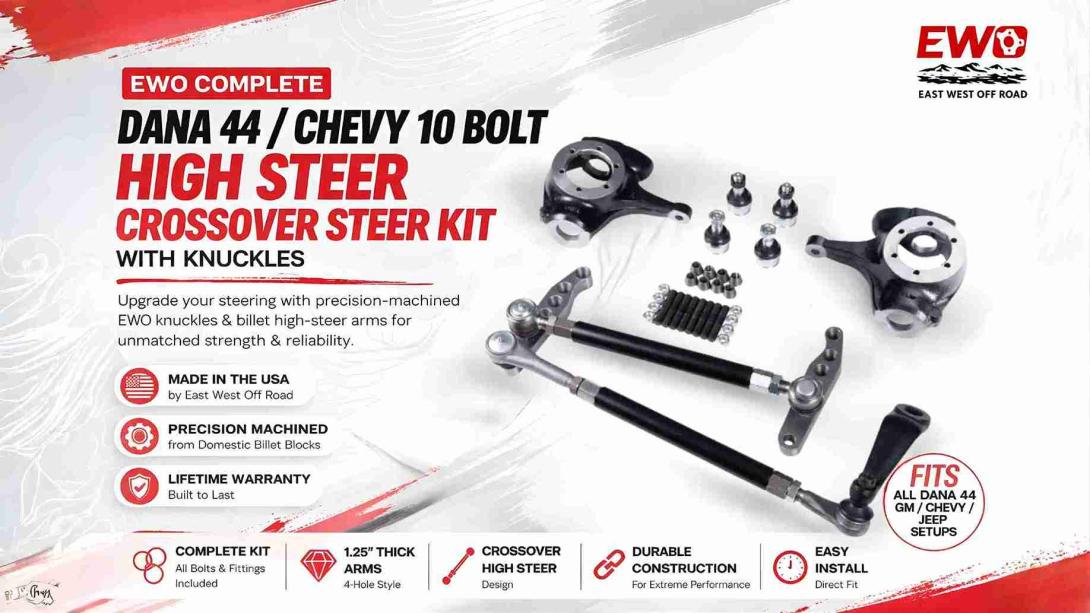
For builders looking for a comprehensive steering upgrade, East West Off Road offers its Complete Dana 44 / Chevy 10 Bolt High Steer Crossover Steering Kit With Knuckles, product number E90157.
The package includes driver-side and passenger-side flat-top steering knuckles, heavy-duty 1.25-inch billet high-steer arms, DOM steel tubing, drag link ends, tie rod ends, ball joints, a dropped pitman arm, and mounting hardware.
This guide explains how flat-top knuckles work, which axle configurations are relevant, when machining or replacement is necessary, and how to plan a complete Dana 44 high-steer crossover conversion.
What Is a Dana 44 Flat Top Knuckle?
A Dana 44 flat-top knuckle is a steering knuckle with an upper mounting surface designed or suitable for preparation to accept an elevated steering arm.
The steering knuckle connects the front axle to the wheel-end components and provides mounting points for steering linkage.
On a solid-front-axle Dana 44, the knuckle pivots on the upper and lower ball joints as the wheels turn.
A flat-top design provides the mounting foundation for certain aftermarket high-steer systems.
How Is a Flat-Top Knuckle Different From a Standard Knuckle?
Many factory steering knuckles use a conventional mounting arrangement for the original tie rod and drag link.
A flat-top knuckle provides a relatively flat upper area where a compatible aftermarket steering arm can be installed.
However, the presence of a flat surface does not automatically mean the knuckle is ready for a high-steer arm.
The mounting surface may still require machining, drilling, tapping, or other preparation.
Why Do Flat-Top Knuckles Matter for High-Steer?
High-steer arms relocate steering connections to higher mounting positions.
These arms need accurately prepared mounting surfaces and appropriate fastener connections.
Flat-top knuckles provide the required foundation.
Are All Dana 44 Flat-Top Knuckles Interchangeable?
No.
Dana 44 axles have been used in Chevy, GMC, Jeep, Dodge, Ford, and custom vehicle applications.
Different versions may use different ball joints, spindles, steering arms, and brake components.
A knuckle intended for one Dana 44 configuration should not be assumed compatible with another.
Why Convert a Dana 44 to Flat-Top Knuckles?
A flat-top conversion is often performed as part of a larger steering upgrade.
The goal is to provide compatible mounting points for elevated steering arms and an appropriate steering-linkage arrangement.
1. Prepare the Axle for High-Steer Arms
The most direct reason to install flat-top knuckles is to support aftermarket high-steer arms.
These arms provide steering-linkage attachment points higher on the knuckles.
Without the correct mounting provisions, a complete high-steer setup cannot be assembled as intended.
2. Improve Steering Linkage Clearance
On some off-road builds, the original tie rod sits close to rocks, obstacles, or other vulnerable areas.
A compatible high-steer arrangement can reposition selected steering components higher relative to the axle.
This may help protect the linkage from certain types of trail impacts.
Actual clearance improvement depends on the steering arms, linkage layout, and vehicle configuration.
3. Support Crossover Steering Conversions
Crossover steering changes how steering input travels from the steering gearbox to the front axle.
Compatible flat-top knuckles and steering arms can provide the mounting points needed for the drag link.
4. Accommodate Suspension Modifications
A suspension lift, spring-over-axle conversion, or custom suspension arrangement may change the available steering clearance.
Flat-top knuckles can be part of creating a linkage arrangement better suited to the modified vehicle.
5. Simplify a Complete Steering Rebuild
When existing knuckles, ball joints, and steering ends are worn or unsuitable, a comprehensive conversion package may simplify parts planning.
However, the components must still match the actual axle and wheel-end arrangement.
Flat-Top vs. Machined vs. High-Steer-Ready Knuckles
One of the most important buying distinctions is the difference between having a flat-top knuckle and having a knuckle that is ready for a high-steer arm.
Factory Flat-Top Knuckle
A factory flat-top knuckle may have an upper surface that can be prepared for an aftermarket steering arm.
However, the surface may not have the required machined plane or threaded mounting holes.
Machined Flat-Top Knuckle
A machined knuckle has been prepared according to the requirements of a particular steering-arm mounting system.
That preparation may include creating a precise mounting surface and drilling or tapping mounting holes.
The exact requirements depend on the knuckle and arm design.
Aftermarket High-Steer-Ready Knuckle
An aftermarket high-steer-ready knuckle is supplied with the intended mounting features already prepared.
It may simplify the conversion by eliminating certain machining work that would otherwise be necessary on an existing knuckle.
Nevertheless, the knuckle must still be compatible with the axle and wheel-end components.
Comparison
Knuckle Type
High-Steer Readiness
Additional Considerations
Conventional factory knuckle
May not support high-steer mounting
Replacement or appropriate conversion may be required
Factory flat-top, unmachined
Potential conversion candidate
Precise machining may be necessary
Professionally machined flat-top
Prepared for specified arm
Verify hole pattern, surface, and hardware
Aftermarket high-steer-ready
Designed for compatible arm mounting
Verify axle, spindle, brake, and ball joint fitment
Complete knuckle-and-arm package
Components selected for intended mounting
Confirm complete wheel-end compatibility
Which Option Is Best?
If the existing knuckles are suitable and professionally machining them is practical, they may be retained.
If the knuckles are damaged, incompatible, or not suitable for high-steer mounting, replacement knuckles may be the better choice.
For a full steering conversion, a coordinated Dana 44 flat top knuckle conversion kit can simplify sourcing compatible knuckles, high-steer arms, and steering-linkage components.
How to Identify Compatible Dana 44 Flat-Top Knuckles
Before ordering conversion parts, identify the actual front axle and existing wheel-end configuration.
A Dana 44 differential cover alone does not establish high-steer compatibility.
Identify the Axle's Original Application
Determine whether the axle came from a Chevy, GMC, Jeep, Dodge, or another vehicle.
If the axle was swapped into a different truck, its donor application is especially important.
Inspect the Knuckle Design
Determine whether the upper mounting surface is conventional, factory flat-top, or already prepared for a steering arm.
Look for evidence of previous machining or modifications.
Confirm Open-Knuckle Construction
Many traditional Dana 44 high-steer conversion systems are designed around compatible open-knuckle, live-spindle axle arrangements.
Closed-knuckle and modern unit-bearing applications can have substantially different designs.
Do not assume a traditional flat-top kit fits them.
Check the Spindle and Brake Configuration
The steering knuckle must work with the correct spindle, brake caliper mounting system, bearings, and related wheel-end components.
Some apparent knuckle interchangeability problems become obvious only when these components are compared.
Check Ball Joint Compatibility
The upper and lower ball joints must match the knuckle and axle arrangement.
Do not assume all Dana 44 ball joints use identical dimensions.
Inspect for Damage
Before reusing or machining an original knuckle, inspect it for cracks, distorted mounting holes, corrosion, and other damage.
A compromised steering knuckle is not a suitable foundation for a high-steer conversion.
East West Off Road Complete Dana 44 Flat-Top High-Steer Kit
East West Off Road offers a comprehensive steering package designed for compatible Chevy Dana 44 and GM Corporate 10-bolt front axle applications.
The product is the Complete Dana 44 / Chevy 10 Bolt High Steer Crossover Steering Kit With Knuckles, item E90157.
EWO E90157 Product Specifications
Product Detail
Specification
Brand
East West Off Road
Product Number
E90157
Product Type
High-steer crossover steering kit with knuckles
Intended Axle Families
Compatible Chevy Dana 44 and GM Corporate 10-bolt
Flat-Top Knuckles
Driver-side and passenger-side
High-Steer Arms
Two heavy-duty billet arms
Arm Thickness
1.25 inches
Steering Tubing
DOM steel
Tube Lengths
54 inches and 43 inches
Tie Rod Ends
ES2234L and ES2234R
Drag Link Ends
ES2026R and ES2027L
Threaded Adapters
7/8"-18 weld bungs
Ball Joints
Upper and lower Dana 44
Pitman Arm
3-inch dropped arm
Steering Gearbox
Compatible 2WD box required
Manufacturing
USA-made construction as advertised
Steering Arm Warranty
Advertised lifetime warranty
Why Is This a Comprehensive Conversion Kit?
Some aftermarket products include only high-steer arms or mounting hardware.
EWO E90157 includes both steering knuckles, both high-steer arms, steering ends, tubing, ball joints, and related hardware.
This makes it relevant for builders planning more than a basic steering-arm replacement.
Does It Include Everything Needed for Every Truck?
Not necessarily.
The supplied kit contents do not include a 2WD steering gearbox, which EWO explicitly requires for this crossover conversion.
Fabrication work, spindle or brake compatibility adjustments, and other vehicle-specific components may also be necessary.
A complete steering-component package should not be confused with a guaranteed no-modification installation.
Complete EWO E90157 Kit Contents
Understanding what comes in the package is important when comparing it with machining an existing set of knuckles or purchasing individual steering parts.
Included Component
Quantity
Purpose
Driver-side flat-top Dana 44 knuckle
1
Compatible steering-knuckle foundation
Passenger-side flat-top Dana 44 knuckle
1
Compatible high-steer mounting foundation
1.25-inch billet high-steer arm
2
Elevated steering connections
ES2026R drag link end
1
Drag link connection
ES2027L drag link end
1
Drag link connection
ES2234L tie rod end
1
Tie rod connection
ES2234R tie rod end
1
Tie rod connection
High-strength steering-arm studs
Included
Arm mounting
Conical washers
Included
Stud and arm retention
Lock nuts
Included
Securing the arms
7/8"-18 weld bungs
Included
Steering tubing adapters
Left- and right-hand jam nuts
Included
Threaded adjustment retention
Upper and lower ball joints
Included
Knuckle articulation
3-inch dropped pitman arm
1
Steering gearbox connection
DOM steel tubing
54-inch section
Fabricated steering link
DOM steel tubing
43-inch section
Fabricated steering link
Installation hardware
Included
Product-specific mounting
Why Are Both Knuckles Included?
A comprehensive high-steer system may use elevated steering connections on both sides of the front axle.
Including both knuckles provides a coordinated starting point for that arrangement.
Why Include Ball Joints?
Knuckle replacement requires compatible upper and lower ball joint connections.
Including ball joints can simplify the component-purchasing process when rebuilding the front steering knuckle assemblies.
Why Include DOM Tubing?
The steering system needs properly sized linkage connecting the tie rod and drag link ends.
DOM tubing provides the material for fabricating the intended links.
Why Include Specific Steering-End Part Numbers?
The steering ends must match the linkage, mounting tapers, threaded adapters, and required articulation.
Specifying the actual parts helps identify suitable replacement and service components.
Dana 44 vs. Chevy 10-Bolt Flat-Top Knuckle Conversion
Chevy Dana 44 and GM Corporate 10-bolt solid front axles are frequently discussed together in the off-road aftermarket.
However, they are different axle families.
Chevy Dana 44 Front Axle
The Dana 44 has been used in numerous solid-front-axle four-wheel-drive applications.
Certain older Chevy Dana 44 arrangements are well suited to aftermarket flat-top and crossover steering conversions.
The exact knuckles, spindles, and brakes must still match.
GM Corporate 10-Bolt Front Axle
The GM Corporate 10-bolt solid front axle is another common platform for classic Chevy and GMC 4x4 builds.
Certain aftermarket flat-top knuckle systems support compatible GM 10-bolt applications as well as older Chevy Dana 44 configurations.
Do Dana 44 and GM 10-Bolt Knuckles Interchange?
Interchangeability depends on the exact axle and wheel-end configuration.
Although some compatible Chevy-style components may be shared, this does not mean that every Dana 44 and GM 10-bolt knuckle is interchangeable.
Dana 44 vs. GM 10-Bolt Comparison
Buying Factor
Chevy Dana 44
GM Corporate 10-Bolt
Axle family
Dana
GM Corporate
Typical conversion application
Older solid-front-axle builds
Older solid-front-axle GM builds
Flat-top conversion
Available for compatible versions
Available for compatible versions
High-steer arms
Require matching knuckles
Require matching knuckles
Ball joints
Exact configuration must match
Exact configuration must match
Brake and spindle fitment
Must be verified
Must be verified
EWO E90157
Advertised for compatible versions
Advertised for compatible versions
Universal interchangeability
No
No
For owners planning a Chevy 10 Bolt Crossover Steering Kit, verifying the spindle, brake, and knuckle arrangement is as important as selecting the steering arms.
Why the Spindle and Brake System Matter
This is one of the most frequently overlooked parts of a flat-top knuckle conversion.
A steering knuckle is not an isolated component.
It connects the axle's ball joints to the wheel-end assembly.
Spindle Compatibility
Traditional open-knuckle Dana 44 axles may use removable spindles.
These spindles must attach correctly to the replacement steering knuckles.
The relevant mounting dimensions and associated components must match.
Brake Caliper Mounting
Different axle applications can use different brake caliper brackets, mounting systems, and related hardware.
A knuckle designed around one wheel-end configuration may not accommodate another without additional properly engineered components.
Wheel Bearings and Hubs
A flat-top conversion should account for the complete wheel-end assembly, including spindles, bearings, hubs, and any related service parts.
Steering Stops
Replacement knuckles may also have different steering-stop arrangements.
The stops must be configured to prevent excessive steering travel and component binding.
Why Jeep and Dodge Axles Need Extra Attention
A Chevy-style Dana 44 knuckle conversion should not automatically be assumed compatible with every Jeep or Dodge Dana 44.
Some versions use different brake, spindle, or steering configurations.
The exact axle and wheel-end design must be identified before ordering.
Three-Stud vs. Four-Stud High-Steer Knuckle Mounting
Some aftermarket Dana 44 flat-top knuckles use three-stud steering-arm arrangements, while others are designed for four-stud mounting.
These configurations are not automatically interchangeable.
Three-Stud High-Steer Arms
Certain traditional Dana 44 high-steer systems use a three-stud steering-arm connection.
The knuckle's mounting surface and holes must match the intended arm and hardware.
Four-Stud High-Steer Arms
Some aftermarket knuckles use a four-stud arrangement.
The additional attachment point changes the mounting design and may provide different load-distribution characteristics when properly engineered.
Why You Must Match the Arm and Knuckle
A steering arm must be designed for the knuckle's mounting arrangement.
Do not assume a four-stud arm can be installed on a three-stud knuckle without the correct engineering and preparation.
What Does EWO E90157 Use?
The supplied product specifications confirm high-strength mounting studs, conical washers, lock nuts, and billet arms.
They do not independently establish every hole-pattern detail or stud count for the E90157 knuckle-arm interface.
Confirm those specifications with EWO before ordering replacement arms or mixing components from different manufacturers.
1.25-Inch Billet High-Steer Arms: Understanding the Design
EWO includes two heavy-duty high-steer arms advertised as 1.25 inches thick.
These arms provide elevated mounting points for the steering linkage.
Why Steering Arm Construction Matters
The steering arms transfer steering forces between the linkage and knuckles.
As the tires encounter resistance, the arms and mounting hardware experience loading.
Appropriate material properties, arm geometry, mounting design, and fastener specifications are essential.
USA-Made Billet Construction
EWO advertises precision-machined billet steering arms made using domestic material.
For buyers seeking USA-made Dana 44 high-steer arms, this is a relevant product characteristic.
Are Billet Arms Automatically Unbreakable?
No.
Even high-strength components have design limits.
Arm thickness alone does not establish a universal strength rating.
Lifetime Warranty
EWO advertises a lifetime warranty on the steering arms.
Buyers should review the manufacturer's current written warranty terms, conditions, and exclusions.
How Flat-Top Knuckles Support Crossover Steering
Installing flat-top knuckles does not automatically complete a crossover steering conversion.
The knuckles provide mounting points, but the rest of the steering layout must also be compatible.
Factory Push-Pull Steering
Many classic Chevy four-wheel-drive trucks use a short, factory-style push-pull drag link.
This arrangement was designed around the vehicle's original steering geometry.
Crossover Steering
A crossover system typically uses a longer drag link connecting the steering gearbox to a point across the front axle.
The intended geometry depends on the vehicle's suspension and steering design.
High-Steer Crossover Steering
A combined conversion also relocates certain steering connections higher on the knuckles.
The EWO E90157 is intended for this comprehensive category.
Flat-Top Knuckles Are the Foundation
The conversion requires more than a machined knuckle surface.
The high-steer arms, drag link, tie rod, steering gearbox, pitman arm, and threaded linkage must all work together.
For compatible vehicles, the complete Dana 44 crossover steering system from EWO provides the major knuckle and steering-linkage components in one package.
The Critical 2WD Steering Box Requirement
One of the most important installation details for EWO E90157 is the required steering gearbox.
East West Off Road specifies that a 2WD steering box is required for the crossover steering conversion.
Why Does the Steering Box Matter?
Older GM four-wheel-drive push-pull steering systems use a steering gearbox and pitman-arm arrangement suited to their original linkage.
A crossover system requires a different output arrangement.
A compatible 2WD steering gearbox provides the intended motion for this EWO conversion.
Can You Retain the Original 4WD Steering Box?
Not if it does not satisfy EWO's explicit 2WD gearbox requirement.
The correct steering gearbox conversion must be part of the project.
Is the Gearbox Included?
The supplied EWO E90157 contents do not identify a 2WD steering box as an included component.
Plan to obtain a compatible gearbox separately unless the vehicle already has the required arrangement.
Why the Pitman Arm Matters
The kit includes a 3-inch dropped pitman arm.
However, the pitman arm must match the selected gearbox sector shaft and the intended steering geometry.
Do not assume every GM steering box has identical splines or mounting dimensions.
DOM Tubing, Weld Bungs, and Steering-End Compatibility
A complete flat-top conversion may involve fabricating the steering linkage that connects the high-steer arms and gearbox.
EWO includes DOM steel tubing and threaded adapters for this purpose.
Included DOM Tubing Lengths
The EWO E90157 includes:
- One 54-inch DOM steel tube.
- One 43-inch DOM steel tube.
These are supplied tube lengths rather than universal finished linkage dimensions.
What Does DOM Mean?
DOM stands for drawn over mandrel.
The process is used to produce steel tubing with controlled dimensional characteristics.
DOM tubing is commonly used in fabricated steering assemblies when the material and dimensions are suitable for the design.
Is the Tubing 1.50 x .250 DOM?
Some off-road builders search for a 1.50 x .250 DOM tubing steering kit, which describes a particular outside diameter and wall thickness.
The supplied EWO E90157 specifications identify DOM steel tubing and the included lengths, but they do not independently confirm those exact diameter and wall-thickness values.
Verify the dimensions before purchasing additional tube adapters or other related parts.
Why Weld Bungs Are Included
Weld bungs provide the threaded interfaces between the tubing and steering ends.
EWO lists 7/8"-18 weld bungs/tube adapters as included components.
The welding must follow appropriate procedures for a safety-critical steering assembly.
Why Left-Hand and Right-Hand Threads Matter
Opposite-hand threaded steering ends can allow controlled adjustment of the steering linkage in appropriately designed assemblies.
EWO includes left-hand and right-hand jam nuts.
The correct thread hand, engagement, and fastening requirements must be followed.
ES-Series Tie Rod Ends and Drag Link Ends
EWO specifies the steering ends included with E90157.
ES2234L and ES2234R Tie Rod Ends
The kit includes:
- ES2234L tie rod end.
- ES2234R tie rod end.
These are intended for the appropriate tie rod connections in the supplied steering system.
ES2026R and ES2027L Drag Link Ends
The package also includes:
- ES2026R drag link end.
- ES2027L drag link end.
These are designated for drag link connections.
Why Exact Part Numbers Matter
Steering ends can vary in stud taper, length, thread direction, and range of articulation.
A component that appears similar may not be suitable for the intended connection.
Can You Substitute Another Tie Rod End?
Only after confirming all relevant specifications and compatibility with the entire assembly.
A mismatched joint can create insecure mounting or insufficient articulation.
Dana 44 Upper and Lower Ball Joint Replacement
Replacing the steering knuckles also provides an opportunity to inspect the ball joints.
EWO includes upper and lower Dana 44 ball joints with E90157.
Why Ball Joints Matter
Ball joints allow the knuckles to pivot relative to the axle.
They also maintain the intended knuckle positioning under load.
Signs of Worn Ball Joints
Potential symptoms include excessive movement, unusual steering noises, and front-end looseness.
However, similar symptoms can result from other suspension or steering problems.
A complete inspection is necessary.
Are All Dana 44 Ball Joints Interchangeable?
No.
The exact axle and knuckle configuration determines which ball joints are suitable.
Why Professional Installation Is Important
Ball joint replacement can involve specialized tools, correct assembly procedures, and manufacturer-specific requirements.
Improper installation can create serious steering and wheel-end safety problems.
Dana 44 Flat-Top Conversion for Chevy K10, K20, and K5 Blazer
Classic Chevy solid-front-axle trucks are among the most common platforms for high-steer conversions.
Chevy K10 Flat-Top Knuckle Upgrade
A lifted K10 may require a revised steering linkage arrangement when factory steering geometry is no longer suitable.
A compatible flat-top conversion can provide the knuckle mounting provisions needed for high-steer arms.
However, the front axle and wheel-end components must be verified before ordering.
Chevy K20 High-Steer Conversion
A K20 used for rock crawling or heavy-duty trail driving may benefit from a steering layout that provides additional clearance.
A flat-top conversion can be part of that upgrade when the axle is compatible.
Chevy K5 Blazer Flat-Top Conversion
The K5 Blazer is another popular candidate for crossover steering.
A properly designed system may provide geometry better suited to certain lifted leaf-spring suspensions.
However, the complete steering and suspension system needs evaluation.
What About the Square Body Chevy High Steer Upgrade?
A Square Body Chevy High Steer Upgrade may involve knuckles, steering arms, linkage, and steering-box changes.
Flat-top knuckles are important, but they are only one part of the overall conversion.
What If the Truck Has a Different Axle?
A previous owner may have installed a GM 10-bolt, Dana 60, or another axle.
The correct steering conversion follows the actual installed hardware.
Dana 44 Flat-Top Conversion for Jeep and Custom Builds
The Dana 44 axle family also appears in Jeep and custom off-road projects.
However, axle identification is essential.
Older Jeep Dana 44 Applications
Certain older Jeep Dana 44 front axles use knuckle and wheel-end configurations relevant to traditional flat-top conversion work.
The exact compatibility depends on the axle's original application and installed hardware.
Jeep Axle Swaps
Some Jeep builders install Chevy Dana 44 axles beneath their vehicles.
In those cases, the donor axle's knuckles and wheel-end components determine the mechanical fitment.
The steering box and suspension layout of the receiving vehicle must also be evaluated.
Modern Wrangler Dana 44 Axles
A modern Jeep Wrangler Dana 44 is not automatically compatible with traditional Chevy-style flat-top knuckle kits.
The knuckle architecture and brake components can differ significantly.
Why a Jeep Dana 44 High-Steer Upgrade Needs Careful Planning
When converting a Jeep build, verify the donor axle, steering gearbox, mounting positions, suspension layout, and wheel-end compatibility.
A generic Dana 44 label is not enough to establish safe fitment.
Does a Flat-Top Knuckle Conversion Fix Bump Steer?
Flat-top knuckles provide mounting locations for steering arms.
They do not independently correct steering geometry.
What Is Bump Steer?
Bump steer occurs when suspension movement creates unintended steering input.
It can result from steering linkage geometry that is poorly matched to the suspension.
How Can Crossover Steering Help?
On certain lifted older GM trucks, a properly designed crossover arrangement can improve the steering linkage's operating geometry.
However, the actual result depends on the vehicle.
Why High-Steer Isn't a Universal Fix
High-steer components change steering-link positions.
They do not automatically correct:
- Incorrect caster.
- Excessive steering-box play.
- Loose ball joints.
- Worn tie rod ends.
- Damaged suspension hardware.
- Misaligned axles.
- Loose steering-box mounts.
- Tire-related instability.
- Incorrect toe alignment.
What Should Be Inspected First?
A front-end inspection should identify existing wear, damage, and geometry problems before a major steering conversion.
For owners trying to fix bump steer on a lifted Chevy K5, diagnosing the cause is more important than assuming the knuckles alone will solve it.
Flat-Top Knuckle Clearance: What Must Be Checked?
A conversion can raise steering components while also moving them closer to other suspension or chassis parts.
This makes full-range clearance testing essential.
Leaf Springs
High-steer linkage can pass near leaf springs or spring plates.
Clearance may be limited depending on lift height and the selected arm arrangement.
Differential Cover
Custom steering tubes and joints must clear the differential cover throughout the required steering range.
Crossmember
A crossover drag link may operate near the frame crossmember.
Some installations need a specifically configured drag link to provide the required clearance.
Brake Hoses
Steering components must not contact or damage hydraulic brake hoses.
Wheels and Tires
The knuckles, steering arms, and tie rod ends must clear the wheels and tires through the entire steering range.
Steering Stops
The completed system needs properly configured steering stops to prevent excessive travel and joint binding.
Suspension Articulation
Static clearance is not sufficient.
The steering system must operate correctly during the vehicle's expected suspension movement.
Is a Dana 44 Flat-Top Knuckle Conversion Bolt-On?
The answer depends on what is being installed and what is already on the vehicle.
Replacement Knuckles
Compatible replacement knuckles can simplify certain parts of the conversion.
However, fitting them still requires correct ball joint and wheel-end assembly.
Bolt-On Steering Arms
High-steer arms use the intended knuckle mounting studs and hardware.
These connections are bolted.
Fabricated Steering Linkage
The EWO E90157 includes DOM tubing and weld bungs.
That means cutting, fitting, and qualified welding may be necessary.
Steering Gearbox Conversion
The required 2WD gearbox is another major part of the project.
Can It Be a No-Reaming Conversion?
Replacing unsuitable original knuckles with appropriately prepared high-steer knuckles may avoid machining those original knuckles.
However, EWO's supplied specifications do not establish a guaranteed no-reaming installation for every application.
Buyers searching for a K10 Crossover Steering Kit No Reaming should confirm the exact stud tapers, knuckle configuration, and steering-arm connections before ordering.
How to Plan a Dana 44 Flat-Top Knuckle Conversion
Steering and wheel-end components are safety-critical.
The following overview is intended for project planning rather than replacing EWO's detailed installation instructions.
Qualified professional installation is recommended when the work involves steering knuckles, wheel bearings, welded linkage, or gearbox conversion.
Step 1: Identify the Exact Front Axle
Determine whether the axle is a compatible Chevy Dana 44, GM Corporate 10-bolt, or another configuration.
Record the existing knuckle and wheel-end specifications.
Step 2: Inspect the Original Knuckles
Check the knuckle design, condition, mounting surfaces, and existing steering arrangement.
Determine whether replacement is necessary.
Step 3: Verify Spindle and Brake Compatibility
Confirm that the supplied replacement knuckles will work with the actual spindles, bearings, hubs, and brake components.
Step 4: Check Ball Joint Requirements
Verify the correct upper and lower ball joints and installation procedures.
Step 5: Confirm the 2WD Steering Box
EWO E90157 requires a compatible 2WD steering gearbox.
Account for this component before beginning the conversion.
Step 6: Plan High-Steer Arm Placement
Determine the intended steering-link mounting positions and confirm the correct arm-to-knuckle hardware.
Step 7: Plan the Tie Rod and Drag Link
Measure the required finished linkage lengths and adjustment ranges.
Do not treat the supplied tube lengths as universal finished dimensions.
Step 8: Prepare the DOM Tubing
Use appropriate fabrication and welding procedures for the included tube adapters.
Step 9: Install and Verify the Steering Components
Follow the manufacturer-specific instructions for the knuckles, ball joints, steering arms, studs, washers, steering ends, and pitman arm.
Step 10: Check Full Steering and Suspension Movement
Verify that the joints articulate correctly and that the linkage clears nearby components.
Step 11: Complete Alignment and Inspection
Have a qualified technician inspect the steering assembly, steering stops, mounting hardware, and front-end alignment before road use.
Dana 44 Flat-Top Conversion Buying Checklist
Before purchasing parts, review the entire steering and axle configuration.
Buying Question
What to Confirm
What Dana 44 axle is installed?
Original application and actual components
Is it a compatible open-knuckle design?
Appropriate conversion architecture
Are the existing knuckles flat-top?
Factory, machined, or unsuitable
Are both replacement knuckles needed?
Intended steering-arm arrangement
Which spindles are installed?
Knuckle and wheel-end compatibility
What brakes are used?
Caliper mounting compatibility
Which ball joints are required?
Correct axle and knuckle fitment
What high-steer arms are used?
Matching mounting design
What mounting hardware is specified?
Stud, washer, and nut compatibility
Is a compatible 2WD steering box installed?
Required for EWO E90157
Is the pitman arm compatible?
Correct sector shaft connection
What tubing dimensions are required?
Proper linkage fabrication
What steering-end threads are used?
Compatible adapters and jam nuts
Are clearance checks planned?
Springs, frame, wheels, and suspension
Is professional installation planned?
Safety-critical assembly
Will the vehicle be aligned afterward?
Proper steering operation
A complete conversion should address every relevant connection from the steering gearbox to the front wheels.
Complete Knuckle Conversion Kit vs. Buying Parts Separately
There are several ways to approach a Dana 44 high-steer project.
Some builders retain and machine existing knuckles.
Others purchase individual replacement knuckles or a complete steering conversion package.
Machining Existing Knuckles
This may be an option if the original knuckles are suitable and professional machining is available.
However, machining costs and component compatibility must be evaluated.
Buying Knuckles and Arms Separately
This can make sense when the builder already has compatible steering tubing, steering ends, or crossover components.
Every new component must match the existing system.
Buying a Complete Steering Kit
A complete package is often more convenient when much of the steering system needs replacement.
Component
Machined Existing Knuckles
Knuckles and Arms Only
EWO E90157
Flat-top knuckles
Existing parts modified
Purchased
Included
High-steer arms
Separate
Included
Included
Tie rod ends
Separate
Separate
Included
Drag link ends
Separate
Separate
Included
DOM tubing
Separate
Separate
Included
Weld bungs
Separate
Separate
Included
Jam nuts
Separate
Separate
Included
Ball joints
Service-dependent
Varies
Included
Dropped pitman arm
Separate
Separate
Included
2WD steering gearbox
Separate if required
Separate if required
Separate; required
Which Approach Makes Sense?
Choose according to the vehicle's existing components, conversion goals, installation capabilities, and total budget.
A coordinated kit may simplify parts sourcing, but it does not eliminate the need for accurate fitment verification.
Common Dana 44 Flat-Top Conversion Mistakes
Mistake 1: Assuming a Flat Surface Is Ready for High-Steer
Some original knuckles still require precise preparation.
Mistake 2: Buying Knuckles Based Only on the Dana 44 Name
Different axle applications can use incompatible spindles, brakes, and ball joints.
Mistake 3: Mixing Three-Stud and Four-Stud Components
The steering arm and knuckle mounting arrangement must match.
Mistake 4: Ignoring Wheel-End Compatibility
A steering knuckle must work with the complete hub, spindle, and brake assembly.
Mistake 5: Forgetting the 2WD Steering Gearbox
EWO E90157 explicitly requires a compatible 2WD steering box.
Mistake 6: Assuming No Fabrication Is Necessary
The package includes DOM tubing and weld bungs.
Mistake 7: Using Incorrect Steering-End Components
The tie rod and drag link ends have specific part numbers and intended mounting locations.
Mistake 8: Guessing at Steering Arm Torque Values
Use the instructions for the actual arm, knuckle, studs, and fastening system.
Do not borrow torque values from an unrelated product.
Mistake 9: Overlooking Suspension Clearance
Elevated steering connections can interfere with springs, crossmembers, or other components.
Mistake 10: Skipping Joint Articulation Checks
A joint must move through the intended steering and suspension range without binding.
Mistake 11: Ignoring Steering Box Frame Damage
Older trucks may have wear or structural problems around the steering gearbox mounts.
Mistake 12: Skipping Professional Alignment
A major steering conversion requires appropriate adjustment and inspection.
How Much Does a Dana 44 Flat-Top Knuckle Conversion Cost?
Total conversion cost depends on the existing parts, machining requirements, and installation work.
Possible Project Expenses
A complete conversion may involve:
- Replacement flat-top knuckles.
- High-steer steering arms.
- Steering-arm studs and hardware.
- Upper and lower ball joints.
- Tie rod and drag link components.
- DOM tubing and adapters.
- Compatible 2WD steering gearbox.
- Pitman arm.
- Spindle or brake service.
- Professional fabrication.
- Steering-box frame repair if required.
- Alignment and final inspection.
Is Machining Existing Knuckles Cheaper?
It may be less expensive if the original knuckles are suitable and professional machining is readily available.
However, this depends on labor costs, component condition, and the other parts needed.
When Is a Complete Kit Better Value?
A complete kit can be more convenient when the original knuckles, steering arms, and linkage are all being replaced.
The total value depends on the components you already own and the work your vehicle requires.
Check Current Pricing
Prices and product availability can change.
Review EWO E90157 for current pricing, availability, and warranty information.
Where to Buy a Dana 44 Flat Top Knuckle Conversion Kit
If you're shopping for a Dana 44 Flat Top Knuckle Conversion Kit, start by identifying the axle and deciding whether you need replacement knuckles only or a complete high-steer crossover steering system.
East West Off Road offers the comprehensive E90157 Complete Dana 44 / Chevy 10 Bolt High Steer Crossover Steering Kit With Knuckles.
The package includes driver-side and passenger-side flat-top knuckles, 1.25-inch billet high-steer arms, steering ends, DOM tubing, ball joints, a dropped pitman arm, and related mounting components.
It is marketed for compatible Chevy Dana 44 and GM Corporate 10-bolt applications, including certain custom and axle-swapped builds.
Before ordering, confirm the axle and wheel-end specifications, steering gearbox, suspension clearance, and required fabrication work.
You can review the East West Off Road steering kit and compare the included components with your intended steering configuration.
The most successful conversions begin with the correct knuckle foundation and a steering system designed around the complete vehicle.
Final Thoughts: Build Your Dana 44 High-Steer Conversion on the Right Knuckles
A Dana 44 Flat Top Knuckle Conversion is more than a cosmetic upgrade or a simple steering-arm swap.
Properly configured flat-top knuckles establish the mounting foundation for a compatible high-steer system.
For older Chevy and GMC trucks, a complete knuckle and crossover steering conversion may help provide a linkage layout better suited to certain lifted and off-road applications.
However, compatibility is essential.
The replacement knuckles must match the axle, spindles, brakes, ball joints, and steering-arm mounting arrangement.
The complete steering conversion must also provide appropriate linkage geometry, clearance, and joint articulation.
East West Off Road's E90157 combines many of the major components into one comprehensive package, including both knuckles, billet steering arms, DOM tubing, steering ends, and mounting hardware.
Before purchasing, verify the required 2WD steering gearbox, wheel-end fitment, and fabrication needs.
With properly selected parts, qualified installation, and professional verification, a flat-top knuckle conversion can provide the foundation for a capable high-steer crossover steering system.
Frequently Asked Questions (FAQs)
1. What is a Dana 44 Flat Top Knuckle Conversion?
It is the process of using or installing appropriately prepared flat-top steering knuckles so compatible high-steer arms can be mounted on a Dana 44 front axle.
2. Why are flat-top knuckles needed for high-steer?
Flat-top knuckles provide the mounting foundation for elevated steering arms. The arms require properly prepared surfaces and secure mounting connections.
3. Are all Dana 44 knuckles flat-top?
No. Different Dana 44 axle applications use different steering knuckle designs. Not every version has the mounting features required for traditional high-steer systems.
4. Does a factory flat-top knuckle automatically accept a high-steer arm?
Not necessarily. Some factory flat-top knuckles require professional machining, drilling, and tapping before a compatible arm can be installed.
5. Can I machine my existing Dana 44 knuckles?
Some existing knuckles may be suitable for professional machining. Their condition, material, mounting design, and intended steering-arm specifications must be verified first.
6. Is it better to buy new flat-top knuckles or machine old ones?
That depends on the original knuckles' condition, their compatibility, machining costs, and the intended high-steer system. Replacement knuckles may simplify a comprehensive conversion.
7. Does EWO E90157 include both flat-top knuckles?
Yes. The advertised package includes driver-side and passenger-side Dana 44 flat-top knuckles.
8. Does the kit include high-steer arms?
Yes. EWO E90157 includes two heavy-duty billet high-steer arms advertised as 1.25 inches thick.
9. Are EWO steering arms made in the USA?
EWO advertises precision-machined steering arms made from domestic billet material.
10. Do the EWO high-steer arms have a lifetime warranty?
The manufacturer advertises a lifetime warranty on the steering arms. Review the current written terms and exclusions for exact coverage.
11. Does the kit fit a Chevy Dana 44 front axle?
EWO markets E90157 for compatible Chevy Dana 44 front axles. Exact fitment depends on the knuckles, spindles, brakes, and other wheel-end components.
12. Can the kit fit a GM Corporate 10-bolt axle?
Yes, EWO advertises the package for compatible GM Corporate 10-bolt solid-front-axle applications. Verify the actual axle and wheel-end configuration.
13. Will the kit work on a Chevy K10 or K20?
It may be appropriate for compatible K10 and K20 builds equipped with the intended front axle. The steering box, wheel-end components, and suspension must also be compatible.
14. Can I use the conversion on a Chevy K5 Blazer?
Yes, compatible K5 Blazer builds are among the advertised applications. Confirm the installed axle and steering system before purchasing.
15. Will it fit a modern Jeep Dana 44?
Not automatically. Modern Jeep Dana 44 axles may use different knuckle, brake, and hub designs from older Chevy-style Dana 44 applications.
16. Does the kit fit a Dana 60 axle?
Do not assume compatibility. Dana 60 steering knuckles and high-steer mounting systems differ from the traditional Dana 44 arrangements addressed by this kit.
17. Does EWO E90157 include upper and lower ball joints?
Yes. The supplied package includes upper and lower Dana 44 ball joints.
18. What is the difference between a three-stud and four-stud high-steer knuckle?
The terms describe different steering-arm attachment arrangements. The arm, knuckle, studs, and mounting hardware must be designed to work together.
19. Is EWO E90157 a completely bolt-on kit?
Not necessarily. The steering arms use bolted connections, but the package also includes DOM tubing and weld bungs that may require fabrication.
20. Does the kit include DOM tubing?
Yes. EWO lists one 54-inch section and one 43-inch section of DOM steel tubing.
21. What tie rod ends and drag link ends are included?
The kit includes ES2234L and ES2234R tie rod ends, along with ES2026R and ES2027L drag link ends.
22. Does the flat-top conversion require a 2WD steering box?
For EWO E90157's complete crossover steering setup, yes. EWO specifies a compatible 2WD steering gearbox, which is not listed among the included components.
23. Can flat-top knuckles help improve steering clearance?
They allow compatible high-steer arms to relocate selected steering connections. This may improve clearance depending on the vehicle's actual linkage arrangement.
24. Will flat-top knuckles fix bump steer?
Not by themselves. Bump steer is a steering and suspension geometry issue. A properly designed crossover conversion may help in certain applications, but the actual cause must be diagnosed.
25. How much does a Dana 44 flat-top conversion cost?
Cost depends on whether the knuckles are machined or replaced, the high-steer arms and linkage selected, gearbox requirements, fabrication work, and installation labor.
26. Where can I buy a complete Dana 44 flat-top knuckle conversion kit?
East West Off Road offers E90157, a complete Dana 44 / Chevy 10-bolt high-steer crossover steering kit with flat-top knuckles, billet arms, DOM tubing, steering ends, ball joints, and mounting hardware. Confirm the exact axle and steering-box configuration before purchasing.