

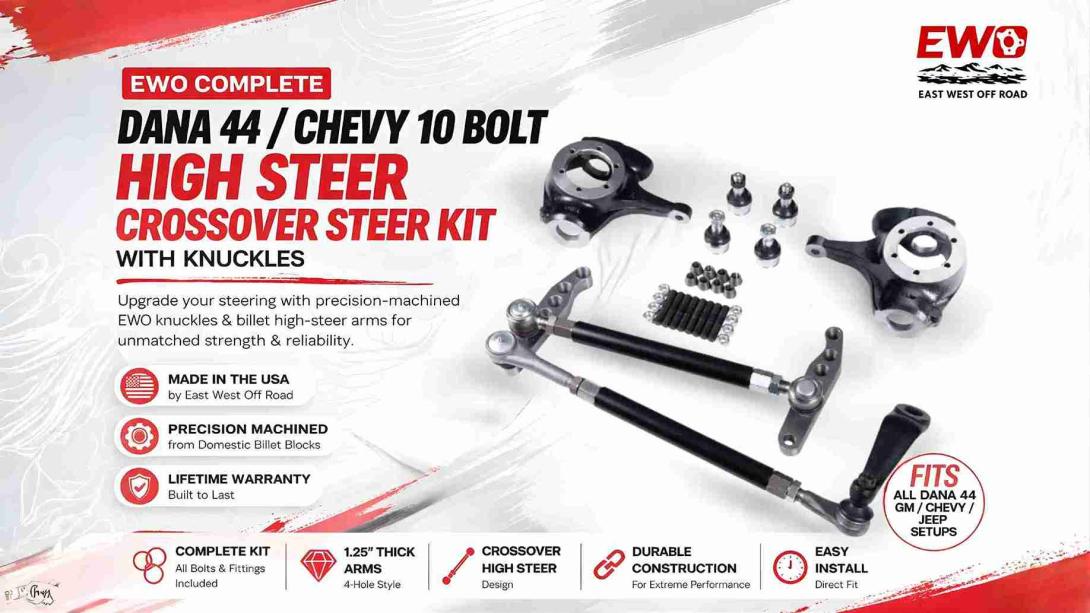
A complete Dana 44 Crossover Steering System is a serious steering upgrade for owners of compatible Chevy, GMC, and custom off-road vehicles who want to replace factory-style push-pull steering with a properly engineered crossover and high-steer arrangement. Whether you're modifying a square-body Chevy K10, upgrading a Chevy 10-bolt front axle, or building a rock crawler with a Dana 44, a complete steering package can simplify parts selection while providing components designed for demanding off-road applications.
Older solid-front-axle GM trucks are popular among off-road enthusiasts because of their rugged construction, modification potential, and straightforward mechanical design.
However, suspension lifts, larger tires, axle modifications, and changing steering angles can expose the limitations of the original steering arrangement.
On certain older GM four-wheel-drive trucks, the factory steering system uses a relatively short drag link in a push-pull configuration.
As the front axle moves through suspension travel, this arrangement can produce undesirable changes in steering behavior.
A properly designed crossover steering system changes the drag link arrangement to provide a more suitable steering path for compatible lifted and off-road applications.
High-steer components can further reposition the steering linkage to improve clearance around rocks, suspension components, and axle hardware.
The challenge is selecting components that actually work together.
A complete conversion may require flat-top steering knuckles, high-steer arms, drag link ends, tie rod ends, heavy-duty tubing, mounting studs, ball joints, and a compatible steering gearbox.
For builders seeking these components in one package, East West Off Road offers its Complete Dana 44 / Chevy 10 Bolt High Steer Crossover Steering Kit With Knuckles, item E90157.
This USA-made kit includes driver-side and passenger-side flat-top knuckles, 1.25-inch billet high-steer arms, DOM steering tubing, steering ends, ball joints, a dropped pitman arm, and related mounting components.
In this guide, we'll explain how crossover and high-steer systems work, compare Dana 44 and GM 10-bolt applications, examine the EWO kit, and identify the most important installation and fitment requirements before you order.
What Is a Dana 44 Crossover Steering System?
A Dana 44 crossover steering system changes how steering input travels from the steering gearbox to the front axle.
On many older GM solid-front-axle trucks, the original steering linkage uses a short drag link connected to a steering arm on the driver's side.
This arrangement is commonly called push-pull steering.
A crossover setup uses a longer drag link that extends across the vehicle toward the opposite steering knuckle or compatible steering arm.
The objective is to create a steering arrangement better suited to the vehicle's front suspension movement.
How Does Factory Push-Pull Steering Work?
In a traditional GM push-pull configuration, the drag link is relatively short and runs generally front to rear near the driver's side.
This arrangement was designed around the factory suspension and steering geometry.
When a vehicle receives a substantial suspension lift or experiences significant axle articulation, the geometry may become less favorable.
The result can include changes in steering behavior as the suspension moves.
How Does Crossover Steering Work?
A crossover steering system changes the steering input path.
Instead of using the original short drag link arrangement, the system connects the steering gearbox to a steering point across the front axle.
This generally requires a compatible pitman arm, drag link, steering arm, and steering gearbox configuration.
For older GM solid-axle applications, a 2WD-style steering gearbox is an essential part of the conversion.
Why Is This Useful for Lifted Trucks?
A correctly designed crossover system can provide more favorable steering-linkage movement on certain lifted leaf-spring trucks.
It can also support a steering arrangement intended for greater axle articulation.
However, the actual benefit depends on the vehicle's suspension geometry, mounting points, and component compatibility.
Crossover steering is not a guaranteed solution for every steering problem.
Crossover Steering vs. High-Steer: What's the Difference?
Crossover steering and high-steer are closely related, but they describe different modifications.
Understanding this distinction helps buyers avoid ordering an incomplete kit.
Crossover Steering Changes the Drag Link Layout
Crossover steering primarily changes how steering input reaches the axle.
Its central feature is the longer cross-vehicle drag link arrangement.
A basic crossover system may retain the tie rod in its original location.
High-Steer Changes the Steering Linkage Position
High-steer uses compatible steering knuckles and elevated steering arms to reposition steering connections.
Depending on the design, the tie rod and drag link may be placed higher relative to the axle.
This can increase clearance beneath steering components.
Combined Crossover and High-Steer Systems
A combined system addresses both steering linkage layout and steering component positioning.
This is the category that includes the EWO E90157.
Feature
Factory Push-Pull
Crossover Steering
Crossover With High-Steer
Drag link arrangement
Short, factory-style
Cross-vehicle linkage
Cross-vehicle linkage
Steering knuckles
Factory configuration
Application-dependent
Compatible flat-top knuckles
High-steer arms
Typically not included
May use one steering arm
Elevated steering arms
Tie rod location
Factory-style
May remain factory-style
Can be relocated higher
Main objective
Original steering operation
Change steering linkage geometry
Improve geometry and steering clearance
Conversion complexity
No conversion
Steering box and linkage changes
Steering box, knuckle, linkage, and mounting changes
For a builder considering both modifications, the complete package can reduce the need to identify individual matching components.
Why Older Chevy Trucks Benefit From a High-Steer Crossover Upgrade
Many classic Chevy and GMC four-wheel-drive trucks use steering configurations originally intended for factory-height suspensions.
Modified vehicles may have substantially different operating requirements.
Improved Steering Geometry on Compatible Lifted Trucks
A suspension lift changes the position of the axle relative to the frame and steering gearbox.
A crossover system can provide a more favorable drag link arrangement for certain applications.
This is one reason crossover conversions are popular on lifted K10, K20, and K5 Blazer builds.
Better Linkage Clearance
Steering components positioned low near the front axle can be exposed to rocks and obstacles.
High-steer arms help relocate selected connections to a higher position.
However, the actual clearance improvement depends on the installed axle, wheels, differential cover, suspension, and steering-linkage design.
Steering Performance During Suspension Articulation
When one front wheel moves upward while the other moves downward, the steering linkage must accommodate axle movement without binding.
A properly engineered crossover setup can be better suited to certain lifted solid-axle configurations than the original short push-pull arrangement.
Heavy-Duty Linkage Construction
The EWO complete system uses substantial billet steering arms, DOM tubing, and heavy-duty steering ends.
These components are relevant to builds intended for demanding trail conditions.
However, component dimensions alone do not guarantee unlimited impact resistance.
Convenient Parts Selection
A custom conversion can involve sourcing numerous separate parts.
Buying a package containing the knuckles, steering arms, steering ends, tubing, and hardware helps simplify the initial planning process.
For compatible GM axle builds, the Chevy 10 Bolt Crossover Steering Kit from East West Off Road brings these major components together.
East West Off Road Complete Dana 44 / Chevy 10-Bolt High-Steer Kit
East West Off Road's E90157 is designed for compatible Dana 44 and GM Corporate 10-bolt solid-front-axle steering applications.
It includes the principal components needed for a comprehensive crossover and high-steer conversion.
EWO E90157 Product Specifications
Product Detail
Specification
Product
Complete Dana 44 / Chevy 10 Bolt High Steer Crossover Steering Kit With Knuckles
Brand
East West Off Road
Product Number
E90157
Product Category
Crossover and high-steer steering system
Intended Axles
Compatible Chevy Dana 44 and GM Corporate 10-bolt
Knuckles
Driver-side and passenger-side flat-top knuckles
Steering Arms
Two heavy-duty billet high-steer arms
Arm Thickness
1.25 inches
Steering Ends
ES2026R, ES2027L, ES2234L, ES2234R
Linkage Material
DOM steel tubing
Supplied Tube Lengths
54 inches and 43 inches
Threaded Adapter Specification
7/8"-18
Ball Joints
Dana 44 upper and lower ball joints
Pitman Arm
3-inch dropped pitman arm
Gearbox Requirement
2WD steering gearbox
Manufacturing
USA-made components as advertised
Steering Arm Warranty
Advertised lifetime warranty
The package is intended for serious off-road steering projects.
However, a complete component package does not necessarily mean a no-fabrication installation.
The supplied weld bungs and DOM tubing require appropriate assembly procedures, and the vehicle must have a compatible steering gearbox.
What Makes the EWO Package Different?
Many aftermarket crossover steering products focus on steering arms and drag links.
The EWO E90157 includes both flat-top steering knuckles along with the high-steer arms and steering components.
That distinction can be important for owners whose existing knuckles do not have the mounting provisions needed for the intended steering-arm arrangement.
The package also includes ball joints and two DOM tubing lengths, providing more of the major conversion components in one purchase.
What's Included in the Complete EWO Crossover Steering Kit?
Understanding the exact package contents is essential when comparing steering products.
The EWO E90157 includes the following advertised components.
Component
Quantity
Purpose
Driver-side Dana 44 flat-top knuckle
1
Supports compatible steering-arm and wheel-end arrangement
Passenger-side Dana 44 flat-top knuckle
1
Supports compatible steering-arm and wheel-end arrangement
Billet high-steer arms
2
Provide elevated steering-link connections
ES2026R drag link end
1
Drag link connection
ES2027L drag link end
1
Drag link connection
ES2234L tie rod end
1
Tie rod connection
ES2234R tie rod end
1
Tie rod connection
Dana 44 high-strength studs
Included
Steering-arm mounting
Conical washers
Included
Steering-arm attachment system
Lock nuts
Included
Steering-arm retention
7/8"-18 weld bungs / tube adapters
Included
Connect steering ends to fabricated linkage
Left-hand and right-hand jam nuts
Included
Secure appropriate threaded adjustments
Upper and lower Dana 44 ball joints
Included
Steering knuckle mounting and articulation
Dropped pitman arm
1
Steering gearbox connection
DOM tubing
54-inch section
Steering linkage fabrication
DOM tubing
43-inch section
Steering linkage fabrication
Additional installation hardware
Included
Product-specific assembly
These components address many of the major items required when building a crossover and high-steer steering system.
However, other vehicle-specific parts or fabrication work may still be necessary.
In particular, the required 2WD steering box must be accounted for separately unless already installed.
Dana 44 Driver and Passenger Flat-Top Knuckles
The included steering knuckles are an important feature of the EWO package.
Flat-top knuckles provide mounting surfaces for compatible high-steer arms.
Why Flat-Top Knuckles Matter
A high-steer arm needs a correctly prepared mounting surface.
Not every factory Dana 44 knuckle is suitable for a high-steer arm without additional machining or replacement.
A knuckle with an unsuitable mounting surface cannot simply accept an aftermarket arm because it belongs to the Dana 44 axle family.
Why Include Both Knuckles?
Some crossover systems require only a particular passenger-side steering connection.
More comprehensive high-steer configurations may use steering arms on both sides.
EWO supplies Dana 44 driver passenger flat top knuckles as part of the package.
This helps buyers who need a coordinated knuckle arrangement for the intended system.
Dana 44 Flat Top Knuckle Conversion
A Dana 44 Flat Top Knuckle Conversion replaces or modifies the steering-knuckle arrangement so compatible high-steer arms can be installed.
In the EWO package, the advertised knuckles are supplied as part of the system.
This may reduce the need to source and machine your existing knuckles.
However, compatibility with the axle's spindles, brakes, ball joints, and mounting hardware must still be verified.
Does Including Knuckles Eliminate All Machining?
Not necessarily.
Although the supplied knuckles may eliminate specific preparation work otherwise needed on unsuitable original knuckles, the complete conversion can still require fabrication, component fitting, and other vehicle-specific work.
Do not assume that a kit with knuckles is universally a no-machining installation.
USA-Made 1.25-Inch Billet High-Steer Arms
The steering arms are another major component of the EWO E90157.
The supplied specifications identify 1.25 inch billet high steer arms manufactured from USA domestic billet material.
What Do High-Steer Arms Do?
High-steer arms attach to compatible flat-top steering knuckles.
They provide elevated steering-link mounting points.
Depending on the system layout, these points can support the tie rod and drag link in positions different from the original factory steering arrangement.
Why Does Arm Thickness Matter?
Steering arms carry significant loads as the driver turns the wheels and the tires encounter resistance.
Material properties, thickness, shape, mounting design, and manufacturing quality all contribute to performance.
The advertised 1.25-inch thickness is a substantial design characteristic, but it should not be interpreted as a guarantee that the arms cannot bend or fail under extreme loading.
Precision-Machined Domestic Billet Construction
EWO advertises its steering arms as precision-machined from domestic billet material.
This is relevant to buyers comparing fabrication methods and component sourcing.
The actual performance of the installed arms depends on the complete mounting arrangement and operating loads.
USA-Made Dana 44 Steering Arms
For shoppers prioritizing USA Made Dana 44 Steering Arms, EWO identifies its high-steer arms as domestically manufactured.
The supplied product information also advertises a lifetime warranty on the arms.
Always review the current written warranty conditions and exclusions before purchase.
DOM Steel Tubing for Heavy-Duty Steering Linkage
A crossover steering conversion requires compatible steering linkage connecting the steering box and front knuckles.
EWO includes DOM steel tubing for this purpose.
What Is DOM Tubing?
DOM stands for drawn over mandrel.
It is a manufacturing process used to produce steel tubing with controlled dimensional characteristics.
DOM tubing is commonly used in fabricated steering and suspension components because it can be specified in suitable dimensions for demanding mechanical applications.
Why Use DOM in Steering Linkage?
Steering bars must transmit forces while maintaining suitable dimensional stability and secure threaded-end connections.
DOM tubing provides a material option for fabricated steering links when properly selected, prepared, and assembled.
The correct tubing dimensions and welding procedures are essential.
Included 54-Inch and 43-Inch Tubes
The EWO package includes:
- One 54-inch DOM tubing section.
- One 43-inch DOM tubing section.
These are the supplied lengths, not a universal guarantee that both tubes are already the finished dimensions for every vehicle.
Builders must verify the final required lengths and adjustment range.
What About 1.50 x .250 DOM Tubing?
Some buyers search specifically for a 1.50 x .250 DOM tubing steering kit, referring to tubing with a 1.50-inch outside diameter and a 0.250-inch wall thickness.
Those dimensions describe a particular tubing specification.
The supplied EWO product details confirm DOM tubing and the 54-inch and 43-inch lengths, but they do not independently establish the exact outside diameter and wall thickness.
Confirm those dimensions directly with EWO before treating this package as a specific 1.50 x .250 tubing configuration.
Understanding the Included Tie Rod and Drag Link Ends
The steering bars are only part of a complete linkage.
The articulated steering ends connect those bars to their mounting points.
EWO supplies specific GM-style steering-end part numbers.
ES2026R and ES2027L Drag Link Ends
The kit includes:
- ES2026R drag link end
- ES2027L drag link end
These are the advertised drag-link components for the conversion.
Their threaded connections and mounting specifications must match the supplied adapters and intended steering-arm or pitman-arm connections.
ES2234L and ES2234R Tie Rod Ends
The kit also includes:
- ES2234L tie rod end
- ES2234R tie rod end
These components connect the tie rod to its intended mounting points.
The left-hand and right-hand designations are important for matching the threaded adapters.
Why Exact Part Numbers Matter
Steering ends with similar overall appearances may have different stud tapers, lengths, threaded dimensions, or articulation requirements.
Using the exact intended parts helps avoid incorrect assembly.
Are Drag Link Ends and Tie Rod Ends Interchangeable?
Not automatically.
Although some aftermarket steering systems use related joint designs, the actual components must match the intended mounting locations.
The EWO kit identifies separate drag link and tie rod end part numbers for a reason.
Do not substitute components without confirming compatibility.
7/8"-18 Weld Bungs, Tube Adapters, and Jam Nuts
Fabricated steering linkage requires secure connections between the DOM tubing and steering ends.
The EWO E90157 includes 7/8"-18 weld bungs or tube adapters, along with left-hand and right-hand jam nuts.
What Does 7/8"-18 Mean?
The specification identifies a nominal 7/8-inch threaded diameter with 18 threads per inch.
The steering end and tube adapter must have compatible threads.
Why Are Weld Bungs Included?
Weld bungs allow the threaded steering ends to be connected to the steel steering tubes.
The adapters must be compatible with the tube dimensions and installed using suitable welding procedures.
Is This a Fully Bolt-On Kit?
Not in the sense that every component arrives ready to install without fabrication.
The package includes weld bungs and DOM tubing, so appropriate tube preparation and welding may be part of the installation.
The fact that the knuckles and steering arms use bolted connections does not make the entire steering conversion fabrication-free.
Why Left- and Right-Hand Jam Nuts Matter
A steering system may use opposite-hand threaded ends to permit controlled linkage adjustment.
The jam nuts help secure the threaded connections after adjustment.
Thread direction, proper engagement, and correct tightening procedures must be verified.
Dana 44 Upper and Lower Ball Joints
The EWO package also includes upper and lower Dana 44 ball joints.
These joints allow the steering knuckles to pivot relative to the axle.
Why Replace Ball Joints During a Knuckle Conversion?
Installing replacement steering knuckles provides an opportunity to inspect and service the ball joints.
Worn ball joints can compromise steering and front-end stability.
Are All Dana 44 Ball Joints the Same?
No.
Dana 44 axles have been used in different vehicles and generations.
Ball joint designs and associated knuckle specifications can vary.
The included parts must match the exact axle and knuckle configuration.
What Should Be Checked During Installation?
The installer should verify the correct ball joints, knuckle seating, mounting hardware, and manufacturer-specified assembly procedures.
Ball joint installation is safety-critical and may require specialized tools.
The 3-Inch Dropped Pitman Arm
The EWO E90157 includes an advertised 3-inch dropped pitman arm.
The pitman arm connects the steering gearbox to the steering linkage.
What Does a Dropped Pitman Arm Do?
A dropped pitman arm changes the position of the drag link connection relative to the steering-box sector shaft.
This can affect steering-link geometry and component clearance.
Is a Drop Pitman Arm Always Better?
No.
Pitman arm geometry must match the actual steering configuration.
A drop that is appropriate for one steering system may create undesirable angles or interference in another.
What About a 32-Spline Pitman Arm?
Some builders search for a 3 inch dropped pitman arm 32 spline when replacing a GM steering gearbox or converting to crossover steering.
The supplied EWO product details confirm a 3-inch dropped pitman arm, but do not independently verify a universal 32-spline fitment specification.
Before ordering, confirm the sector shaft's actual spline count, shaft dimensions, indexing, and compatibility with the included arm.
Do not assume every GM 2WD steering gearbox uses the same pitman-arm connection.
Critical Requirement: A 2WD Steering Box Is Necessary
One of the most important installation requirements for this product is the steering gearbox.
East West Off Road specifies that a 2WD steering box is required for all installations of this crossover steering kit.
This requirement should be addressed before purchasing the steering components.
Why Does Crossover Steering Need a Different Gearbox?
Older GM factory four-wheel-drive steering configurations use a steering-box and pitman-arm movement arrangement suited to the original push-pull linkage.
A crossover configuration requires a different output arrangement to operate the cross-vehicle drag link correctly.
For the EWO system, a compatible 2WD steering box provides the required steering motion.
Can You Keep Your Original 4WD Steering Box?
Not if it is incompatible with EWO's stated gearbox requirement.
The product explicitly calls for a 2WD steering box.
Do not assume the existing factory four-wheel-drive gearbox will work without conversion.
Is the 2WD Steering Box Included?
The supplied kit contents do not list a 2WD steering gearbox.
Therefore, owners should plan to obtain a compatible gearbox separately unless the vehicle already has the required setup.
Other Gearbox Considerations
A 2wd steering box crossover setup should also account for:
- Steering-box mounting compatibility.
- Sector shaft specifications.
- Pitman arm fitment.
- Steering shaft connection.
- Hydraulic power steering hose connections.
- Frame and mounting condition.
- Drag link clearance and travel.
A complete steering-system inspection is important before returning the vehicle to service.
Dana 44 vs. Chevy 10 Bolt Crossover Steering
The Dana 44 and GM Corporate 10-bolt front axles are often compared because both appear in classic GM four-wheel-drive applications.
They are different axle families, but certain versions share steering-conversion concepts and compatible component arrangements.
Chevy Dana 44 Front Axles
Chevy Dana 44 solid-front-axle applications are popular candidates for crossover and high-steer conversions.
Their steering knuckles and mounting configuration must be identified before selecting replacement components.
GM Corporate 10-Bolt Front Axles
The GM Corporate 10-bolt solid front axle is another common platform in classic Chevy and GMC four-wheel-drive builds.
Certain knuckle and steering components can be compatible across appropriate Chevy Dana 44 and Corporate 10-bolt configurations.
However, interchangeability is not universal across every year or axle variant.
Dana 44 vs. 10 Bolt Crossover Steering Comparison
Factor
Chevy Dana 44
GM Corporate 10-Bolt
Axle family
Dana
General Motors Corporate
Common application
Older GM 4x4 trucks
Older GM 4x4 trucks
Crossover conversion
Available for compatible axles
Available for compatible axles
Flat-top knuckle requirement
Must be verified
Must be verified
High-steer arm mounting
Configuration-specific
Configuration-specific
Ball joint compatibility
Exact axle and knuckle dependent
Exact axle and knuckle dependent
2WD steering box for EWO E90157
Required
Required
EWO advertised application
Yes, compatible versions
Yes, compatible versions
Which Axle Is Better for Crossover Steering?
The better choice depends on your vehicle and intended build.
Both can support a properly engineered crossover steering system when the correct knuckles and linkage are used.
Instead of selecting solely by axle name, identify the actual housing, knuckles, spindles, brakes, and steering configuration.
Square-Body Chevy High-Steer Upgrade: K10, K20, and K5 Blazer
The square-body Chevrolet truck platform is a popular starting point for crossover steering projects.
Many builds combine leaf-spring suspension lifts with larger tires and modified solid front axles.
Chevy K10 Crossover Steering
A lifted K10 may benefit from a properly engineered crossover arrangement when its original steering geometry becomes unsuitable for the suspension configuration.
The EWO product is advertised for compatible Chevy Dana 44 and Corporate 10-bolt applications.
Chevy K20 High-Steer Conversion
A K20 used for off-road driving may require greater steering-component clearance and a steering arrangement appropriate for its suspension.
A combined high-steer and crossover system can be considered when the axle and other components match.
Chevy K5 Blazer Steering Upgrade
The K5 Blazer is a common platform for suspension lifts, larger tires, and trail modifications.
These changes can affect steering behavior, especially when the original push-pull configuration is retained.
A crossover conversion may be part of correcting an unsuitable linkage arrangement.
Can You Fix Bump Steer on a Lifted Chevy K5?
Owners searching for ways to Fix Bump Steer Lifted Chevy K5 should begin by diagnosing the actual steering and suspension behavior.
A properly designed crossover system may reduce undesirable steering effects associated with certain lifted push-pull arrangements.
However, other factors such as steering-box play, leaf-spring and shackle geometry, caster, loose hardware, and component condition must also be considered.
A crossover kit is not a guaranteed cure for every steering issue.
K10 Crossover Steering Kit Without Reaming
Some shoppers specifically search for a K10 Crossover Steering Kit No Reaming.
The EWO package includes replacement flat-top knuckles, which may avoid some machining associated with adapting existing unsuitable knuckles.
However, the provided specifications do not guarantee a universally no-reaming installation.
Verify the supplied stud tapers and exact vehicle configuration before ordering.
Bolt-On High-Steer Kit for GM 10-Bolt: What Does Bolt-On Really Mean?
The term "bolt-on" is commonly used in aftermarket steering products.
However, it can describe only certain parts of an installation.
Bolted Steering Arms
The high-steer arms attach to compatible flat-top knuckles using the specified studs and mounting hardware.
This is a bolted connection.
Replacement Steering Knuckles
The supplied knuckles are intended to work with the applicable axle and wheel-end components.
However, replacing knuckles is a substantial mechanical procedure that requires correct ball joint installation and compatibility checks.
Fabricated Steering Tubes
The EWO package includes DOM tubing and weld bungs.
Depending on the final arrangement, the steering tubes require correct preparation, sizing, and welding.
Why the Distinction Matters
A shopper researching a Bolt-On High Steer Kit GM 10 Bolt should confirm exactly which operations are bolt-on and which require fabrication.
A complete component kit may simplify sourcing without eliminating every installation task.
Is This High-Steer Kit Suitable for Jeep Dana 44 Applications?
The EWO product is also marketed toward compatible Jeep Dana 44 applications.
However, the Jeep Dana 44 name covers many axle designs.
Older Jeep Dana 44 Builds
Certain older Jeep or full-size Jeep builds using compatible Chevy-style Dana 44 front axle components may be candidates for crossover and high-steer systems.
The exact knuckle and wheel-end arrangement must be verified.
Jeep Axle Swaps
Some Jeep builders install Chevy Dana 44 axles or compatible steering components as part of a custom axle conversion.
A complete crossover package may be relevant to these projects.
However, steering-box compatibility and suspension geometry require particular attention.
Modern Jeep Dana 44 Axles
Modern Wrangler Dana 44 axles do not automatically share the knuckle and steering architecture of older Chevy Dana 44 axles.
Do not assume the EWO kit directly fits a Jeep TJ, JK, JL, or another modern Jeep solely because it uses a Dana 44 axle.
Jeep Dana 44 High-Steer Upgrade Checklist
Before planning a Jeep Dana 44 high steer upgrade, verify the axle's original application, knuckle and spindle configuration, steering gearbox, brake components, ball joints, and suspension geometry.
Custom applications should be reviewed with EWO before purchasing.
Complete Crossover Kit vs. Steering Arms Only
When comparing high-steer products, the package contents can make a major difference.
Some conversion kits contain only steering arms and mounting hardware.
Others include a drag link and steering ends.
More comprehensive packages add knuckles, tie rod components, ball joints, and tubing.
Comparison of Common Kit Types
Component
Arm-Only Kit
Basic Crossover Kit
EWO E90157 Complete Kit
High-steer arms
Usually
Usually
Included
Driver-side flat-top knuckle
Usually not
Often separate
Included
Passenger-side flat-top knuckle
Usually not
May be separate
Included
Drag link ends
Usually not
Commonly
Included
Tie rod ends
Usually not
Varies
Included
DOM steering tubing
Usually not
Varies
Included
Weld bungs
Usually not
Varies
Included
Jam nuts
Usually not
Varies
Included
Ball joints
Usually not
Usually separate
Included
Dropped pitman arm
Usually not
Often included
Included
2WD gearbox
Usually separate
Usually separate
Not listed as included
A comprehensive kit can make parts planning easier, particularly when the existing knuckles are unsuitable.
For builders evaluating an EWO complete Dana 44 high steer kit, the inclusion of both flat-top knuckles, steering arms, linkage components, and ball joints is a major consideration.
High-Steer Clearance and Suspension Geometry
A steering conversion should be evaluated as part of the vehicle's overall front suspension design.
Installing heavier components without checking geometry can create new problems.
Steering Linkage Clearance
The drag link and tie rod must clear nearby components throughout their operating range.
These may include:
- Leaf springs.
- U-bolts and spring plates.
- Differential covers.
- Shock absorbers.
- Frame components.
- Crossmembers.
- Wheels and tires.
- Brake hoses.
- Other axle-mounted hardware.
Suspension Articulation
A rock-crawling suspension may experience substantial movement.
Steering joints must articulate correctly without binding or reaching their movement limits.
Steering Stops
The steering stops must prevent the knuckles and linkage from moving beyond the safe operating range of the components.
Do not use the internal steering box stop or joint binding as a substitute for correctly configured steering stops.
Frame and Steering-Box Condition
Older GM truck frames should be inspected around the steering-box mounting location.
Cracks, loose bolts, damaged mounting surfaces, or other structural issues require correction.
A stronger drag link cannot compensate for a compromised steering-box mount.
Alignment and Caster
Caster, toe, and other steering-related alignment parameters influence vehicle behavior.
After significant steering or axle work, the completed system should be professionally checked.
Is This an HD Crossover Steering Kit for Rock Crawling?
The EWO E90157 is marketed for demanding off-road applications.
Its construction and package contents are relevant to builders planning substantial steering modifications.
Rock Crawling
Technical rock crawling places significant demands on steering components as tires encounter rocks and obstacles.
A properly engineered high-steer system may improve the position of exposed steering linkage.
However, even heavy-duty components remain vulnerable to excessive impacts.
Trail-Driven Trucks
A lifted trail truck may benefit from a crossover arrangement that is better suited to its suspension movement.
Correct alignment and joint articulation are important for on-road and off-road performance.
Overlanding Builds
Overlanding vehicles often travel long distances while carrying additional equipment.
For these builds, serviceability, correct component fitment, and replacement-part availability are important.
Custom Fabrication Projects
The kit includes DOM tubing and adapters, making it relevant to capable builders assembling compatible custom steering links.
Fabrication should follow appropriate engineering and welding procedures.
Off-Road Racing
The product is marketed toward demanding off-road use, but suitability for a particular racing class or event depends on the rules and technical requirements involved.
Do not assume approval for competitive use without checking the applicable standards.
Installation Planning for a Complete Dana 44 Crossover Steering System
A steering conversion is a safety-critical modification.
The following information is intended as a planning overview, not a substitute for EWO's complete installation instructions.
Qualified professional installation is recommended when the project involves steering-knuckle replacement, linkage fabrication, or steering-box conversion.
Step 1: Identify the Exact Front Axle
Confirm whether the vehicle uses a Chevy Dana 44 or compatible GM Corporate 10-bolt solid front axle.
Inspect the knuckles, spindles, brakes, and other components for previous modifications.
Step 2: Confirm Steering Gearbox Compatibility
EWO requires a 2WD steering box.
Verify that the correct gearbox is installed or included in your separate project plan.
Step 3: Review Existing Suspension Geometry
Inspect the lift height, leaf-spring arrangement, steering-box location, crossmember clearance, and axle position.
Step 4: Inspect Existing Components
Check the ball joints, wheel bearings, steering knuckles, frame, steering-box mount, and suspension hardware.
Any worn or damaged components must be addressed.
Step 5: Verify Knuckle and Brake Fitment
Confirm that the supplied flat-top knuckles are compatible with the intended axle and wheel-end components.
Do not assume every Dana 44 uses identical brakes or spindles.
Step 6: Install Ball Joints and Steering Knuckles
Use the manufacturer's procedures and specified hardware.
Incorrect ball joint installation or steering-knuckle mounting can create serious safety hazards.
Step 7: Install the High-Steer Arms
Install the arms using the intended studs, conical washers, lock nuts, and other supplied components.
Follow the required tightening sequence and torque specifications.
Step 8: Prepare the DOM Steering Linkage
Determine the required finished lengths and adjustment ranges.
Prepare and install the weld bungs according to the relevant manufacturer and fabrication requirements.
Step 9: Install the Tie Rod and Drag Link Ends
Use the specified ES-series components in their intended locations.
Verify thread direction, adjustment range, mounting taper, and joint articulation.
Step 10: Install the Pitman Arm
Confirm the arm is compatible with the gearbox sector shaft and intended steering geometry.
Do not assume that matching the nominal drop dimension establishes compatibility.
Step 11: Check Full Steering and Suspension Movement
Verify that the steering system operates correctly throughout the required steering and suspension ranges.
Inspect all nearby components for interference.
Step 12: Perform Final Alignment and Inspection
A qualified technician should verify hardware security, steering stops, alignment, steering-box function, and safe component movement before road use.
Pre-Purchase Checklist: Is Your Vehicle Ready for EWO E90157?
Before buying, answer the following questions.
Question
Why It Matters
Is the axle a compatible Chevy Dana 44 or GM 10-bolt?
Establishes intended fitment
Are the existing knuckles factory or modified?
Affects wheel-end compatibility
Will the supplied flat-top knuckles fit the axle?
Essential to the conversion
Is the steering box a compatible 2WD unit?
Explicit EWO requirement
Is the pitman arm compatible with the sector shaft?
Prevents spline and indexing problems
Are the brakes and spindles compatible?
Required for safe wheel-end assembly
What suspension lift is installed?
Influences geometry and clearance
What leaf springs or spring plates are used?
May affect tie rod and drag link clearance
What are the finished steering-link lengths?
Determines fabrication requirements
Can the installer weld steering tube adapters correctly?
Important for secure linkage connections
Are the correct tie rod and drag link ends included?
Prevents incompatible joints
Will the joints articulate without binding?
Essential through suspension travel
Are the frame and steering-box mounts sound?
Critical to steering safety
Is professional alignment planned?
Required after substantial steering changes
These checks are more important than selecting a steering kit based on vehicle model alone.
Common Mistakes to Avoid During a Crossover Steering Upgrade
Assuming All Dana 44 Axles Are Identical
Different Dana 44 generations and applications use different knuckles and wheel-end components.
Ordering a Kit Without Planning the 2WD Steering Box
EWO explicitly requires a 2WD gearbox.
The gearbox is not identified as an included component.
Assuming the Entire Kit Requires No Fabrication
The package includes DOM tubing and weld bungs.
Appropriate cutting, fitting, and welding may be necessary.
Ignoring Pitman Arm Spline Compatibility
The included pitman arm must match the actual sector shaft.
Confusing Tie Rod and Drag Link Ends
The kit lists different part numbers for these connections.
Use each component according to the intended assembly.
Skipping Brake and Spindle Compatibility Checks
Replacement knuckles must work with the complete axle wheel-end arrangement.
Ignoring Steering-Linkage Clearance
Elevated steering arms can change where the tie rod and drag link pass near suspension components.
Failing to Check Joint Articulation
A joint that binds before the suspension or steering reaches its intended range is unsuitable.
Overlooking Frame Damage
A damaged steering-box mounting area should be repaired before installing upgraded linkage.
Expecting Crossover Steering to Cure Every Problem
Improper caster, loose ball joints, damaged steering components, or incorrect alignment can still cause undesirable driving behavior.
How Much Does a Complete Dana 44 High-Steer Conversion Cost?
The total cost of a crossover steering conversion depends on the components included, the existing vehicle condition, and the required installation work.
A more complete kit may reduce individual parts purchases, but additional items can still be required.
Components That Influence the Total Budget
A project may involve:
- Complete crossover steering kit.
- Compatible 2WD steering gearbox.
- Steering shaft or hydraulic connection changes.
- Professional installation.
- Steering tube fabrication.
- Wheel-end service.
- Bearings or seals.
- Brake-related modifications.
- Frame repair or reinforcement when necessary.
- Front-end alignment.
Why Kit Contents Matter More Than Headline Price
A less expensive arm-only kit may require separate purchases of knuckles, joints, tubing, and hardware.
A more comprehensive package may simplify sourcing those components.
However, the best value depends on the parts your existing vehicle actually needs.
Is EWO E90157 a Complete Ready-to-Install System?
It includes many of the major steering-conversion components.
Nevertheless, the required 2WD steering box is not included in the supplied contents, and fabrication or vehicle-specific modifications may be necessary.
A buyer should treat it as a comprehensive component package rather than a guaranteed installation requiring no additional work.
Check Current Pricing
Prices, availability, and product options may change.
Review the current EWO E90157 product listing for up-to-date purchase information.
Where to Buy a Complete Dana 44 Crossover Steering System
If you're shopping for a complete Dana 44 crossover or Chevy 10-bolt high-steer upgrade, first confirm the exact front axle and steering gearbox configuration.
East West Off Road's E90157 combines major components required for the intended conversion, including:
- Driver-side and passenger-side flat-top knuckles.
- Heavy-duty 1.25-inch billet high-steer arms.
- DOM steering tubing.
- ES2026R and ES2027L drag link ends.
- ES2234L and ES2234R tie rod ends.
- Ball joints.
- Steering-arm studs and mounting hardware.
- 7/8"-18 weld bungs and jam nuts.
- A 3-inch dropped pitman arm.
The kit is marketed for compatible GM/Chevy Dana 44 and GM Corporate 10-bolt steering applications, with some compatible swapped-axle uses.
For buyers seeking a comprehensive conversion package, the East West Off Road steering kit is worth evaluating against their exact axle, suspension, and steering-box requirements.
Before ordering, confirm any vehicle-specific installation needs and the required 2WD gearbox.
Final Thoughts: Build a Complete High-Steer System, Not Just a Collection of Parts
A complete Dana 44 Crossover Steering System can be a valuable upgrade for a compatible classic Chevy, GMC, or custom off-road build.
The combination of crossover steering and high-steer components addresses two important objectives: establishing a suitable steering linkage layout and repositioning key connections for improved clearance.
East West Off Road's E90157 stands out as a comprehensive component package because it includes both flat-top knuckles, heavy-duty billet steering arms, DOM tubing, steering ends, ball joints, and related hardware.
Its USA-made construction and advertised lifetime warranty on steering arms are additional purchasing considerations.
However, the correct installation depends on more than the included parts.
A compatible 2WD steering box is required, fabrication may be necessary, and every steering connection must match the intended axle and suspension configuration.
For the best results, confirm fitment before ordering, follow the exact manufacturer's assembly procedures, and have the completed steering system professionally inspected.
The right high-steer conversion is one that fits correctly, articulates without interference, and supports dependable steering operation on the road and trail.
Frequently Asked Questions (FAQs)
1. What is a complete Dana 44 crossover steering system?
It is a steering conversion package designed to change the factory steering-linkage arrangement to a compatible crossover system. A comprehensive high-steer version may also include flat-top knuckles, elevated steering arms, tie rod components, and associated hardware.
2. What does crossover steering do on a Chevy truck?
Crossover steering changes the drag link layout from certain original short push-pull configurations to a longer cross-vehicle arrangement. This can improve steering geometry on compatible lifted solid-axle trucks.
3. What is the difference between crossover steering and high-steer?
Crossover steering changes the drag link layout. High-steer changes the location of selected steering connections by using compatible elevated steering arms.
4. Does EWO E90157 include both steering knuckles?
Yes. The supplied specifications list driver-side and passenger-side flat-top Dana 44 knuckles.
5. Does the kit include high-steer arms?
Yes. It includes two heavy-duty billet high-steer arms with an advertised thickness of 1.25 inches.
6. Are EWO's high-steer arms made in the USA?
Yes. The supplied product information describes the steering arms as precision-machined using USA domestic billet material.
7. Does EWO offer a warranty on the steering arms?
The manufacturer advertises a lifetime warranty on the arms. Review the current written warranty terms for the exact coverage and exclusions.
8. Will EWO E90157 fit a Chevy Dana 44 front axle?
It is marketed for compatible Chevy Dana 44 front-axle applications. Exact fitment depends on the axle, wheel-end components, and steering system.
9. Does the kit work with a GM Corporate 10-bolt front axle?
Yes, EWO advertises the product for compatible Chevy/GM Corporate 10-bolt front-axle applications. Verify the exact axle and knuckle configuration.
10. Will this crossover kit fit a Chevy K10?
It is relevant to compatible K10 builds with the intended solid front axle. Steering-box, suspension, and wheel-end compatibility must still be confirmed.
11. Can it be used on a Chevy K20?
It may be suitable for compatible K20 Dana 44 or GM 10-bolt front-axle applications. Check the actual installed components before purchasing.
12. Will this kit work on a K5 Blazer?
EWO lists compatible Chevy K5 Blazer applications. Verify the specific front axle, steering box, and suspension setup before ordering.
13. Does this kit fit Jeep Dana 44 axles?
It may be suitable for certain compatible older or Chevy-style Dana 44 applications used in Jeep builds. It is not a universal direct-fit conversion for every Jeep Dana 44 axle.
14. Is the system suitable for a Jeep Wrangler JK or JL?
Do not assume direct fitment. Modern Wrangler Dana 44 axles use different steering and wheel-end configurations. Contact EWO with the exact axle specifications.
15. Does this kit require a 2WD steering box?
Yes. EWO explicitly specifies a 2WD steering box for installations of this crossover steering kit.
16. Is the 2WD steering box included?
The supplied kit contents do not list a steering gearbox. Plan to obtain a compatible 2WD gearbox separately unless the vehicle already has one.
17. Can I use my original Chevy 4WD steering box?
Not if it fails to meet the required 2WD crossover steering configuration. The appropriate steering gearbox conversion must be completed.
18. Does the kit include a pitman arm?
Yes. The supplied specifications identify a 3-inch dropped pitman arm.
19. Is the pitman arm a 32-spline design?
The supplied product details do not independently establish a universal 32-spline specification. Verify the actual sector shaft and pitman arm compatibility with EWO.
20. Does the kit include DOM tubing?
Yes. The package lists 54-inch and 43-inch DOM steel tubing sections.
21. Is the included DOM tubing 1.50 x .250?
The supplied details confirm DOM tubing and its listed lengths but do not independently verify that exact diameter and wall thickness. Confirm the tubing specification with EWO before ordering.
22. Are tie rod ends included?
Yes. The kit includes ES2234L and ES2234R tie rod ends.
23. Are drag link ends included?
Yes. The supplied components include ES2026R and ES2027L drag link ends.
24. What thread size does the kit use?
The supplied weld bungs and tube adapters are specified as 7/8"-18. Match all threaded steering components to the intended assembly.
25. Does the kit include ball joints?
Yes. EWO lists upper and lower Dana 44 ball joints among the included components.
26. Can I install the high-steer system without reaming?
The supplied replacement knuckles may avoid certain machining operations associated with preparing existing knuckles, but the product details do not guarantee a universally no-reaming installation. Verify the exact mounting tapers and fitment.
27. Is the kit completely bolt-on?
Not necessarily. The steering arms use bolted mounting connections, but the package also includes DOM tubing and weld bungs that may require fabrication.
28. Do I need to weld the steering tubes?
The kit includes weld bungs for the DOM linkage. Those components require appropriate fabrication procedures as specified by the manufacturer.
29. Will crossover steering fix bump steer on a lifted Chevy?
It may improve steering geometry on compatible lifted applications, but it is not a guaranteed cure. Suspension geometry, caster, component wear, and the complete steering system must also be evaluated.
30. Does high-steer increase ground clearance?
It can increase clearance beneath selected steering components by relocating their mounting positions higher. The actual improvement depends on the vehicle and installed linkage.
31. Is crossover steering useful for rock crawling?
A properly engineered crossover and high-steer arrangement can be suitable for compatible rock-crawling vehicles. Correct joint articulation and component clearance remain essential.
32. Does a Dana 44 high-steer kit fit a Dana 60?
No universal interchangeability should be assumed. Dana 60 axles use different knuckle and mounting configurations. Select a steering system intended for the actual axle.
33. What is the advantage of including both flat-top knuckles?
Including both knuckles can simplify sourcing for a high-steer build and provide the intended mounting arrangement for the compatible steering arms.
34. Do I need an alignment after installing a crossover steering system?
Yes. A substantial steering conversion requires professional inspection and alignment, along with verification of steering stops, joint articulation, and all mounting connections.
35. Does the kit include every component needed for every vehicle?
It includes many of the major conversion components, but vehicle-specific parts, fabrication, and a compatible 2WD steering box may still be necessary.
36. How much does a complete Dana 44 crossover steering kit cost?
Pricing depends on the package contents, manufacturer, and current availability. Check the EWO E90157 product page for updated pricing.
37. Can I install the kit myself?
Experienced fabricators and mechanics may have the appropriate skills, but steering-knuckle replacement, welding, and gearbox conversion are safety-critical. Professional installation is recommended where the owner lacks the required expertise.
38. Where can I buy a complete Dana 44 crossover steering system?
East West Off Road offers E90157, a complete Dana 44 / Chevy 10-bolt high-steer crossover steering kit with knuckles. Verify the exact axle and required steering-box configuration before purchasing.