

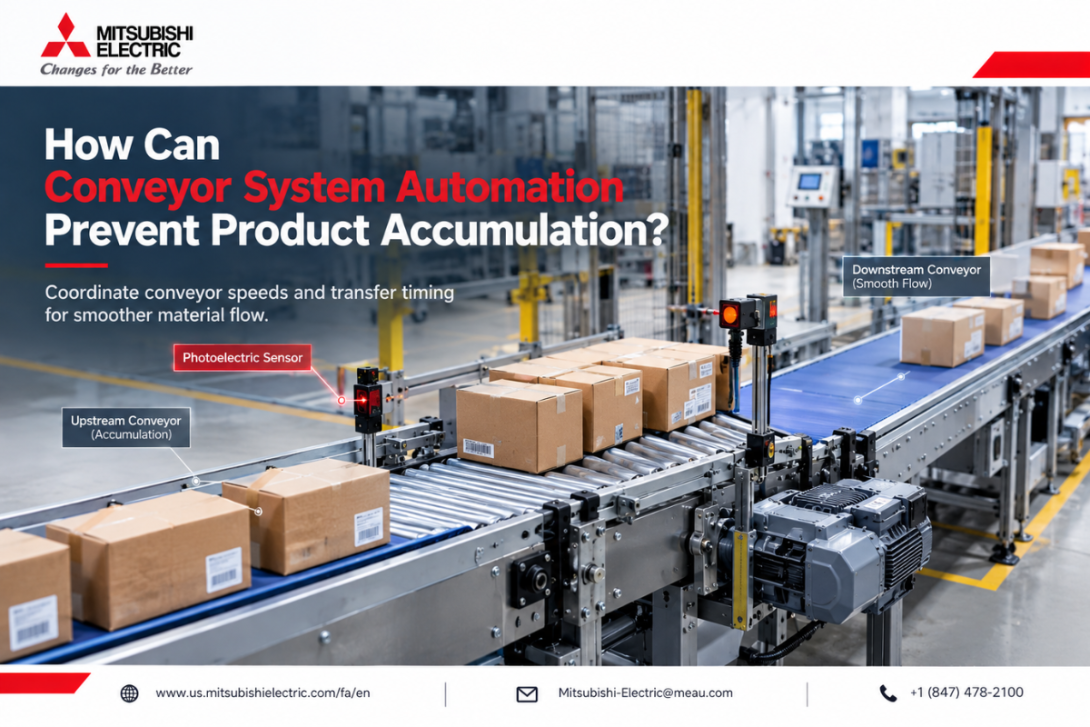
Product bunching is a frequent material handling problem associated with products moving too close to each other or accumulating at a rate that exceeds the processing capabilities of the downstream equipment. In an automated process chain, this could lead to issues with scanning, sorting, robot picking, and inspection among other procedures which require precise product spacing. The problems may affect not only the conveyor line itself but the subsequent steps in the process.
Conveyor system automation starts with the identification of causes of the irregular spacing of the product on the conveyor. Uncoordinated speeds of different conveyors can lead to reduction of space between products in the transition between the segments of the process chain. Dimensions, friction, alignment, and transfer of products could affect their movement in some way. Products may queue up due to temporary stops of the downstream equipment while improper sensor placement would result in irregular release of products.
Engineers need to look at the whole product flow process rather than simply tweaking one conveyor at a time. The pertinent questions are whether the upstream segment is delivering products at an appropriate rate, whether the geometries allow for easy transfer, and whether downstream machinery can accommodate the incoming products. The sensor positioning and reaction times need to be calibrated based on the size of products and their speed on conveyors.
Based on the application, the various options for control include keeping minimum spacing, releasing products in clusters, synchronizing conveyor speeds, or even stopping the upstream flow if the downstream segment is unavailable. These control schemes need to be chosen according to the nature of products and machine requirements.
The testing needs to cover varying sizes of products, proper throughput, and any interruptions which may cause changes in spacing between products. A system that is designed for handling identical products will function differently when dealing with different length packages or non-periodic arrivals of products.
Additionally, operators must identify where bunching is occurring and how often manual intervention is needed for this. This information may prove useful in separating a recurring control issue from mechanical transfer issues or a capacity issue in the downstream operations.
By considering all these factors, conveyor system automation will provide better consistency in the spacing and transfer of the products being handled. The goal is not to just make every conveyor faster, but to optimize the entire handling process such that products are received by the downstream equipment in an appropriate way.