

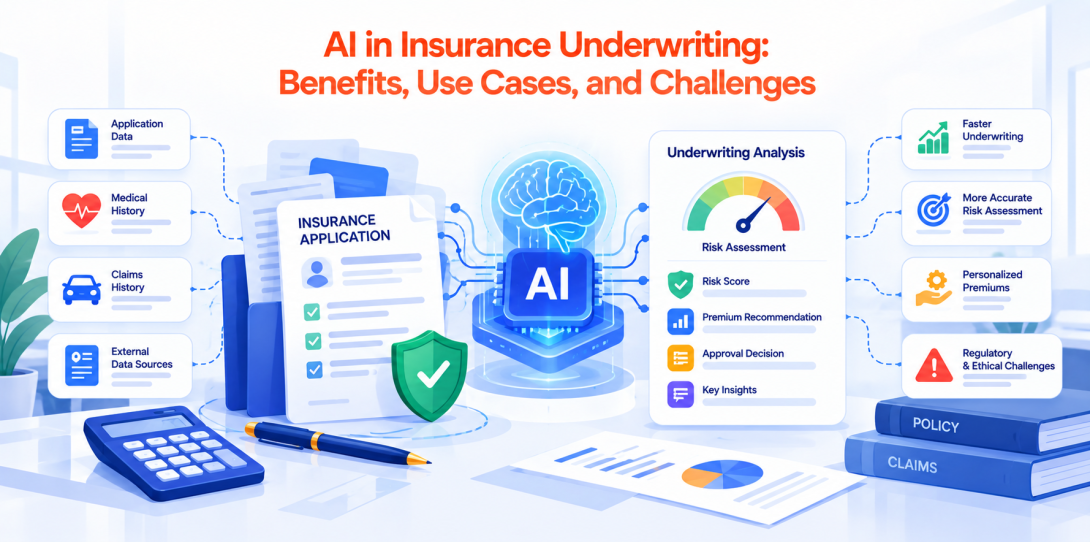
AI in insurance underwriting is changing how carriers evaluate risk, price policies, and respond to applicants.
Machine learning models now read documents, score exposures, and flag anomalies in minutes, while underwriters focus on complex judgment calls.
This guide explains how the technology works in practice, where it delivers value, which challenges slow adoption, and how insurers can implement it responsibly and at scale.
AI in Insurance Underwriting
AI in insurance underwriting is the use of machine learning, natural language processing, computer vision, and generative AI to assess applicants, score risk, and recommend pricing.
Instead of relying only on application forms and static rating tables, models learn from historical policies, claims, and external data. Recent insurtech statistics show how quickly carriers are funding these capabilities.
It does not replace the underwriter. Most production systems automate low-complexity submissions and prepare the rest for human review with summaries, risk flags, and suggested terms. That split between straight-through processing and assisted decisions is the defining design pattern of modern underwriting platforms, and it shapes every use case covered below.
How Does AI-Powered Insurance Underwriting Work?
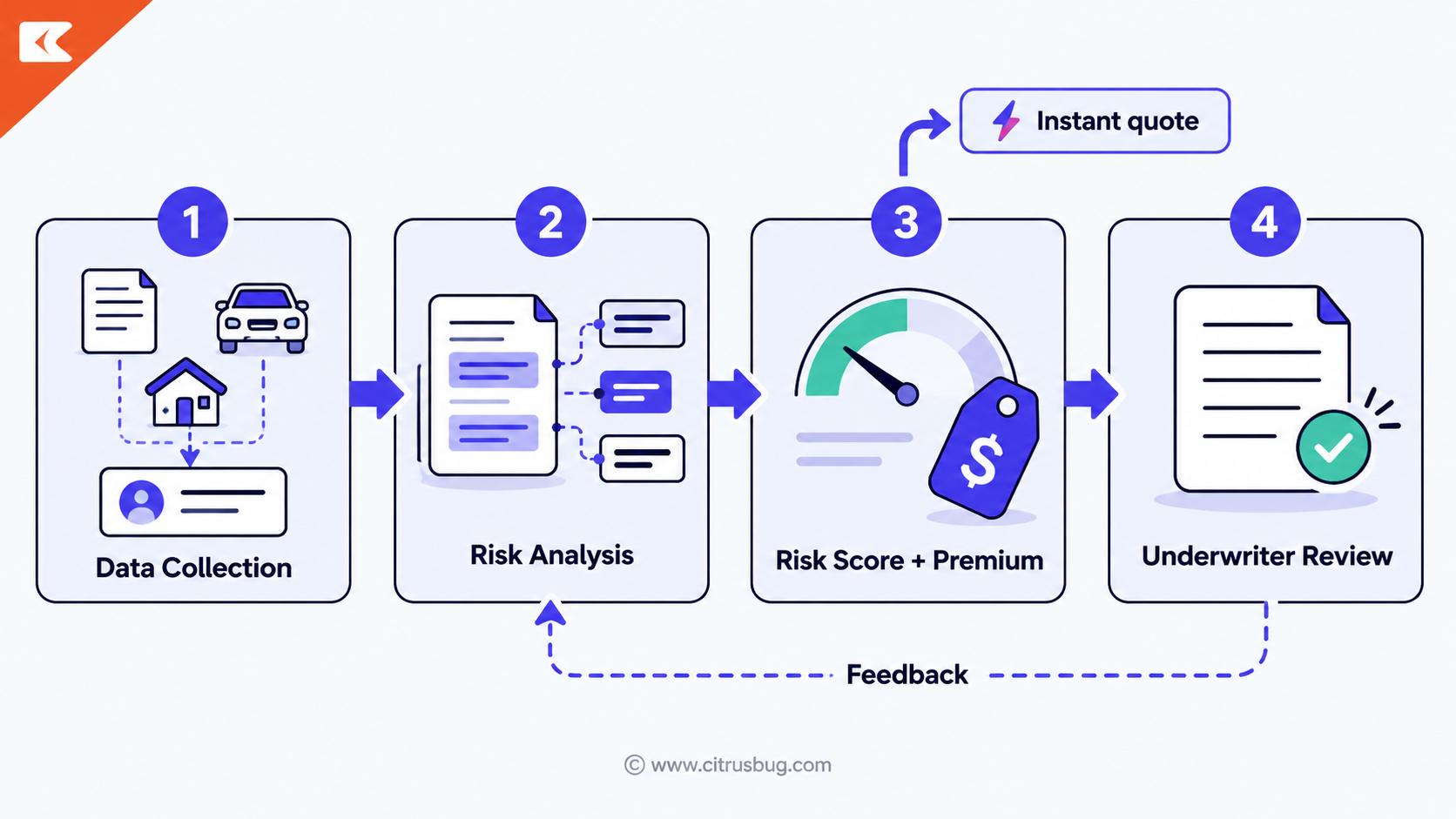
AI-powered underwriting follows a repeatable pipeline from intake to decision. Each stage can be automated on its own, which lets carriers start with one step and expand over time.
The four stages below describe how most modern platforms operate, from the first data pull to the final human sign-off on a policy.
Data Collection and Integration
The process starts by pulling data from applications, broker submissions, policy administration systems, and third-party sources such as credit bureaus, motor vehicle records, telematics feeds, and property databases. Integration layers and APIs normalize these inputs into a single applicant profile. The quality of this foundation determines how accurate every later step can be.
Data Processing and Risk Analysis
Natural language processing and OCR extract fields from unstructured files such as loss runs, medical records, and inspection reports. Machine learning models then compare each risk against historical patterns, identify anomalies, and surface the factors that drive loss. This stage turns raw data into structured signals that underwriters and pricing engines can act on.
Risk Scoring and Premium Estimation
Predictive models convert those signals into a risk score and a recommended premium range. Pricing engines apply the carrier's rating rules, appetite, and regulatory limits, then adjust for exposure, coverage terms, and competitive position. Low-risk applications can receive an instant quote, while higher-risk files move to a queue for human review.
Underwriter Review and Decision-Making
Underwriters review flagged or complex cases with AI-generated summaries, risk drivers, and suggested terms alongside the source documents. They can accept, adjust, or override the recommendation, and those decisions feed back into the model. This human-in-the-loop step keeps accountability with licensed professionals and creates an audit trail for regulators.
Key Use Cases of AI in Insurance Underwriting
AI touches nearly every underwriting workflow, from the first submission to final pricing. The use cases below are the ones carriers deploy most often, and they frequently work together inside a single underwriting workbench. Carriers usually start with the highest-volume workflow and layer on others as data and governance mature.
Automated Risk Assessment and Risk Scoring
Models score each application against historical loss data, applicant attributes, and external signals, then rank submissions by expected profitability. Underwriters see a prioritized queue instead of a first-in, first-out pile. Consistent scoring also helps carriers apply appetite rules the same way across teams, regions, and brokers, which reduces leakage from subjective decisions.
Intelligent Document Processing
Underwriting files arrive as PDFs, spreadsheets, emails, and scanned forms. Intelligent document processing classifies each file, extracts key fields, and validates them against other sources, removing hours of rekeying. Carriers building this layer often start with intelligent document automation before adding generative AI summaries that condense long submissions into a one-page brief.
Predictive Analytics for Risk Modeling
Predictive models estimate the likelihood and severity of future claims using gradient boosting, neural networks, and generalized linear models. They can incorporate telematics, weather, geospatial, and behavioral data that traditional rating variables miss. Actuaries typically validate these models against holdout data before they influence pricing, since added accuracy only matters if it holds up on new business.
AI-Powered Fraud Detection
Misrepresentation at application, such as understated mileage, a false garaging address, or omitted health history, inflates loss ratios before a claim is ever filed. Anomaly detection and network analysis compare declared data with external records to flag inconsistencies. For a deeper look at detection techniques.
Automated Underwriting for Life and Health Insurance
Life carriers use accelerated underwriting to replace paramedical exams with prescription histories, motor vehicle records, and other data sources. About 73% of applicants are eligible for products that offer it, and half of eligible applicants receive an offer through that path. Health and disability lines apply similar automation to medical record review and risk classification.
Commercial Insurance Underwriting
Commercial underwriters handle complex submissions with loss runs, schedules, financials, and broker correspondence. AI triages incoming submissions by appetite, extracts exposure data, and drafts summaries so underwriters spend their time on negotiation and structuring. Property, casualty, cyber, and specialty lines all benefit, particularly in segments such as middle market and excess and surplus where submission volume is high.
Benefits of AI in Insurance Underwriting
The case for AI rests on measurable gains in speed, accuracy, and cost. Results vary by line of business and data maturity, but the same five benefits appear across the carriers, managing general agents, and reinsurers that have moved beyond pilots into production use. Each benefit below ties to a specific part of the underwriting workflow.
Faster Underwriting Decisions
Automating intake, data enrichment, and scoring compresses turnaround from days to minutes on routine risks. AIG reported that its generative AI assistant cut underwriter time to quote by 55% in its Lexington middle market property business. Speed matters in competitive broker markets, where a fast and clear quote often decides which carrier wins the business.
Improved Risk Assessment and Pricing Accuracy
Models detect nonlinear patterns and interactions across hundreds of variables that manual review and traditional rating tables overlook. Better segmentation lets insurers price low-risk customers competitively and charge adequately for high-risk exposures. The result can be a healthier loss ratio and less adverse selection, provided models are validated and monitored on an ongoing basis.
Reduced Manual Work and Operational Costs
Underwriters often lose hours to data entry, document review, and information gathering that add little judgment. Automation absorbs those tasks, so the same team can handle more submissions without proportional headcount growth. Fewer handoffs and less rework also lower expense ratios across the policy lifecycle, from quote through renewal.
More Consistent Underwriting Decisions
Two underwriters reviewing the same file can reach different conclusions. AI applies the same guidelines and appetite rules to every submission, which reduces variance and makes outcomes easier to explain. Consistency also simplifies audits and training, because senior judgment becomes encoded in documented rules and model behavior that newer underwriters can learn from.
Better Customer Experience and Quicker Policy Issuance
Applicants expect digital, low-friction buying. Pre-filled forms, instant quotes, and no-exam life policies shorten the path from application to coverage. Brokers benefit too, with faster responses and clearer reasons when a risk is declined. Less abandonment during lengthy underwriting translates directly into higher conversion and more premium written.
Challenges of Implementing AI in Insurance Underwriting
Value does not arrive automatically. Carriers face technical, ethical, and regulatory hurdles that can stall projects or create liability if ignored. Addressing the six challenges below early is far cheaper than retrofitting controls after a model is already making or influencing decisions in production. Each challenge below is manageable with the right planning and clear ownership.
Data Quality and Data Silos
Underwriting data lives across policy administration systems, broker portals, spreadsheets, and legacy mainframes, often with inconsistent formats and missing fields. Models trained on incomplete or siloed data produce unreliable scores. Insurers need data governance, master data management, and integration pipelines in place before they can trust AI outputs at scale.
Algorithmic Bias and Unfair Risk Assessment
Models can learn proxies for protected characteristics from variables such as ZIP code, credit information, or purchasing behavior, which leads to unfair discrimination. Carriers should test for disparate impact, document variable choices, and follow ethical AI practices in software development across the model lifecycle. Regulators increasingly expect this testing to be documented and repeatable.
Model Explainability and Decision Transparency
A black-box score is hard to defend when an applicant is declined or charged more. Regulators and consumers expect clear reasons for adverse decisions. Techniques such as SHAP values, reason codes, and interpretable model architectures help underwriters explain outcomes, and a simpler model is sometimes the better choice when explainability outweighs a marginal accuracy gain.
Data Privacy and Cybersecurity
Underwriting uses sensitive personal, financial, and health information, which makes it a target for breaches and a focus of privacy law. Carriers must apply data minimization, encryption, access controls, and vendor due diligence, particularly when third-party models or large language models process applicant data. Security reviews should cover prompts, logs, and training datasets, not only databases.
Regulatory Compliance and Auditability
Roughly half of US states have adopted the NAIC model bulletin on insurers' use of AI, which expects a written governance program and third-party oversight. Colorado has its own rules, and the EU AI Act treats AI used for life and health insurance risk assessment and pricing as high-risk. Audit-ready logging is easier with dedicated risk and compliance solutions than reconstruction later.
Model Drift and Changing Risk Patterns
Risk patterns shift with climate events, economic cycles, new vehicle technology, and changing medical practice. A model trained on past data can quietly lose accuracy as conditions change. Carriers need ongoing monitoring of input distributions and loss performance, scheduled retraining, and clear thresholds that trigger review or rollback when performance degrades.
How to Implement AI in Insurance Underwriting
A phased approach reduces risk and builds internal trust. The seven steps below move from choosing a workflow to scaling a governed program, and each step produces evidence that supports the next investment decision. Skipping steps often stalls AI projects in underwriting, so the sequence matters as much as the technology chosen.
Identify High-Impact Underwriting Workflows
Start with workflows that combine high volume, repetitive effort, and clear success metrics, such as submission triage or document extraction. Quantify baseline turnaround, hit rate, and cost per policy so results can be measured later. Avoid starting with the most complex, judgment-heavy lines, where early wins are harder to prove.
Audit Data Readiness and Existing Systems
Inventory the data sources, quality, lineage, and access rights that your chosen workflow needs. Gaps in historical outcomes, inconsistent fields, and unclear consent are common blockers. A structured AI readiness assessment clarifies what to fix first and prevents teams from building models that production data cannot support.
Choose the Right AI Approach and Technology
Match the technique to the task. Gradient boosting and generalized linear models fit structured risk scoring, OCR and NLP fit document extraction, and large language models fit summarization and question answering. Decide whether to buy, build, or combine vendor platforms with custom models, weighing explainability, data residency, integration effort, and long-term cost of ownership.
Integrate AI With Underwriting and Policy Systems
Models only create value when their outputs reach underwriters inside the tools they already use. Integrate through APIs with the underwriting workbench, policy administration, rating, and CRM systems. Working with an experienced insurance software development company helps connect legacy platforms without disrupting live operations or creating duplicate data entry.
Establish Human Oversight and Governance
Define which decisions are automated, which are assisted, and who can override. Set up a model risk committee, document each model's purpose and limitations, and require bias and performance testing before release. Governance aligned to the NAIC bulletin and similar frameworks turns AI from an experiment into an accountable business capability.
Run a Pilot and Validate Model Performance
Pilot on a limited book or product line, ideally running the model in shadow mode alongside current decisions. Compare accuracy, speed, override rates, and fairness metrics against the baseline. Actuaries and compliance teams should sign off on results before expansion, and underwriters should give feedback on usability and trust.
Monitor Outcomes and Scale Gradually
After launch, track loss ratios, hit and bind rates, turnaround, drift indicators, and underwriter overrides on a regular schedule. Expand to new lines and regions only when metrics hold. Treat the system as a living product with owners, release cycles, and retraining plans rather than a one-time project.
Real-World Applications and Examples of AI in Insurance Underwriting
Public evidence varies in quality, so this section separates production deployments from pilots and vendor announcements. The examples span commercial, property, life, auto, and health lines, and the figures come from company disclosures or named executives rather than marketing estimates. Where a result comes from a vendor announcement instead of a carrier, the text says so.
Commercial Insurance: AIG Assist at Lexington
AIG offers the clearest production example. On its first quarter 2026 earnings call, CEO Peter Zaffino said AIG Assist helped Lexington's middle market property business quote 30% more submissions, cut underwriter time to quote by 55%, and increase the number of submissions bound by roughly 40%.
AIG has since started building a multi-agent underwriting system with Palantir and Anthropic. That next phase is still early, so its results should be treated as a work in progress rather than proven performance, unlike the AIG Assist figures above, which come from live use.
Property Insurance: Zurich North America and Nearmap
Zurich North America integrated Nearmap aerial imagery and roof condition scoring, delivered through the Betterview platform, into its US Middle Market underwriting platform. After a pilot, Zurich extended the technology across its Middle Market underwriting offices, which makes it a production rollout. Zurich frames the goals as fewer manual processes, more consistent data, and quicker quotes.
Life Insurance: Accelerated Underwriting at Scale
Accelerated underwriting is the most mature data-driven workflow in life insurance. Munich Re US reports that 73% of applicants are eligible on products that offer it, 63% of eligible applicants receive an accelerated decision, and 50% receive an offer. Carriers still monitor mortality results closely, because reduced medical evidence can change risk selection over time.
Auto Insurance: Usage-Based Pricing With Telematics
Telematics-based pricing has been in production for over a decade. Progressive's Snapshot program, for example, uses driving data from a mobile app or device to adjust rates based on observed behavior such as hard braking, mileage, and time of day. It shows how behavioral data can replace broad demographic proxies in rating.
Health Insurance: Where Evidence Is Thinner
Verified results are scarcest in health underwriting. In the US individual and small group markets, insurers cannot use medical underwriting, so AI appears mostly in large group, supplemental, disability, and international medical lines, often as document review support. Treat vendor claims here as pilots until a carrier publishes outcomes.
The same caution applies to newer agentic products. Sixfold announced its AI Underwriter in June 2026, but that is a product launch, and carrier-level results are not yet public. Readers evaluating vendors should ask for named customers, measured baselines, and the share of volume actually running in production.
The Future of AI in Insurance Underwriting
The next wave of change moves beyond single-task models toward systems that plan, monitor, and reason across data types. Three developments are worth watching, and each raises the bar for governance as much as it raises the ceiling for efficiency. Carriers that prepare now will adapt faster than those that wait for standards to settle.
Agentic AI and Multi-Step Underwriting Workflows
Agentic systems break underwriting into steps handled by specialized agents that retrieve data, check guidelines, draft recommendations, and challenge one another's conclusions. AIG describes agents as knowledge assistants, adviser agents, and critic agents that work alongside underwriters. Humans stay accountable for final decisions, but the volume of submissions a team can review rises sharply.
Real-Time and Continuous Risk Assessment
Underwriting is moving from a point-in-time decision at binding toward continuous monitoring. IoT sensors, telematics, satellite imagery, and open data can update risk profiles during the policy term, enabling mid-term pricing signals, loss prevention alerts, and sharper renewals. Insurers will need clear consent and fairness rules so continuous scoring does not feel like surveillance.
Multimodal AI for Documents, Images, and Geospatial Data
Multimodal models read text, photos, floor plans, drone images, and maps in a single pass. An underwriter could ask for roof condition, nearby wildfire exposure, and prior losses in one query and receive an answer with cited sources. Accuracy and hallucination controls remain essential, so every output must link back to evidence an underwriter can verify.
Conclusion
AI in insurance underwriting has moved from pilot projects to production systems that quote faster, price more precisely, and free underwriters for complex judgment.
The gains are real, but so are the risks around data quality, bias, explainability, and regulation.
Carriers that start with a focused workflow, govern models carefully, and scale gradually will capture the most value from AI in insurance underwriting without sacrificing trust.