

Introduction
Artificial Intelligence has become an important technology across industries, supporting automation, predictive analytics, language processing, and intelligent application development. As organizations explore AI-powered solutions, individuals with machine learning and deep learning knowledge are increasingly interested in developing specialized technical skills.
Before joining a training program, learners often want to understand the course syllabus, important technologies, and potential career opportunities.
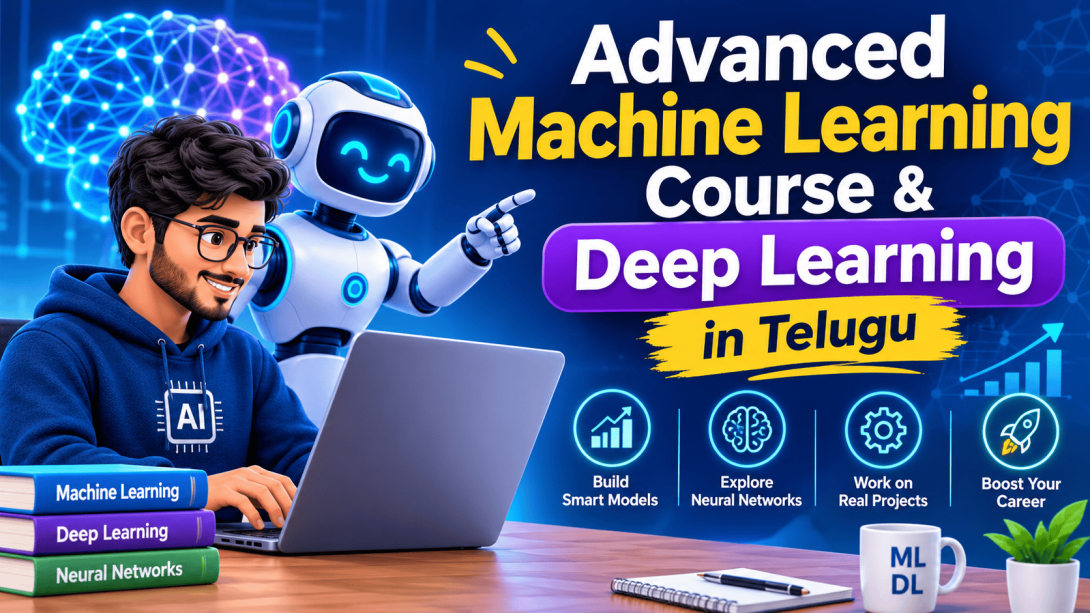
An Advanced Machine Learning Course & Deep Learning in Telugu can provide a structured learning path covering programming fundamentals, machine learning algorithms, neural networks, and practical AI applications.
Understanding the syllabus helps students select suitable training and prepare for their learning journey.
What Is Covered in an Advanced Machine Learning Course?
A comprehensive machine learning syllabus should progress from fundamental programming concepts to advanced model development.
1. Python Programming Fundamentals
Python is widely used for machine learning because of its simple syntax and extensive development ecosystem.
Important topics include:
- Variables and data types.
- Conditional statements and loops.
- Functions and modules.
- Object-oriented programming.
- Lists, tuples, and dictionaries.
- File handling and exception handling.
Learners should also understand NumPy, Pandas, and Matplotlib.
2. Mathematics and Statistics for Machine Learning
Mathematical concepts help explain how machine learning algorithms process data.
The syllabus may include:
- Linear algebra.
- Probability and statistics.
- Calculus fundamentals.
- Statistical distributions.
- Optimization techniques.
These subjects support understanding model calculations and prediction methods.
3. Data Analysis and Preprocessing
Data preparation is an important stage in machine learning development.
Students should learn data collection, cleaning, handling missing values, exploratory data analysis, feature selection, and data visualization.
These techniques help prepare datasets for effective model training.
4. Machine Learning Algorithms
A good syllabus should cover different learning approaches.
Supervised Learning:
- Linear Regression.
- Logistic Regression.
- Decision Trees.
- Random Forest.
- Support Vector Machines.
- K-Nearest Neighbors.
Unsupervised Learning:
- K-Means Clustering.
- Hierarchical Clustering.
- Principal Component Analysis.
Model Evaluation:
Understand accuracy, precision, recall, F1-score, confusion matrices, and cross-validation.
5. Deep Learning and Neural Networks
Deep learning focuses on training multi-layered neural networks to identify complex patterns.
Important topics include:
- Artificial Neural Networks.
- Convolutional Neural Networks.
- Recurrent Neural Networks.
- Long Short-Term Memory.
- Transformers.
- Activation functions.
- Backpropagation.
- Loss functions and optimization.
6. Deep Learning Frameworks
Learners should gain practical exposure to commonly used frameworks.
TensorFlow provides tools for developing and training machine learning and deep learning models.
PyTorch supports flexible neural network development and experimentation.
Understanding these frameworks helps learners implement theoretical concepts through coding.
7. Practical Projects and Applications
Project-based learning connects technical knowledge with real-world problems.
Examples include:
- Image classification.
- Customer segmentation.
- Fraud detection.
- Recommendation systems.
- Sentiment analysis.
- Sales prediction.
Career Opportunities After Machine Learning and Deep Learning Training
After developing relevant technical skills, learners can explore several AI-related roles.
Job Role
Key Responsibilities
Machine Learning Engineer
Develops and maintains predictive models
AI Engineer
Builds intelligent software applications
Data Scientist
Analyzes data and develops insights
Deep Learning Engineer
Develops neural network solutions
NLP Engineer
Builds language-processing systems
Computer Vision Engineer
Works with image and video analysis
Job requirements vary depending on the employer, experience level, and specialization.
Additional Skills That Improve Career Preparation
Apart from the main syllabus, learners can explore Git, SQL, API development, cloud platforms, model deployment, and MLOps.
Communication skills and the ability to explain technical projects are also valuable during interviews.
How to Choose the Right Training Program
Before selecting an Advanced Machine Learning Course & Deep Learning in Telugu, evaluate whether it offers:
- Structured Python training.
- Detailed explanations of machine learning algorithms.
- Practical deep learning implementation.
- Hands-on assignments.
- Real-world project development.
- Exposure to TensorFlow and PyTorch.
- Career-oriented learning support.
A balanced syllabus should provide both theoretical understanding and practical experience.
Frequently Asked Questions (FAQs)
1. What topics are included in a machine learning course syllabus?
Common topics include Python, mathematics, statistics, data preprocessing, machine learning algorithms, neural networks, and practical projects.
2. Is deep learning included in advanced machine learning training?
Many advanced programs include neural networks, CNNs, RNNs, transformers, and deep learning frameworks.
3. Which programming language is used in machine learning?
Python is widely used because it provides libraries such as NumPy, Pandas, Scikit-learn, TensorFlow, and PyTorch.
4. What career opportunities are available after machine learning training?
Potential roles include AI Engineer, Machine Learning Engineer, Data Scientist, NLP Engineer, and Deep Learning Engineer.
5. Are practical projects important in an AI course?
Yes. Projects help learners understand implementation, model evaluation, and real-world problem-solving.
6. Can freshers join machine learning training?
Yes. Freshers can begin with Python and fundamental mathematics before progressing to advanced AI concepts.
Conclusion
An organized syllabus helps learners understand the complete journey from Python programming to advanced deep learning applications. By combining machine learning algorithms, neural networks, practical projects, and modern development frameworks, students can develop valuable technical knowledge. An Advanced Machine Learning Course & Deep Learning in Telugu can provide a structured learning foundation for individuals interested in exploring different AI career opportunities.