

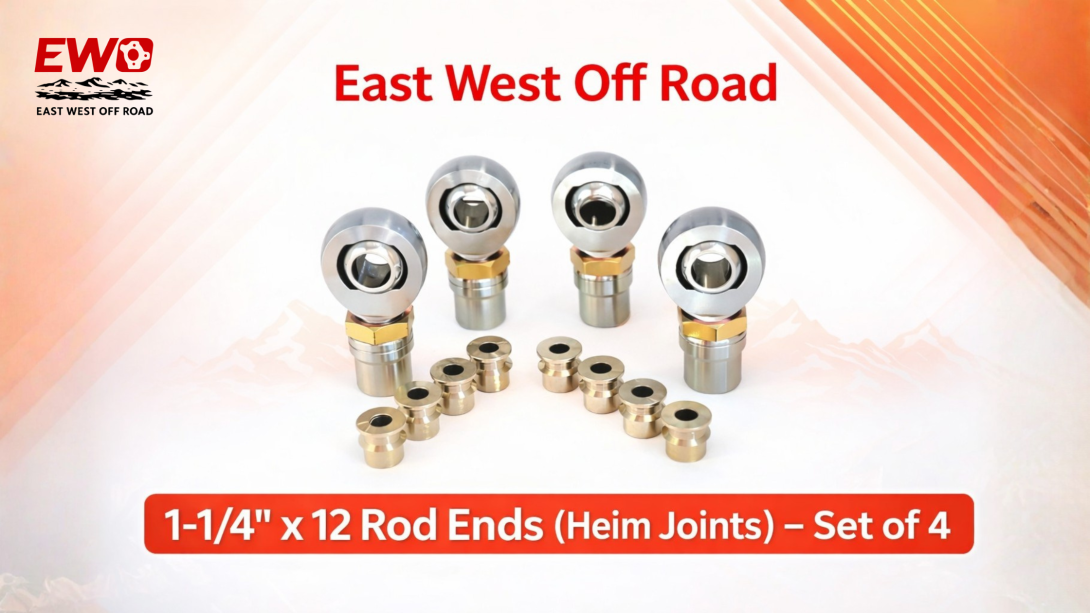
Buy Now: https://www.eastwestoffroad.com/product/1-14%22-x-12-rod-ends-(heim-joints)-set-of-4
A 4 Link Kit is one of the most important components to research when building a custom off-road suspension system. Whether you are fabricating a rock crawler, upgrading a trail truck, or planning a solid-axle suspension conversion, a properly designed four-link setup helps control axle movement while allowing the suspension to travel through its intended range.
However, shopping for a heavy-duty 4 link suspension kit involves more than finding four control arms and installing them beneath your vehicle.
Link geometry, axle location, rod-end construction, mounting brackets, DOM tubing, misalignment spacers, and installation requirements all influence how the finished suspension operates.
Some aftermarket packages include almost everything needed for a fabricated four-link system, while others provide only selected components, such as suspension links, rod ends, or mounting hardware.
Understanding those differences is essential before ordering parts.
This guide explains how four-link suspension systems work, the differences between parallel and triangulated configurations, what components to look for, and how to select compatible heim joints for your off-road build.
What Is a 4 Link Suspension Kit?
A four-link suspension system uses four primary locating links to control axle movement relative to the vehicle chassis.
These links connect the axle to mounting points on the frame or chassis structure.
Their arrangement helps determine how the axle moves under acceleration, braking, suspension compression, and articulation.
A typical solid-axle four-link arrangement includes two upper links and two lower links.
The links help control axle position and rotation, but the complete suspension design may also require a separate method of lateral axle location.
What Does a Four-Link Suspension Do?
The four locating links work together to control the axle's movement.
Their geometry influences:
- Fore-and-aft axle movement
- Axle rotation under driving and braking forces
- Pinion-angle changes through suspension travel
- Suspension articulation
- Acceleration-related suspension behavior
- Vehicle handling and stability
The specific results depend on link lengths, mounting locations, angles, and the overall suspension design.
A four-link system does not automatically improve every aspect of vehicle performance.
Its effectiveness depends on proper engineering and installation.
Is a 4 Link Kit the Same as a Lift Kit?
No.
A suspension lift kit is primarily intended to change vehicle ride height, although it may include components that affect suspension geometry.
A four-link system is a method of locating and controlling a solid axle.
A custom four-link build may use coil springs, coilovers, air springs, or another properly engineered spring and damper arrangement.
The four locating links themselves do not provide the springing or damping required for a complete suspension.
Parallel vs. Triangulated 4 Link Kits
One of the first decisions in planning a four-link suspension is choosing the appropriate geometry.
Two widely recognized configurations are parallel and triangulated four-link systems.
Parallel 4 Link Suspension
In a parallel four-link arrangement, the primary locating links are positioned in a configuration that does not provide sufficient lateral axle location through link triangulation alone.
A separate lateral locating device, such as a Panhard bar or track bar, is typically required.
That additional component controls side-to-side axle movement.
A parallel system can be suitable for certain applications where the vehicle layout, frame design, and suspension objectives support this arrangement.
However, the track bar and its mounting geometry must be incorporated into the overall design.
Triangulated 4 Link Suspension
A triangulated four-link system uses angled suspension links to provide lateral axle control through the linkage geometry.
Depending on the design, the upper links, lower links, or both pairs may be triangulated.
With sufficient properly engineered triangulation, a separate Panhard bar may not be necessary.
This can make triangulated systems attractive for certain custom rock crawlers and off-road vehicles.
However, triangulation introduces packaging and geometry considerations that must be addressed.
Single vs. Double Triangulated Four-Link Systems
A single-triangulated system generally uses one angled link pair.
A double-triangulated system incorporates triangulation in both upper and lower link pairs.
The choice affects lateral axle control, available packaging space, bracket placement, and suspension behavior.
Neither configuration should be selected simply because it appears more capable.
The correct design depends on the vehicle's chassis, axle, driveline, and intended operating conditions.
Which Four-Link Configuration Is Better?
Factor
Parallel 4 Link
Triangulated 4 Link
Main locating links
Four
Four
Lateral axle location
Typically requires a track bar
May be provided through triangulation
Bracket arrangement
Based on parallel geometry
Requires angled link geometry
Packaging considerations
Includes lateral locator clearance
Requires room for angled links
Off-road applications
Possible with proper engineering
Common in custom off-road builds
Key design concern
Track-bar geometry and axle movement
Triangulation, clearance, and binding
Both configurations can work well when properly designed.
The goal is to choose a system that matches the vehicle rather than assuming one layout is universally superior.
What Parts Do You Need for a Complete 4 Link Kit?
The contents of a four-link suspension package vary by manufacturer.
Some are nearly complete DIY fabrication packages. Others include only brackets or link-related components.
For a custom suspension project, the overall parts list may include the following.
Four Suspension Links
The system uses four primary locating links.
These may be supplied as finished assemblies or fabricated from suitable tubing and compatible threaded adapters.
Their lengths and dimensions must match the engineered suspension geometry.
Heim Joints or Other Suspension Joints
Suspension joints connect the links to the mounting brackets.
Some systems use spherical heim joints, while others use rebuildable flex joints, bushings, or combinations of different joint types.
Frame and Axle Mounting Brackets
Properly designed brackets provide the mounting points for the links.
Their placement and strength are critical because the brackets transfer suspension loads into the chassis and axle structure.
Tube Adapters and Jam Nuts
When adjustable tubular links are used, threaded tube adapters may connect the suspension tubing to the rod ends.
Compatible jam nuts or other specified locking arrangements help secure the final adjustments.
Misalignment Spacers
High-misalignment spacers may be needed to provide the correct mounting interface and angular clearance for spherical rod ends.
Their dimensions must match the rod-end ball, bolt, and bracket arrangement.
Mounting Hardware
Bolts, nuts, washers, and other hardware must match the specified joint and mounting system.
Hardware should never be selected by approximate appearance alone.
Lateral Locating Components
Parallel four-link systems generally require an additional lateral locating device.
This often means a track bar with appropriate brackets and joint connections.
Springs, Dampers, and Related Mounts
The four-link system also needs a properly engineered spring and damper arrangement.
Depending on the vehicle, that may include coil springs, coilovers, shock mounts, bump stops, and related components.
Important: A heim-joint package is not the same as a complete four-link suspension kit.
Buyers should always confirm what is included and what must be purchased separately.
Why Heim Joints Matter in a 4 Link Suspension Build
Heim joints are widely used in custom off-road suspension applications because they provide articulated connections between suspension links and mounting points.
A spherical bearing allows angular movement within the joint's designed range.
For vehicles experiencing substantial suspension articulation, selecting the correct joint is an important engineering decision.
What Is a Chromoly Heim Joint?
A chromoly heim joint uses chromium-molybdenum alloy steel in the components identified by the manufacturer.
Different products may use different housing constructions, spherical bearing designs, liners, and manufacturing processes.
The term chromoly does not automatically establish a specific load rating or service life.
Buyers should compare the actual joint specifications.
Why Consider 1-1/4-Inch Heim Joints?
Rod ends with 1-1/4-inch threaded shanks are common in certain heavy-duty custom suspension products.
The larger thread size can be part of a substantial adjustable-link design.
However, the threaded shank size alone does not determine the suitability of the rod end.
Joint bore, mounting width, articulation, material specifications, and the complete suspension loads must also be considered.
East West Off Road Chromoly Rod Ends
East West Off Road offers a 1-1/4" x 12 Chromoly Heim Joint Kit – Set of 4, product SKU E63002.
The kit is a rod-end component package intended for custom fabrication applications.
It is not advertised as a complete suspension system containing four finished links and all required chassis brackets.
Builders considering 1-1/4-inch chromoly heim joints for a 4 link kit can review the EWO listing and choose from its available spacer and tube-adapter configurations.
The exact contents of the selected configuration should be verified before ordering.
How Many Heim Joints Does a 4 Link Kit Need?
A common question among DIY builders is whether four heim joints are enough for a complete four-link suspension.
The answer depends on the type of joint used at each mounting point.
Four Links With Two Heim Joints Each
Consider a design in which every suspension link uses a spherical rod end at both ends.
The calculation is straightforward:
4 suspension links × 2 heim joints per link = 8 heim joints
Under that arrangement, a set of four rod ends would cover only half of the required joints.
Four Links With Mixed Joint Types
Some suspension systems use different joint designs at opposite ends of the links.
For example, a project may use spherical rod ends at one end and compatible bushing-style joints at the other.
Such a design could require four heims, but the number and type of joints must be determined from the engineered layout.
Replacing Existing Suspension Joints
A set of four can also be useful when servicing a portion of an existing custom suspension system.
If four worn rod ends require replacement, a compatible four-piece package may match that repair.
However, thread direction, ball bore, mounting width, and joint specifications must match the existing assembly.
Quick Heim-Joint Quantity Guide
Suspension Project
Example Heim-Joint Requirement
Two links, heims at both ends
4 joints
Four links, heims at both ends
8 joints
Four links, one heim per link
4 joints
Partial repair on an existing four-link
Number of joints requiring replacement
Parallel four-link with separate track bar
Four-link joints plus the track-bar joint requirements
These are planning examples, not universal kit specifications.
EWO also lists larger sets of 1-1/4"-12 chromoly rod ends for builders requiring more than four joints.
Choose quantities according to the actual suspension design.
Choosing DOM Tubing for a DIY 4 Link Kit
DOM tubing is widely used in custom off-road link fabrication.
DOM stands for drawn over mandrel, a manufacturing process used for certain precision steel tubes.
Choosing suspension tubing involves more than selecting the largest outside diameter available.
The tubing must be appropriate for the engineered loads and compatible with the intended adapters.
Outside Diameter vs. Inside Diameter
A tube has an outside diameter, wall thickness, and inside diameter.
These measurements are related but are not interchangeable.
If a tube adapter is designed for a specific inside diameter, the tubing must match that requirement.
Two tubes can have the same outside diameter but different inside diameters because of differences in wall thickness.
Why Wall Thickness Matters
Wall thickness affects the tubing's weight and mechanical properties.
The correct value depends on the suspension design, material, link length, expected loads, and other engineering considerations.
There is no single DOM tubing size that should automatically be used for every four-link suspension.
Do Heim Joint Kits Include DOM Tubing?
Not necessarily.
A rod-end kit typically supplies joint-related components rather than finished suspension links.
The tubing may need to be ordered separately.
Before buying, verify the selected rod-end package, required tube adapters, and the tubing specified for the project.
Choosing Tube Adapters and Misalignment Spacers
A suspension joint may have the correct thread size and still be incompatible with the rest of the assembly.
Tube adapters and spacers are important because they connect the rod ends to the suspension links and mounting brackets.
Tube Adapter Compatibility
The EWO E63002 listing offers these tube-adapter configurations:
- 1.5-inch I.D. hex tube adapter
- 1.5-inch I.D. round tube adapter
- No tube adapter
The adapter must match the tubing's inside diameter, threaded rod end, and intended fabrication method.
Hex and round options have different exterior profiles that may affect tool access and fabrication preferences.
Misalignment-Spacer Compatibility
The same EWO listing offers spacer choices identified as:
- 1 inch to 3/4 inch
- 1 inch to 5/8 inch
- 1 inch to 9/16 inch
- Without spacers
These are product-specific selectable options, not universal requirements for all four-link suspensions.
The correct spacer depends on the joint's ball bore, intended mounting bolt, bracket width, and required articulation.
Why Clearance Matters
As the suspension cycles, the rod end must move without contacting the bracket or surrounding components.
Incorrect spacer dimensions can create binding or an improper mounting condition.
Never rely on bolt diameter alone when determining whether a spacer arrangement fits.
Before purchasing a set of four 1-1/4"-12 rod ends, confirm the dimensions of the brackets and links being fabricated.
4 Link Suspension Geometry: What Builders Need to Understand
Good suspension geometry cannot be purchased by selecting premium joints alone.
Even high-quality components can produce undesirable behavior when the link mounting points are poorly positioned.
A professional suspension designer should evaluate the complete geometry before fabrication.
Link Length and Mounting Position
The length and position of each link influence the path the axle follows during suspension travel.
They also influence how the axle rotates as the suspension compresses and extends.
Very different upper and lower link lengths can create different pinion-angle behavior.
The correct arrangement depends on the vehicle's packaging constraints and suspension goals.
Link Separation
The vertical and lateral distances between upper and lower mounting points influence the forces acting on the suspension.
These relationships affect how the axle reacts to acceleration, braking, and terrain.
Bracket placement should be calculated for the intended application rather than copied without evaluation from another vehicle.
Anti-Squat
Anti-squat is a suspension-geometry characteristic describing how suspension forces interact with vehicle weight transfer during acceleration.
It is influenced by link geometry and vehicle configuration.
A design that produces a particular anti-squat value may behave differently when vehicle weight distribution, ride height, or mounting geometry changes.
There is no universal anti-squat setting that is optimal for every rock crawler, street-driven truck, or off-road race vehicle.
Pinion-Angle Changes
As a solid axle moves through suspension travel, its orientation can change.
The resulting pinion-angle behavior affects driveshaft operating conditions.
The appropriate setup depends on the driveline arrangement and suspension design.
Pinion angle should be evaluated throughout the intended operating range, not just while the vehicle is parked.
Roll Steer and Axle Movement
Suspension geometry can cause the axle to change its orientation relative to the vehicle as the suspension articulates.
This behavior is sometimes called roll steer.
Its magnitude and direction depend on the link geometry.
For off-road vehicles that experience significant axle articulation, understanding this behavior is particularly important.
Custom 4 Link Kit vs. Vehicle-Specific Bolt-On Kit
Not all four-link suspension products serve the same buyer.
Some are engineered for a particular vehicle model.
Others provide universal fabrication components intended for custom builds.
Vehicle-Specific Bolt-On Systems
These systems are designed around defined vehicle applications.
They may offer predetermined mounting locations and installation procedures.
However, bolt-on does not automatically mean that no professional adjustment or inspection is required.
Universal DIY Four-Link Kits
Universal fabrication packages provide components that must be positioned and assembled for a custom chassis or axle arrangement.
They may include brackets, rod ends, spacers, and other hardware.
Depending on the supplier, tubing and additional components may still be excluded.
Component-Only Packages
Component packages supply individual parts needed for a larger suspension project.
Examples include:
- Heim-joint sets
- Tube adapters
- Misalignment spacers
- Mounting brackets
- DOM tube kits
- Hardware packages
These products can be useful when the builder already has a suspension design and knows which parts are required.
For a custom build, ordering components separately allows flexibility, but it also places more responsibility on the designer and fabricator.
4 Link Kit Planning Checklist Before You Buy
A well-organized purchasing plan can prevent incompatible parts and unnecessary delays.
Planning Item
Questions to Answer
Vehicle application
Which axle, frame, and suspension components are being used?
Suspension type
Parallel, single triangulated, or double triangulated?
Lateral axle location
Is a track bar or other device required?
Link geometry
Have lengths and mounting points been evaluated?
Rod-end quantity
How many spherical joints are required?
Rod-end threads
What size, pitch, and handedness are needed?
Tube adapters
Do they match the tubing inside diameter?
Spacers
Do they match the ball bore, bolt, and brackets?
Mounting hardware
Are all bolts and locking components specified?
Clearance
Will parts clear the drivetrain and chassis through travel?
Springs and shocks
Is the spring and damping system included or separate?
Fabrication
Who will perform and inspect the structural work?
This worksheet is useful whether you are comparing a complete universal four-link package or sourcing components individually.
Common Mistakes When Building a 4 Link Suspension
Assuming a Rod-End Set Is a Complete Kit
Four heim joints are not a substitute for four finished suspension links and the mounting components they require.
Buying the Wrong Number of Joints
Four suspension links with heims at both ends typically require eight rod ends.
Calculate the quantity before ordering.
Ignoring Lateral Axle Location
A parallel four-link generally requires a separate lateral locating device.
A properly engineered triangulated arrangement may provide lateral location through the links themselves.
Selecting Tubing by Outside Diameter Alone
Weld-in adapters must fit the actual tubing dimensions, including inside diameter.
Using Incompatible Left-Hand and Right-Hand Threads
Matching thread direction is essential for adjustable links.
The joint, adapter, and jam nut must be compatible.
Overlooking Full Suspension Travel
A suspension that clears surrounding parts at ride height may still bind or collide at full compression, droop, or articulation.
Copying Geometry From an Unrelated Vehicle
A successful suspension on one chassis does not guarantee the same link mounting locations will work on another.
Wheelbase, center of gravity, axle location, driveline arrangement, and vehicle use all matter.
Skipping Professional Fabrication Review
Structural brackets, welding, fasteners, and suspension geometry are safety-critical.
Inadequate design or installation can cause serious component failures.
Choosing a 4 Link Kit for a Rock Crawler or Trail Rig
A rock crawler and a regularly street-driven trail truck can have different priorities.
The same suspension layout will not necessarily be ideal for both applications.
Rock-Crawling Applications
A dedicated rock crawler may prioritize suspension articulation, obstacle clearance, serviceability, and compatibility with substantial axle travel.
The chassis and driveline must still be protected from interference.
Trail-Driven 4x4s
Vehicles that regularly operate on highways as well as trails need appropriate road handling, predictable suspension response, and compliance with applicable vehicle requirements.
Joint choice, maintenance, and suspension geometry should reflect that mixed use.
Custom Fabrication Projects
For a purpose-built chassis, the designer can establish mounting locations around the intended wheelbase, ride height, suspension travel, and drivetrain arrangement.
That flexibility can be useful, but it makes complete engineering especially important.
Where to Buy Heim Joints for a Custom 4 Link Kit
Builders shopping for a four-link suspension project should distinguish between complete suspension packages and individual fabrication components.
If the suspension design is already established and you need compatible spherical rod ends, a component kit may be an appropriate purchase.
East West Off Road offers its E63002 1-1/4" x 12 Chromoly Heim Joint Kit – Set of 4, with available tube-adapter and misalignment-spacer selections.
This product can be considered when the build specifically requires four compatible rod ends.
For a design requiring eight joints, buyers should calculate the full quantity before ordering. EWO also lists a separate set-of-eight product.
You can shop chromoly heim joints for your 4 link suspension build and review the available options before selecting the package that suits your project.
Always confirm the final hardware requirements with the suspension designer or qualified fabricator.
Final Thoughts: Build the Complete System, Not Just the Parts List
A 4 Link Kit can form the foundation of a capable custom off-road suspension system, but the success of the project depends on more than purchasing heavy-duty components.
Parallel and triangulated four-link systems use different methods of locating the axle.
Both require properly engineered link geometry, compatible joints, appropriate brackets, and sufficient clearance through suspension travel.
For builders using spherical rod ends, selecting the right thread size, bore, tube adapters, jam nuts, and misalignment spacers is essential.
East West Off Road's E63002 set of four 1-1/4"-12 chromoly heim joints can be a useful component package for projects that require those specifications.
However, it should not be mistaken for a complete four-link suspension system.
Plan the suspension first, verify every component, and rely on qualified engineering and fabrication practices.
The right combination of geometry and compatible hardware matters more than any single part advertised as heavy duty.
Frequently Asked Questions (FAQs)
What Is a 4 Link Kit?
A four-link kit generally refers to components used to construct a suspension system with four primary locating links.
Depending on the manufacturer, the package may include finished links, rod ends, mounting brackets, adapters, and hardware.
Some products contain only selected components, so the exact package contents must be verified before buying.
What Is the Difference Between a Parallel and Triangulated 4 Link?
A parallel four-link generally requires a separate lateral locating device, such as a track bar.
A properly engineered triangulated four-link can use the angled links to provide lateral axle location.
Both systems require suitable geometry, mounting structures, and suspension travel clearance.
Is a 4 Link Suspension Good for Rock Crawling?
Four-link suspensions are commonly used in custom rock crawlers.
They can be designed around significant axle articulation and demanding operating conditions.
However, performance depends on the complete suspension design, joint selection, mounting geometry, and installation quality.
How Many Heim Joints Are Needed for a 4 Link Kit?
A system using two heim joints on each of its four suspension links requires eight rod ends.
Other designs may use a combination of heims and different joint types.
Count the connection points in your actual design before selecting a four-piece or eight-piece kit.
What Size Heim Joints Should I Use for a 4 Link Suspension?
The correct size depends on the engineered loads, vehicle configuration, mounting hardware, and suspension design.
Some aftermarket systems use 1-1/4"-12 chromoly rod ends, but that size is not a universal requirement.
Use components with suitable manufacturer-documented specifications.
Are 1-1/4-Inch Heim Joints Stronger Than 7/8-Inch Heim Joints?
A larger threaded shank is one dimensional difference, but it does not establish a universal strength comparison.
Material properties, housing design, bearing construction, mounting arrangement, and documented ratings must also be considered.
Compare complete component specifications rather than relying only on thread diameter.
Does a 4 Link Kit Include DOM Tubing?
Not always.
Some packages include tubing, while others provide brackets, rod ends, and hardware without the link tubes.
Check the exact parts list for the selected product.
A heim-joint kit should not be assumed to contain suspension tubing.
What Do High-Misalignment Spacers Do?
They can adapt a spherical joint to a particular mounting-bolt diameter and provide geometry that accommodates angular movement.
Spacer width and shape also affect bracket compatibility.
The correct spacers must be selected for the joint and suspension mounting arrangement.
Can I Use a 4 Link Kit Without a Track Bar?
Some properly engineered triangulated four-link suspensions can provide lateral axle location without a separate track bar.
A parallel four-link generally requires a lateral locating component.
Whether a track bar is necessary depends on the exact linkage geometry.
Is a 4 Link Kit Better Than a 3 Link Kit?
Neither system is automatically better for every vehicle.
A three-link and a four-link suspension use different axle-location arrangements and may have different packaging, articulation, and geometry requirements.
The correct system depends on the vehicle's intended use and engineering constraints.
Can I Install a Universal 4 Link Kit Myself?
A universal four-link project may require extensive fabrication, welding, geometry analysis, and structural modifications.
Because suspension components are safety-critical, qualified fabrication and professional inspection are strongly recommended.
Follow product-specific requirements and applicable vehicle regulations.
Where Can I Buy Heim Joints for a DIY 4 Link Kit?
East West Off Road offers a 1-1/4"-12 chromoly heim joint kit in a set of four, product E63002.
The listing includes selectable tube-adapter and misalignment-spacer options.
Buyers should confirm the necessary joint quantity and exact specifications before ordering.