

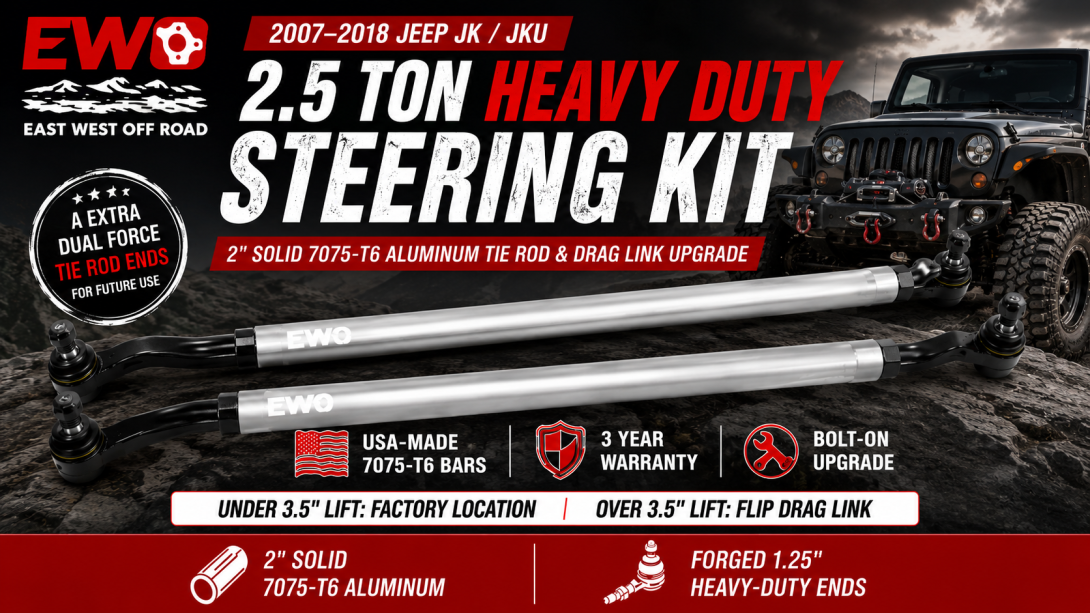
A 2.5 ton Jeep steering kit is an upgrade worth considering when your Jeep Wrangler JK or JKU needs a more substantial steering linkage system for larger tires, challenging trails, or a modified suspension setup. Whether you drive your Wrangler daily, spend weekends rock crawling, or are preparing for a complete off-road build, the tie rod and drag link are essential components that deserve careful attention.
For owners of 2007–2018 Jeep Wrangler JK and JKU models, aftermarket steering options range from factory-style replacement parts to heavy-duty 1-ton and 2.5-ton steering systems.
But what makes a 2.5-ton steering kit different? Is it always better than a 1-ton option? And how do you determine whether a 7075 aluminum tie rod and drag link package is the right choice for your Jeep?
This guide explains the differences, explores common applications, and helps you make a well-informed purchasing decision.
What Is a 2.5 Ton Jeep Steering Kit?
A 2.5-ton Jeep steering kit is an aftermarket steering linkage package generally marketed for heavy-duty applications.
Depending on the manufacturer, these kits may feature larger steering bars, upgraded tie rod ends, and components designed for modified vehicles.
For a Jeep Wrangler JK or JKU, a complete package typically focuses on two major steering components.
Heavy-Duty Tie Rod
The tie rod connects the front steering knuckles, coordinating their movement so the front wheels turn together.
It also allows adjustment of front-wheel toe alignment.
During off-road driving, the tie rod may be exposed to rocks, uneven terrain, and other obstacles.
Damage or excessive wear can affect vehicle handling and alignment.
Heavy-Duty Drag Link
The drag link transfers steering movement from the pitman arm toward the steering knuckle.
Its configuration influences steering-wheel centering and must work properly with the vehicle's suspension geometry.
Together, the tie rod and drag link form critical parts of the Jeep's steering linkage.
A complete kit addresses both components rather than focusing on a single replacement.
What Does the 2.5-Ton Rating Actually Mean?
The term 2.5 ton is an aftermarket product-category description.
It does not mean the Jeep can safely carry an additional 2.5 tons.
Installing a larger steering linkage does not increase:
- Gross vehicle weight rating (GVWR)
- Axle weight ratings
- Payload capacity
- Towing capacity
Those ratings depend on the vehicle and its approved components.
When shopping for steering upgrades, compare the actual materials, component dimensions, joint design, fitment, and installation requirements rather than relying on the tonnage label alone.
1 Ton vs. 2.5 Ton Jeep Steering Kit: What's the Difference?
One of the biggest questions among Wrangler owners is whether they should choose a 1-ton or 2.5-ton steering package.
Both categories are popular in the off-road aftermarket, but there is no universal construction standard that every manufacturer follows.
A product described as a 2.5-ton kit may use a different steering bar, joint design, or mounting arrangement from another brand's kit with the same name.
General Comparison
Feature
1-Ton Steering Kit
2.5-Ton Steering Kit
Typical market position
Heavy-duty steering replacement or upgrade
More substantial heavy-duty steering option
Intended buyers
Modified daily drivers and trail vehicles
More demanding or extensively modified builds
Tie rod and drag link
Depends on kit configuration
Often offered as a complete package
Materials
Steel or aluminum, depending on product
Steel or aluminum, depending on product
Joint design
Manufacturer-specific
Manufacturer-specific
Lift compatibility
Requires individual verification
Requires individual verification
Installation
Depends on vehicle and kit
Depends on vehicle and kit
The 2.5-ton category is often attractive to Jeep owners seeking a more substantial steering system.
However, a correctly engineered and installed 1-ton package can be appropriate for many vehicles.
When Is a 1-Ton Kit Worth Considering?
A 1-ton steering upgrade may suit a Jeep that sees daily highway use, moderate off-road trails, and occasional difficult terrain.
It can also be worth considering when the factory steering components need replacement and the owner wants a heavy-duty alternative.
When Does a 2.5-Ton Kit Make More Sense?
A 2.5-ton steering system may deserve consideration when a Wrangler has larger tires, extensive suspension modifications, regular exposure to rocky obstacles, or a history of damaged steering linkage.
In those situations, the overall design and compatibility of the replacement system become particularly important.
Neither category should be selected without considering the actual vehicle configuration.
Why 7075 Aluminum Is Used in Heavy-Duty Jeep Steering
Aluminum steering components have become a familiar option in the off-road aftermarket.
Many manufacturers offer steering bars made from high-strength aluminum alloys, including 7075.
For buyers comparing a 7075 aluminum tie rod Jeep JK upgrade, understanding the material's role is useful.
What Is 7075 Aluminum?
7075 is an aluminum alloy known for its high strength relative to many commonly used aluminum alloys.
It is used in applications where material strength and weight are important engineering considerations.
In steering-linkage products, the final performance depends on more than the alloy name.
Important factors include the material condition, bar dimensions, joint connections, mechanical design, and manufacturing quality.
Why Do Some Off-Road Builders Prefer Aluminum Steering Bars?
Some manufacturers design aluminum steering bars to allow a degree of elastic deflection under certain loads.
This can be useful in steering systems intended to experience off-road impacts.
However, the amount of elastic deformation and ability to recover depend on the actual part design and loading conditions.
Aluminum is not immune to permanent bending, cracking, fatigue, or other damage.
Any steering component that has sustained a significant impact should be inspected carefully.
7075 Aluminum vs. 7075-T6
These terms are related but are not identical.
7075 describes an aluminum alloy.
T6 describes a specific temper condition.
A product advertised as 7075 aluminum should not automatically be described as 7075-T6 unless the manufacturer confirms that specification.
The same principle applies to claims about bar diameter, forged steering ends, or specific steel alloys used in joints.
Product-specific documentation is more reliable than assumptions based on competing products.
Which Jeep JK Builds Benefit Most From Heavy-Duty Steering?
Not every Wrangler has the same steering requirements.
The best upgrade depends on how the vehicle is configured and used.
Daily-Driven Jeep Wrangler JK
A mostly stock Jeep used primarily for commuting may not require the same steering components as a dedicated trail vehicle.
If the factory linkage is worn, replacement may be appropriate.
The right choice depends on the vehicle's condition, driving requirements, and available replacement options.
Lifted Jeep JK With Larger Tires
Suspension lifts and larger tires are common Wrangler modifications.
These changes can affect steering geometry, available clearance, and loads experienced by steering components.
A heavy duty steering kit for lifted Jeep JK applications should be evaluated alongside the front axle, wheels, track bar, and suspension system.
A larger steering bar alone does not guarantee that the complete setup will work correctly.
Jeep JKU Used for Overlanding
A four-door Wrangler Unlimited may be used for long highway trips combined with remote trails.
Owners often prioritize predictable road handling, serviceability, and dependable components.
A heavy-duty steering upgrade may be part of a broader maintenance or vehicle-preparation plan.
However, replacing the tie rod and drag link does not eliminate the need to maintain other steering and suspension components.
Jeep JK Used for Rock Crawling
Rock crawling can expose steering linkage to direct contact with obstacles.
A heavy duty steering kit for rock crawling Jeep JK builds should be chosen based on clearance, component design, compatibility, and the types of terrain encountered.
Regular inspections are particularly important for vehicles used in demanding off-road conditions.
East West Off Road 2.5 Ton Jeep JK/JKU Steering Kit
East West Off Road offers a dedicated steering package listed as:
2.5 TON JEEP JK / JKU HEAVY DUTY 7075 ALUMINUM TIE ROD & DRAG LINK STEERING KIT FOR 2007–2018
The product is identified as E35115 in available East West Off Road product information.
Its main advertised characteristics include:
- Application for 2007–2018 Jeep Wrangler JK and JKU models
- Heavy-duty tie rod and drag link package
- 7075 aluminum steering links
- Factory-location and flip-style steering configurations described in published product information
The correct configuration should be selected based on the specific Jeep, suspension setup, and current manufacturer instructions.
If you're considering a 2.5 ton Jeep steering kit, review the product listing and verify all compatibility requirements before ordering.
Factory Location vs. Flip Drag Link: Choosing the Correct Option
One of the most important decisions when buying a steering kit for a lifted Jeep JK is selecting the drag-link mounting position.
Factory Location / Under the Knuckle
A factory-location configuration generally retains the drag-link connection in the original under-the-knuckle position.
Published East West Off Road information for its E35115 package describes this option for Jeeps with 3.5 inches of lift or less.
This configuration may be appropriate for builds where the existing steering geometry is intended to remain closer to the factory arrangement.
Actual compatibility must still be verified.
Flip Kit / Over the Knuckle
A flip drag-link configuration changes the connection position at the steering knuckle.
Published EWO information describes its flip option for lifts over 3.5 inches.
This arrangement is often considered for taller lifted Jeep JK and JKU applications.
However, moving the drag-link mounting position changes steering geometry.
The relationship between the drag link and track bar must be reviewed together.
Why the Track Bar Matters
The track bar locates the front axle laterally beneath the vehicle.
As the suspension moves, the track bar and drag link follow their respective movement arcs.
If their geometry is poorly matched, unwanted steering behavior may occur.
For this reason, selecting a flip drag link based solely on suspension lift height can be a mistake.
Always verify the manufacturer's requirements for the complete setup.
How Steering Geometry Affects Jeep Handling
A steering kit can use high-quality materials and still perform poorly if it is installed with incorrect geometry.
Steering linkage must function properly throughout normal driving and suspension movement.
Toe Alignment
Toe describes the direction the front wheels point relative to one another when viewed from above.
Tie-rod adjustment influences toe.
Incorrect toe settings can contribute to tire wear, poor handling, or unusual steering response.
Steering-Wheel Centering
Drag-link adjustment is generally involved in centering the steering wheel after changes to the steering system.
The exact procedure depends on the installed components.
Suspension Travel
Steering links must maintain appropriate clearance throughout suspension movement.
Checking only the vehicle at normal ride height may miss interference that occurs during compression, droop, or full steering lock.
Steering Stabilizer Compatibility
Some aftermarket steering systems change the available mounting space or require different stabilizer hardware.
Confirm whether the existing steering stabilizer, bracket, and clamps are compatible with the chosen package.
Is a 2.5 Ton Jeep Steering Kit Worth the Investment?
The value of a steering upgrade depends on the needs of the vehicle and the total cost of installation.
A heavy-duty kit can be appealing when it addresses worn components or supports a planned off-road build.
However, buyers should evaluate more than the advertised price.
Consider the Complete Cost
A steering upgrade may involve:
- Tie rod and drag link components
- Required installation hardware
- Optional drag-link configuration parts
- Professional installation
- Alignment
- Additional geometry corrections where necessary
- Replacement components and future maintenance
The least expensive steering kit is not always the least expensive completed installation.
Evaluate Replacement-Part Availability
For a regularly driven Jeep, long-term service support matters.
Before purchasing, ask whether compatible replacement tie rod ends and other service components can be purchased separately.
Verify whether special tools or procedures are required.
Review Warranty Terms Carefully
Steering manufacturers may offer different warranty policies for bars, joints, finishes, and associated hardware.
A warranty advertised by one manufacturer does not automatically apply to another.
Check the written warranty terms for the exact steering kit being purchased.
Consider Future Vehicle Modifications
If you plan to change axles, wheels, or suspension height in the near future, factor those changes into the purchasing decision.
A steering kit selected for the current configuration may not remain compatible after extensive modifications.
Five Questions to Ask Before Ordering a 2.5-Ton Steering Kit
A little research before checkout can prevent expensive installation problems.
1. Will This Kit Fit My Exact Front Axle?
Confirm whether the Jeep retains its factory axle and steering knuckles.
Aftermarket axles or custom knuckles may introduce additional requirements.
2. Is the Kit Compatible With My Suspension Lift?
Record the installed lift height and current steering configuration.
Select the manufacturer's appropriate factory-location or flip option.
3. Will the Steering Components Clear My Wheels?
Check wheel backspacing, wheel diameter, tire size, differential-cover clearance, and nearby suspension parts.
Larger aftermarket joints may require additional room.
4. What Components Are Included?
Confirm whether the current package includes both major links, the appropriate steering ends, required hardware, and any advertised spare parts.
Do not assume accessories are included without checking the listing.
5. What Professional Installation Work Is Required?
Ask about alignment, clearance checks, required modifications, and any installation restrictions.
A complete steering replacement should be planned as a safety-critical mechanical job.
Why Bigger Steering Components Are Not Always Better
It is tempting to compare steering kits solely by the diameter of their aluminum bars or the size of the tie rod ends.
However, steering-linkage design is more complicated.
A larger bar may offer a different mechanical profile, but it can also require more installation space.
An oversized steering end may create clearance problems near the wheel.
A drag-link configuration that works well on one lifted Jeep may not be appropriate for another.
The correct combination of design, dimensions, material, and geometry matters more than a single impressive specification.
This is why buyers should compare complete steering systems rather than isolated marketing claims.
Buying a Complete Jeep JK Tie Rod and Drag Link Upgrade
For owners replacing both major steering links, purchasing a matched package may simplify component selection.
It also creates an opportunity to inspect the rest of the steering system.
A replacement or upgrade should be considered alongside the condition of:
- Track-bar joints and bushings
- Front ball joints
- Steering box and mounting hardware
- Wheel bearings
- Front axle components
- Tires and wheels
- Suspension bushings
- Existing steering stabilizer
Worn parts elsewhere can continue to affect steering behavior even after a new linkage kit is installed.
A complete Jeep JK heavy duty steering kit is best treated as part of a properly planned front-end upgrade rather than a guaranteed solution to every steering problem.
Can a 2.5-Ton Steering Kit Fix Jeep Death Wobble?
This is an important question because severe steering oscillation is a concern among some Wrangler owners.
Death wobble can involve multiple parts of the front suspension and steering system.
Possible contributing factors include worn joints, loose mounting components, track-bar problems, damaged suspension parts, and alignment-related issues.
Replacing worn steering linkage may address an identified problem, but a new 2.5-ton steering kit is not a guaranteed cure.
A qualified technician should inspect the complete front end to determine the underlying cause.
Driving with severe steering instability can be dangerous and should not be ignored.
Installation and Maintenance Tips for Heavy-Duty Jeep Steering
Proper installation is as important as choosing the right parts.
Follow the Manufacturer's Instructions
Use the installation procedures and fastener specifications supplied for the exact kit.
Do not substitute torque values or modification instructions from an unrelated product.
Inspect Steering Clearance
Check the complete steering range and appropriate suspension travel.
Ensure that the linkage does not contact the wheels, differential cover, suspension components, or other hardware.
Have the Jeep Professionally Aligned
A qualified shop should inspect the completed assembly, set the required alignment measurements, and verify steering-wheel centering.
Replacing major steering components without checking alignment is not recommended.
Perform Regular Inspections
Inspect steering components after significant impacts and according to the manufacturer's maintenance schedule.
Look for unusual joint movement, damaged boots, loose hardware, or visible component damage.
If a problem is suspected, have the vehicle inspected before continued use.
Where to Buy a 2.5 Ton Jeep Steering Kit for 2007–2018 JK/JKU
Jeep owners shopping for a 2.5 ton steering kit for sale should compare actual vehicle fitment, product specifications, package contents, installation requirements, and service support.
East West Off Road offers its 2.5-ton 7075 aluminum tie rod and drag link package for 2007–2018 Jeep Wrangler JK and JKU applications.
The product is intended for buyers seeking a complete heavy-duty steering linkage option.
Before ordering, confirm your exact front axle, suspension lift, steering mounting location, and any modifications that could affect fitment.
You can shop Jeep JKU tie rod and drag link kit options through the East West Off Road product listing and review the available configuration before checkout.
Final Verdict: Is a 2.5-Ton Steering Upgrade Right for You?
A 2.5 ton Jeep steering kit can be a worthwhile option for Wrangler JK and JKU owners planning a substantial steering linkage upgrade.
It may be especially relevant for modified Jeeps running larger tires, suspension lifts, or regularly encountering demanding off-road conditions.
However, the best steering upgrade is not necessarily the one advertised with the largest dimensions or highest tonnage label.
The right product should have documented specifications, verified vehicle compatibility, appropriate steering geometry, and access to replacement parts.
For owners considering a 2007–2018 Jeep JK or JKU upgrade, the East West Off Road 7075 aluminum steering package provides a product worth evaluating against those requirements.
Confirm the configuration, plan for professional installation, and prioritize safe, predictable steering performance on and off the road.
Frequently Asked Questions (FAQs)
What Does a 2.5 Ton Jeep Steering Kit Do?
A 2.5-ton steering kit generally replaces or upgrades major steering linkage components, often including the tie rod and drag link.
It is marketed as a heavy-duty steering option, but actual capabilities depend on the specific product.
Is a 2.5 Ton Steering Kit Better Than a 1 Ton Kit?
Not automatically.
Different manufacturers use different materials, dimensions, and joint designs.
A correctly matched 1-ton kit may work well for one Jeep, while a 2.5-ton package may be more appropriate for another.
Will a 2.5 Ton Jeep Steering Kit Fit a 2007–2018 Wrangler JK?
Some 2.5-ton aftermarket steering products, including East West Off Road's E35115 package, are marketed for 2007–2018 Jeep JK and JKU applications.
Final fitment depends on the actual axle, steering knuckles, suspension lift, and other modifications.
Is 7075 Aluminum Good for Jeep Steering?
7075 is a high-strength aluminum alloy used in certain aftermarket steering systems.
Its suitability depends on the complete component design, manufacturer specifications, and intended application.
The alloy name alone does not guarantee a particular level of performance.
Does a 2.5 Ton Jeep Steering Kit Include a Drag Link?
Many complete packages include both the tie rod and drag link.
However, kit contents vary, so buyers should verify the exact components listed by the seller.
What Is the Difference Between Factory-Location and Flip Drag Links?
Factory-location configurations generally retain the original under-the-knuckle mounting arrangement.
Flip configurations change the drag-link attachment to an over-the-knuckle position.
The correct choice depends on the specific kit and complete suspension geometry.
Do I Need a 2.5 Ton Steering Kit for 35-Inch or 37-Inch Tires?
Tire size alone does not determine the correct steering kit.
Wheel specifications, vehicle use, axle configuration, lift height, clearance, and overall steering condition are also important.
Can a 2.5 Ton Steering Kit Fix Death Wobble?
It may address damaged steering linkage when that linkage is contributing to the problem, but it cannot guarantee a repair.
Death wobble requires a complete inspection of the front suspension and steering system.
Does a 2.5 Ton Steering Kit Require Alignment?
Yes. After replacing major steering linkage components, professional alignment and steering-wheel centering should be checked.
The technician should also verify component clearance and proper operation.
Where Can I Buy a 2.5 Ton Jeep Steering Kit?
East West Off Road offers a heavy-duty 7075 aluminum tie rod and drag link steering kit for 2007–2018 Jeep Wrangler JK and JKU applications.
Review the current listing, verify your vehicle's configuration, and confirm all installation requirements before placing an order.