

A 14 bolt full float brake kit is a practical upgrade for Chevy and GMC truck owners looking to replace their original rear drum brakes with a modern disc brake system. Whether you're restoring a classic square-body truck, building a heavy-duty off-road rig, or installing a GM 14-bolt rear axle in a custom 4x4, a properly selected disc conversion can make brake maintenance easier and provide a more service-friendly rear braking setup.
The GM 14-bolt full-float rear axle is a popular choice for older 3/4-ton and 1-ton trucks. Its substantial hub, bearing, and axle-shaft construction also makes it a common choice for off-road builds and axle swaps.
However, the original drum brake assemblies on many older 14-bolt axles can be heavy and time-consuming to service.
Replacing worn shoes, wheel cylinders, adjusters, and springs is not always a simple job—especially when dealing with decades-old components.
A rear disc brake conversion provides an alternative.
But choosing the right kit requires careful attention to the axle itself.
A GM 14-bolt full-float axle is not the same as a semi-float axle, and a single-rear-wheel (SRW) hub is not interchangeable with every dually or cab-and-chassis configuration.
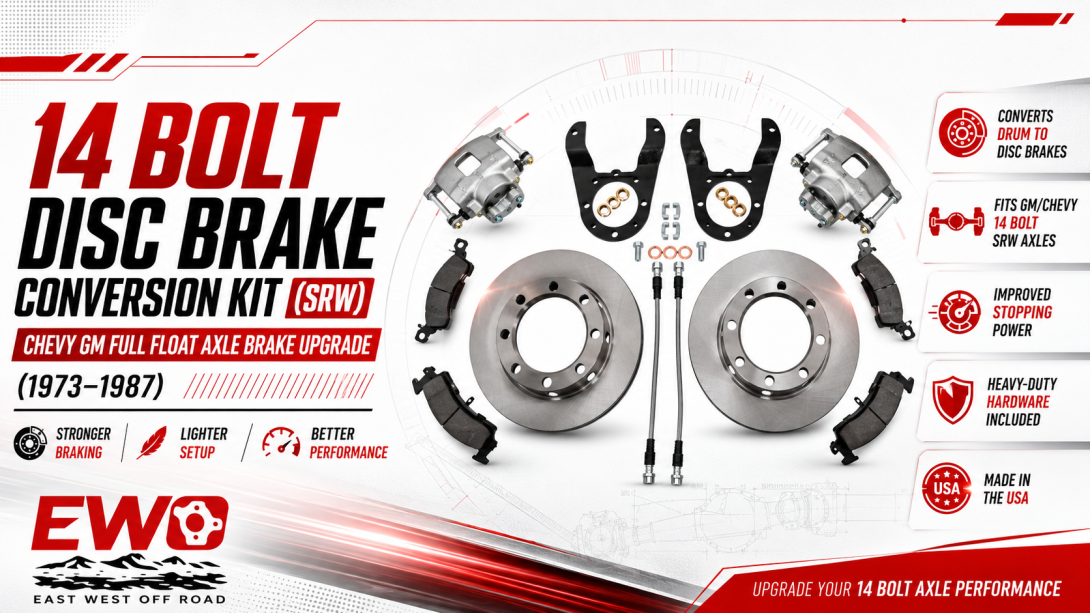
For compatible 1973–1987 Chevy/GM applications, East West Off Road offers its 14 Bolt Disc Brake Conversion Kit (SRW), product number E1877.
This kit includes the main components required to replace the original rear drum arrangement with disc brakes, including heavy-duty brackets, rotors, calipers, pads, hydraulic hoses, and mounting hardware.
In this guide, we'll explore how full-float axles work, why axle identification matters, how to confirm brake conversion fitment, and what to consider before upgrading your Chevy or GMC rear brakes.
What Is a 14-Bolt Full-Float Brake Kit?
A 14-bolt full-float brake kit is a brake conversion package designed for a compatible GM 14-bolt full-floating rear axle.
In a traditional drum-brake arrangement, hydraulic wheel cylinders push brake shoes against the inside of a rotating drum.
A disc brake conversion replaces those friction components with rotors and calipers.
When the driver presses the brake pedal, hydraulic pressure moves the caliper pistons, pressing the pads against the brake rotors.
What Components Are Needed for a Disc Conversion?
A typical complete rear disc brake conversion requires:
- Caliper mounting brackets.
- Compatible disc brake rotors.
- Brake calipers.
- Brake pads.
- Hydraulic brake hoses.
- Appropriate mounting hardware.
- Compatible brake line connections.
Depending on the vehicle, additional parking-brake, hydraulic balance, or wheel-stud components may also be necessary.
What Makes This Different From a Basic Brake Repair?
A drum brake repair restores the original braking system.
A disc brake conversion changes the mechanical braking arrangement and may alter its hydraulic requirements.
That means a conversion should be planned as a complete system rather than treated as a direct replacement of one worn part.
Is Every 14-Bolt Brake Kit the Same?
No.
The GM 14-bolt axle family includes several configurations with different hubs and brake mounting arrangements.
A conversion designed for one version may not fit another.
The correct kit depends on the actual axle rather than the differential cover or vehicle model alone.
Understanding the GM 14-Bolt Full-Float Rear Axle
Before shopping for a conversion kit, it helps to understand why the full-float axle design matters.
A full-floating rear axle uses a hub-and-bearing arrangement that supports the wheel load separately from the axle shaft's main job of transmitting driving torque.
This differs from a semi-floating axle.
How a Full-Float Axle Works
In a full-float axle, the hub rotates on bearings supported by the axle housing spindle.
The axle shaft transfers torque from the differential to the hub.
Because the hub and bearing assembly supports the wheel, the axle shaft is not required to carry the wheel load in the same way as a semi-float design.
How to Recognize a Full-Float Hub
One common identifying feature is a removable axle-shaft flange at the center of the wheel hub.
Depending on the hub design, the axle-shaft flange is secured with multiple fasteners.
This is a useful identification clue, but it should not be the only check.
A qualified technician can confirm the exact axle arrangement.
What Is a Semi-Float Axle?
A semi-floating axle uses a different bearing and axle-shaft arrangement.
The axle shaft participates in supporting wheel loads while also transferring driving torque.
Because of these mechanical differences, the wheel-end and brake mounting configurations are not identical.
Full-Float vs. Semi-Float Comparison
Feature
Full-Float 14-Bolt
Semi-Float 14-Bolt
Wheel support
Hub and bearing assembly
Axle shaft participates in wheel-load support
Axle-shaft function
Primarily transfers torque
Transfers torque and supports some wheel loading
Hub design
Full-floating hub
Semi-floating arrangement
Brake mounting
Full-float application-specific
Semi-float application-specific
EWO E1877 compatibility
Specific SRW version only
Not compatible
Identification
Inspect hub and axle construction
Inspect axle construction
The EWO E1877 is intended for the specified full-float arrangement.
It should not be purchased for a semi-floating axle simply because both are described as GM 14-bolt rear ends.
Why Convert a Full-Float 14-Bolt Axle From Drums to Discs?
Many older GM trucks still use their original rear drum brakes.
When properly maintained, drum brakes can serve their intended function.
However, a disc conversion may provide several practical benefits.
Easier Brake Pad and Rotor Inspection
Disc brake pads and rotor surfaces are generally more accessible than the internal components of drum brakes.
This can make regular inspection more convenient.
Owners who frequently maintain their trucks after off-road trips may find the change useful.
Simplified Friction-Component Service
A drum brake assembly contains shoes, springs, adjusters, and wheel cylinders.
Replacing these components can require more disassembly than servicing many disc brake systems.
A correctly installed disc system typically makes pad replacement and inspection more straightforward.
Potential Reduction in Brake Assembly Weight
Large full-float drum assemblies are substantial.
A disc conversion may reduce the weight of the brake components.
However, the actual difference depends on the specific drums, brackets, calipers, and rotors being compared.
Do not assume a fixed weight reduction for every axle.
Brake Heat Management
Disc brakes can offer favorable heat-management characteristics in properly designed systems.
However, the actual results depend on rotor design, friction materials, hydraulic components, tire grip, and vehicle weight.
A rear disc conversion does not automatically guarantee a shorter stopping distance.
Easier Maintenance After Trail Use
Off-road vehicles may expose braking components to mud, water, and debris.
Disc brakes can be easier to inspect and clean after certain conditions.
They still require maintenance, particularly when exposed to contamination or corrosion.
East West Off Road 14-Bolt Full-Float Disc Brake Conversion Kit
East West Off Road offers the 14 Bolt Disc Brake Conversion Kit (SRW) for Chevy/GM Full Float Axles (1973–1987).
Product number E1877 is designed for compatible older GM single-rear-wheel, full-floating rear axles.
EWO E1877 Specifications
Specification
Product Details
Product Name
14 Bolt Disc Brake Conversion Kit (SRW)
Brand
East West Off Road
Product Number
E1877
Axle Family
GM/Chevy 14-bolt
Axle Construction
Full-float
Wheel Configuration
Single rear wheel (SRW)
Intended Axle Years
1973–1987
Original Brake Type
Behind-the-hub drum
New Brake Configuration
Rear disc brakes
Mounting Brackets
Two 3/8-inch-thick brackets
Mounting Hardware
Grade 8 hardware
Caliper Hydraulic Connection
10 mm banjo connection for standard calipers
Hydraulic Hose Connection
3/8"-24 inverted flare
Optional Parking-Brake Calipers
Available
Optional Steel-Braided Hoses
Available
Country of Manufacture
USA
The kit is intended for a specific axle configuration.
Before ordering, verify the hub type, mounting measurements, original drum arrangement, and wheel clearance.
Why Choose a Complete Conversion Kit?
A complete package can simplify component sourcing.
Instead of purchasing caliper brackets and separately identifying matching rotors, pads, and hydraulic hoses, the major components are selected for the intended application.
However, vehicle-specific changes may still be necessary.
These can include parking-brake connections, wheel-stud replacement, brake-line modifications, or hydraulic brake-balance adjustments.
For owners considering a 14 bolt disc brake conversion kit, confirming the full-float SRW axle configuration is the first step toward selecting the right package.
What Comes With the EWO 14-Bolt Full-Float Brake Kit?
The supplied product specifications identify the main components required to convert both sides of the compatible rear axle.
Complete Kit Components
Component
Quantity
Description
Disc brake brackets
2
Heavy-duty 3/8-inch mounting brackets
Bracket hardware
Set
Grade 8 mounting hardware
Brake calipers
2
Calipers in the selected configuration
Brake rotors
2
Compatible behind-the-hub rotors
Brake pads
4
Two pads for each rear caliper
Hydraulic brake hoses
2
3/8"-24 inverted-flare connection
Brake line clips
2
For securing brake-line routing
Caliper and hose options
As selected
Optional parking-brake and braided-hose configurations
Always confirm the current package contents and selected configuration before beginning installation.
Heavy-Duty Caliper Mounting Brackets
The brackets establish the position of the brake calipers relative to the rotors.
The EWO kit uses 3/8-inch-thick brackets and Grade 8 hardware.
Correct bracket placement is essential because caliper alignment affects rotor clearance and pad contact.
Brake Rotors
The kit includes two rotors for the intended behind-the-hub arrangement.
The rotor mounting design is an important fitment detail.
Do not assume a rotor intended for a different 14-bolt hub arrangement will fit.
Brake Calipers
Two calipers are included in the selected package.
The standard caliper configuration uses the specified 10 mm banjo hydraulic connection.
If you choose an optional parking-brake caliper, confirm its exact fittings and any required additional hardware.
Brake Pads
Four brake pads are included.
Future replacement pads should be selected based on the specific calipers installed.
Hydraulic Hoses
The package includes hydraulic brake hoses and clips.
The supplied specifications identify 3/8"-24 inverted-flare hose connections.
Correct hose length, routing, and attachment are important for safe operation.
The Most Important Fitment Check: SRW, DRW, and Cab-and-Chassis Hubs
One of the biggest mistakes when shopping for a full-float brake conversion is assuming every full-floating 14-bolt axle uses identical hubs.
They do not.
Standard Single-Rear-Wheel (SRW) Hubs
The EWO E1877 is intended for a specific standard single-rear-wheel hub configuration.
These hubs position the wheel and brake components according to the intended axle design.
Dual-Rear-Wheel (DRW) Hubs
Dually hubs are designed for dual rear wheels.
Their mounting offset and physical arrangement can differ from standard SRW hubs.
The EWO E1877 does not fit dually hubs.
Cab-and-Chassis Hubs
Some cab-and-chassis axles use different hub geometry from standard pickup axles.
A cab-and-chassis axle may be installed in an off-road vehicle with only one rear wheel per side.
That does not automatically make the hubs standard SRW components.
Why Current Wheel Configuration Can Be Misleading
A truck may have been modified by a previous owner.
Wheel adapters, axle swaps, and hub changes can make identification less obvious.
The fact that your truck currently runs single rear wheels does not establish that its axle has the hubs required by EWO E1877.
Hub Configuration Comparison
Axle/Hub Setup
EWO E1877 Fitment
Standard 1973–1987 SRW full-float, behind-the-hub drums
Intended application, subject to dimensions
Dually hubs
Not compatible
Cab-and-chassis hubs
Not established; verify separately
Semi-float axle
Not compatible
Later slip-over drum full-float axle
Not compatible
Modified or unknown full-float axle
Identify and measure first
Behind-the-Hub vs. Slip-Over Drums
A full-float axle's original drum arrangement is another major factor in kit selection.
Behind-the-Hub Drum Arrangement
The EWO E1877 is designed for axles where the original drum mounts behind the wheel hub.
In this arrangement, the wheel-end construction determines the rotor mounting position.
Hub service may be involved during removal of the original drum assembly.
Slip-Over Drum Arrangement
A slip-over drum fits over the wheel studs from the outside of the hub.
This differs from a drum mounted behind the hub.
Some later axle configurations use this arrangement.
Why the Two Designs Are Not Interchangeable
A conversion bracket must position the caliper around the rotor correctly.
If the rotor is mounted differently, the caliper and bracket may not line up.
This can create interference, incorrect pad contact, or unsafe operation.
The EWO E1877 is not designed for slip-over drum configurations.
Quick Identification Guide
Feature
Behind-the-Hub
Slip-Over
Drum location
Behind hub
Outside hub over studs
Hub service during drum removal
May be required
Often less involved
EWO E1877
Intended style
Not compatible
Buying consideration
Verify dimensions
Select a compatible alternative
Before purchasing, identify the actual original brake arrangement.
The axle's appearance from outside the wheel is not always enough to establish fitment.
The 4-11/16-Inch Measurement Explained
One of the most important fitment specifications for EWO E1877 is the distance between the brake mounting flange and the hub face.
The kit specifies approximately 4-11/16 inches.
Why Is This Measurement Important?
The distance helps determine whether the caliper mounting bracket will position the caliper correctly relative to the rotor.
Different hubs can place the rotor at different locations.
A bracket designed for one hub arrangement may not work with another.
Where Should You Measure?
The manufacturer's guidance refers to the relevant four-bolt caliper bracket mounting flange and hub face.
Because measuring from an incorrect surface can produce a misleading result, confirm the exact reference surfaces in the kit's instructions or with EWO before using the dimension to determine compatibility.
What If Your Measurement Is Different?
Do not assume a spacer or improvised bracket modification will resolve the difference.
A different measurement may indicate another hub type or axle configuration.
Contact the manufacturer with your axle details before ordering.
Why This Matters on Axle Swaps
A GM 14-bolt axle may be installed under a different truck, Jeep, or custom off-road vehicle.
The recipient vehicle's model year does not change the axle's mounting dimensions.
The physical axle measurements should determine which conversion kit is appropriate.
Full-Float Brake Kit Compatibility by Vehicle
The EWO kit is associated with compatible 1973–1987 Chevy/GM 3/4-ton and 1-ton truck axle applications.
However, the installed axle must be identified before purchasing.
Chevy K20 and C20
Some older K20 and C20 trucks use full-float GM rear axles.
If equipped with the specified 14-bolt SRW axle, they may be appropriate candidates for the EWO conversion.
However, not every truck has the same axle.
Chevy K30 and C30
One-ton trucks may use different hub configurations depending on their original equipment.
SRW and dually versions require different fitment considerations.
The EWO product is not intended for dually hubs.
GMC 2500 and 3500 Trucks
Compatible GMC applications may use the same GM axle family.
The correct kit still depends on the actual installed axle and hubs.
Square-Body Chevy Restorations
A square-body truck restoration can involve original axles or components from different model years.
When prior modifications are unknown, inspect the wheel hubs and brake mounting arrangement rather than relying on the vehicle identification.
Custom 4x4 Axle Swaps
A 14-bolt axle may be installed in a Jeep, trail buggy, or custom truck.
The EWO conversion may be considered if the axle itself matches its stated specifications.
The recipient vehicle's hydraulic braking system and parking brake must also be evaluated.
Wheel Diameter and Backspacing Requirements
A full-float disc brake conversion changes the space occupied by the brake components.
A wheel that originally cleared the drum assembly may not clear the new caliper.
15-Inch Steel Wheel Requirements
The EWO kit specifies 15-inch steel wheels with 4 inches of backspacing or less.
The actual wheel must still provide adequate caliper clearance.
Larger Aluminum Wheels
Larger aluminum wheels are listed as an option.
However, the inner-barrel shape, spoke clearance, and backspacing vary among wheel designs.
An advertised wheel diameter does not guarantee fitment.
How Backspacing Affects Brake Clearance
Backspacing is the distance from the wheel's mounting surface to its inner edge.
It helps determine how far the wheel extends inward.
Excessive inward positioning may interfere with the caliper.
Wheel Fitment Checklist
Before installing the wheels, verify:
- Caliper-to-wheel-barrel clearance.
- Clearance around the hydraulic hose connection.
- Caliper bracket and fastener clearance.
- Appropriate wheel-stud engagement.
- No interference with brake components.
Do not assume wheel spacers are a universal solution for an incompatible wheel-and-brake combination.
Rotor and Wheel Stud Fitment
The relationship between the rotor, hub, and wheel studs is important in a behind-the-hub conversion.
Wheel Studs Must Fit Freely Through the Rotor
EWO specifies that the wheel studs must pass freely through the rotor holes.
The rotor should not be press-fitted onto the studs.
What If the Wheel Studs Are Too Large?
The product notes indicate that oversized studs may require drilling of the rotor holes.
Any machining should follow the manufacturer's approved instructions and specifications.
Do not enlarge rotor holes by guesswork.
Minimum Lug Nut Engagement
The supplied installation requirements specify at least 5/8 inch of lug nut engagement.
The complete wheel, stud, and lug nut assembly must also satisfy all other applicable hardware requirements.
What If Existing Studs Are Too Short?
Some combinations of wheels and rotors may reduce the available stud engagement.
Compatible longer wheel studs may be required.
The correct studs should be selected according to the hub, wheel, and conversion kit.
Inspect Hub Components During Service
A conversion involving the full-float wheel hub provides an opportunity to inspect bearings, seals, and associated components.
Any worn or damaged parts should be repaired before the truck returns to service.
Parking Brake Options for a 14-Bolt Full-Float Disc Conversion
A parking-brake plan is an essential part of converting rear drums to discs.
Many drum brake assemblies include mechanical parking-brake components.
Removing the drum assembly can also remove the original parking-brake function.
Standard Hydraulic Calipers
Standard rear disc calipers may not include an integrated mechanical parking brake.
They provide braking through hydraulic pressure but do not automatically secure the vehicle when parked.
Parking-Brake Caliper Option
The EWO E1877 product page offers a parking-brake caliper upgrade selection.
This option should be considered when the vehicle needs an appropriate mechanical parking brake.
Will Factory Parking-Brake Cables Work?
Not necessarily.
Depending on the truck and selected calipers, additional cables, brackets, adapters, or adjustments may be required.
Verify the complete parking-brake connection before purchasing.
Why Parking-Brake Function Matters
A parking brake helps secure a stationary vehicle independently of the normal service-brake hydraulics.
A functional parking brake may also be required by applicable road-use and inspection regulations.
Never assume a hydraulic service-brake system replaces the need for a mechanical parking-brake solution.
Hydraulic Brake Balance After a Full-Float Disc Conversion
The mechanical conversion is only part of the project.
Changing rear drum brakes to discs may affect the vehicle's hydraulic braking characteristics.
Understanding Brake Bias
Brake bias describes how braking force is distributed between the front and rear wheels.
The appropriate distribution depends on the vehicle's brake components, loading, tires, and other operating factors.
Why Brake Balance Can Change
Disc calipers and drum wheel cylinders may use different piston areas and hydraulic characteristics.
The friction materials and braking surfaces also differ.
These changes can affect how the front and rear brakes respond to pedal input.
Why EWO Recommends a Manual Proportioning Valve
The supplied product details recommend a manual proportioning valve to help establish proper brake balance.
An appropriate adjustable proportioning valve may help control rear brake pressure.
However, it must be selected and adjusted as part of the complete braking system.
A qualified brake technician should evaluate the setup.
What Happens if Rear Brakes Apply Too Much Force?
Excessive rear braking can contribute to premature rear-wheel lockup under certain conditions.
This can affect vehicle stability.
The complete converted system must be evaluated before normal road use.
Residual Pressure Valves and Rear Brake Drag
Older drum-brake systems may use residual-pressure valves that affect the hydraulic circuit.
What Is a Residual Pressure Valve?
A residual-pressure valve maintains a specified pressure in part of a brake system.
Its intended function depends on the particular hydraulic design.
Why Can a Drum-Specific Valve Cause Problems?
An incompatible residual-pressure arrangement may prevent new disc calipers from releasing fully.
This can contribute to brake drag and excessive heat.
Should Every Residual Valve Be Removed?
No.
The EWO instructions call for addressing residual pressure that would create drag in the converted rear brake circuit.
However, some hydraulic systems require different residual-pressure arrangements.
A qualified technician should identify the valve configuration before modifying it.
Do You Need a New Master Cylinder or Brake Booster?
Changing the rear brakes does not automatically mean every other brake component must be replaced.
However, hydraulic compatibility is essential.
Master Cylinder Compatibility
The master cylinder supplies hydraulic pressure and fluid displacement.
Its specifications must be appropriate for the complete braking system.
A rear disc conversion may require evaluation of the master cylinder's characteristics.
Brake Booster Considerations
The booster affects brake-pedal assist.
It does not replace the need for properly matched hydraulic components.
A stronger booster is not a universal solution for incorrect brake balance or fluid-volume requirements.
When Should Additional Components Be Replaced?
A master cylinder, booster, line, or valve may require replacement when defective or incompatible with the final configuration.
The correct decision should come from inspecting the complete system.
Standard vs. Steel-Braided Brake Hoses
The EWO product offers standard hydraulic hoses and an optional steel-braided hose selection.
Standard Brake Hoses
The supplied kit includes hydraulic hoses with the specified 3/8"-24 inverted-flare connections.
The standard calipers use 10 mm banjo connections.
Steel-Braided Hose Upgrade
Braided brake hoses can offer different expansion and durability characteristics depending on their construction.
However, correct routing and compatible fittings remain essential.
Hose Clearance
Brake hoses must remain clear of:
- Rotating wheels.
- Moving suspension components.
- Sharp edges.
- Excessive heat.
- Pinch points.
- Other potentially damaging surfaces.
If the axle is installed in a lifted or custom vehicle, hose routing must accommodate the intended suspension travel.
Complete Full-Float Brake Kit vs. Bracket-Only Conversion
Not every 14-bolt brake conversion product includes the same components.
Some products contain only caliper brackets, while others supply a more complete mechanical package.
Bracket-Only Conversion
A bracket-only kit provides mounting brackets.
The installer must separately source compatible rotors, calipers, pads, hoses, and hardware.
This may suit an experienced builder with a specific custom configuration.
Complete Disc Conversion Kit
A complete kit includes the primary brake components for its intended axle application.
This may simplify parts ordering.
Comparison
Factor
Complete Kit
Bracket-Only Kit
Caliper brackets
Included
Included
Rotors
Included
Separate purchase
Calipers
Included
Separate purchase
Pads
Included
Separate purchase
Hydraulic hoses
Included
Separate purchase
Parts sourcing
More coordinated
More individual research
Customization
Based on available product options
Greater component-selection responsibility
Best suited for
Compatible standard conversion
Experienced custom builds
For a compatible older GM axle, a complete 14 bolt SRW disc brake kit offers the convenience of a matched primary component package.
However, parking-brake and hydraulic-system requirements must still be addressed.
Installation Overview for a GM 14-Bolt Full-Float Brake Kit
Brake-system modifications are safety-critical.
The following overview is intended for planning rather than as a substitute for the manufacturer's detailed installation instructions.
Professional installation is recommended when the owner lacks experience with full-float hubs and hydraulic brakes.
Step 1: Confirm Exact Axle Compatibility
Verify the full-float axle configuration, SRW hubs, intended year range, drum mounting style, and bracket-to-hub-face measurement.
Do not begin the conversion with unresolved fitment questions.
Step 2: Inspect Existing Hub and Brake Components
Check wheel bearings, seals, studs, axle components, brake lines, and mounting surfaces.
Replace worn or damaged components as required.
Step 3: Remove the Original Drum Assembly
Follow the correct procedures for the installed axle.
Behind-the-hub drum removal may involve hub-related service.
Step 4: Verify Rotor and Stud Compatibility
Confirm the rotor mounting arrangement and the required free fit of the studs through the rotor holes.
Do not force incompatible components together.
Step 5: Install the Brake Mounting Brackets
Use the manufacturer's specified bracket positioning, hardware, and fastening requirements.
The brackets must locate the calipers correctly relative to the rotors.
Step 6: Install the Calipers and Pads
Follow the instructions for the selected caliper configuration.
Verify proper mounting and component clearance.
Step 7: Connect the Hydraulic Hoses
Install the correct hose connections and secure them according to the instructions.
Check the routing for potential interference.
Step 8: Complete Parking-Brake and Hydraulic Modifications
Address the parking-brake arrangement, brake proportioning, and residual-pressure requirements.
Additional components may be necessary.
Step 9: Bleed the Entire Brake System
EWO specifies a full system re-bleed.
Inspect the hydraulic connections for leaks and verify appropriate pedal function.
Step 10: Inspect and Test the Completed Brakes
Verify the mechanical connections, wheel clearance, wheel-stud engagement, and parking-brake operation.
A qualified technician should verify the completed system and perform appropriate controlled braking tests before normal road use.
Common Problems After a 14-Bolt Disc Conversion
Understanding common symptoms can help you recognize when a converted braking system needs further inspection.
Symptom
Possible Causes to Investigate
Soft brake pedal
Air, hydraulic leaks, incompatible components
Excessive pedal travel
Air, caliper or master cylinder mismatch, other faults
Rear brakes dragging
Residual pressure, caliper release, mechanical interference
Rear wheels locking early
Brake bias, traction, hydraulic configuration
Brake fluid leakage
Hose, fitting, caliper, or line issue
Uneven pad contact
Incorrect caliper or rotor positioning
Wheel contacting caliper
Incorrect wheel clearance
Abnormal rotor heat
Brake drag or other mechanical issues
Parking brake not holding
Incorrect caliper, cable, or adjustment
Vibration during braking
Rotor, mounting, or other brake-related concerns
These symptoms require diagnosis rather than continued operation.
A truck with unresolved brake problems should not return to normal driving until the issue is corrected.
Is a Full-Float Disc Brake Conversion Worth It for Off-Road Use?
Many custom 4x4 builds use GM full-float rear axles because of their application in heavy-duty vehicles.
A disc conversion can be relevant to several off-road driving styles.
Rock Crawling
A trail rig may benefit from easier inspection and service access.
However, the calipers, hoses, and other brake components must be protected from interference and damage.
Mud and Water
Disc brakes may be easier to inspect after exposure to muddy conditions.
Nevertheless, water and contamination can still affect the braking system.
Overlanding
For long-distance travel, serviceability and replacement-part planning are important.
Owners should identify the exact caliper, rotor, and pad specifications for future maintenance.
Axle-Swap Projects
A full-float 14-bolt axle installed under a different vehicle needs a conversion that matches the axle.
The recipient vehicle's master cylinder, front brakes, wheels, and parking-brake system must also be compatible.
Towing and Heavy Loads
A disc brake conversion does not increase the manufacturer's rated towing capacity, payload, or axle capacity.
A truck used for towing must have a properly engineered braking system suitable for its complete loaded configuration.
Cost of a 14-Bolt Full-Float Brake Conversion
The cost of converting to rear disc brakes varies according to the kit and additional work required.
A complete conversion package simplifies the main component purchase, but it may not include every vehicle-specific part.
Possible Project Costs
Expense
Why It May Be Needed
Disc brake kit
Main conversion components
Parking-brake calipers
Mechanical parking-brake option
Parking-brake cables
Vehicle-specific connection
Steel-braided hoses
Optional upgrade
Wheel studs
Correct rotor/wheel engagement
Hub bearings and seals
Condition-based service
Brake line changes
Hydraulic compatibility
Proportioning valve
Brake-balance adjustment
Master cylinder service
Compatibility or repair
Brake fluid
Complete hydraulic bleeding
Professional labor
Installation and verification
Is It Cheaper Than Rebuilding the Original Drums?
That depends on the condition of the original system.
A basic drum brake service may cost less than converting to discs.
However, a major drum rebuild involving multiple worn components can become more involved.
For some owners, the future maintenance convenience of discs may justify the conversion.
How to Evaluate Value
Consider the parts included, axle compatibility, parking-brake requirements, installation labor, and future replacement-part availability.
A kit that correctly fits the axle can be a better value than a cheaper product requiring extensive additional modifications.
Common Mistakes When Buying a Full-Float Brake Kit
Mistake 1: Assuming Every 14-Bolt Is Full-Float
The 14-bolt family includes full-float and semi-float designs.
Mistake 2: Assuming Every Full-Float Hub Is SRW
Dually and cab-and-chassis hubs can have different mounting dimensions.
Mistake 3: Buying by Truck Year Alone
The installed axle may have been changed.
Mistake 4: Ignoring the Original Drum Configuration
The EWO E1877 requires the intended behind-the-hub arrangement.
Mistake 5: Skipping the Mounting Measurement
The approximately 4-11/16-inch dimension is a key compatibility check.
Mistake 6: Forgetting Wheel Clearance
The calipers must fit inside the intended wheels.
Mistake 7: Press-Fitting Rotors onto the Studs
EWO specifies that the studs must pass freely through the rotor holes.
Mistake 8: Insufficient Lug Nut Engagement
The kit specifies at least 5/8 inch of engagement.
Mistake 9: Forgetting the Parking Brake
The original mechanical parking-brake components may be removed during the conversion.
Mistake 10: Ignoring Brake Bias
The front and rear brakes must operate together appropriately.
Mistake 11: Overlooking Residual Pressure
An incompatible valve arrangement can contribute to brake drag.
Mistake 12: Skipping Hydraulic Bleeding
A full brake-system bleed and leak inspection are necessary after installation.
Where to Buy a 14-Bolt Full-Float Brake Kit
When shopping for a 14 bolt full float brake kit for sale, focus on finding a conversion that matches the actual rear axle rather than selecting a product based only on the truck's model year.
For compatible 1973–1987 Chevy/GM 14-bolt SRW full-float axles, East West Off Road offers its E1877 complete rear disc conversion package.
It includes the primary components needed for the intended drum-to-disc conversion, including mounting brackets, rotors, calipers, pads, hydraulic hoses, and mounting hardware.
The product also offers options for parking-brake calipers and steel-braided brake hoses.
Before purchasing, confirm the original behind-the-hub drum arrangement, SRW hub type, approximately 4-11/16-inch mounting measurement, wheel specifications, and hydraulic-system requirements.
You can review the chevy truck brake conversion package on East West Off Road's product page and select the configuration suited to your project.
The right conversion begins with accurate axle identification and ends with proper installation and brake-system verification.
Final Thoughts: Make Your 14-Bolt Full-Float Disc Brake Upgrade Count
A 14 bolt full float brake kit can be a useful upgrade for owners restoring older GM trucks or building custom off-road vehicles.
Rear disc brakes offer a more accessible service arrangement than traditional drums and can be part of a properly planned brake-system modernization.
However, full-float construction alone does not establish kit compatibility.
The EWO E1877 is intended for the specific 1973–1987 SRW full-float axle configuration with behind-the-hub drums and the correct mounting dimensions.
Dually hubs, semi-float axles, and slip-over drum configurations require different fitment consideration.
Once the correct axle is identified, the installation must address wheel clearance, rotor and stud compatibility, hydraulic brake balance, parking-brake operation, and complete system bleeding.
Whether your project is a Chevy square-body restoration, an axle-swapped trail truck, or a custom 4x4 build, careful fitment verification and professional brake-system inspection are essential to a dependable conversion.
Frequently Asked Questions (FAQs)
1. What is a 14 bolt full float brake kit?
A 14-bolt full-float brake kit is a conversion package designed to replace the drum brakes on a compatible GM 14-bolt full-floating rear axle with disc brake components.
2. What does full-float mean on a 14-bolt axle?
Full-float describes an axle arrangement in which the wheel hub and bearing assembly supports the wheel load, while the axle shaft primarily transfers driving torque.
3. How do I know if my 14-bolt axle is full-float?
A removable axle-shaft flange at the wheel hub is a common clue. Inspect the complete hub and axle construction to confirm the exact configuration.
4. Are all GM 14-bolt axles full-float?
No. The GM 14-bolt axle family includes both full-float and semi-float configurations.
5. Does EWO E1877 fit every full-float 14-bolt axle?
No. It is designed for compatible 1973–1987 SRW full-float axles with behind-the-hub drums and the required mounting dimensions.
6. What Chevy trucks use 14-bolt full-float axles?
Various older heavy-duty Chevy and GMC truck applications use full-float 14-bolt axles. Exact equipment depends on the truck's original configuration and any subsequent modifications.
7. Will this kit fit a Chevy K20?
It may fit a K20 equipped with the specified axle configuration. Confirm SRW hubs, full-float construction, original drum style, and mounting dimensions before ordering.
8. Will the kit fit a Chevy K30?
It may fit certain K30 SRW full-float applications, but it does not fit dually hubs. Verify the actual axle rather than relying only on the model designation.
9. What does SRW mean?
SRW means single rear wheel. It describes a vehicle with one rear wheel per side, but the underlying hub configuration must still be checked.
10. Does this kit fit dually axles?
No. The EWO E1877 does not fit dually hubs.
11. Will the kit fit a cab-and-chassis axle?
Do not assume compatibility. Cab-and-chassis hubs can differ from standard SRW hubs, and another kit may be required.
12. Can I use it on a semi-float 14-bolt?
No. The product is not compatible with semi-floating axle applications.
13. What is a behind-the-hub drum?
It is a brake drum mounted behind the wheel hub rather than one that slips over the wheel studs from the outside.
14. Does this kit fit slip-over drums?
No. EWO E1877 is intended for the older behind-the-hub drum arrangement.
15. Why is the 4-11/16-inch measurement important?
It helps verify the relationship between the brake bracket mounting flange and hub face, which is necessary for correct rotor and caliper positioning.
16. What if my axle has a different mounting measurement?
Do not assume the kit will fit. Confirm the axle and hub configuration with the manufacturer before ordering.
17. What comes with the EWO 14-bolt full-float brake kit?
The supplied specifications identify two caliper brackets, two rotors, two calipers, four pads, two hydraulic hoses, line clips, and mounting hardware.
18. Are the caliper brackets heavy-duty?
Yes. EWO specifies two 3/8-inch-thick brackets with Grade 8 mounting hardware.
19. Does the kit include brake rotors?
Yes. The advertised package includes two rotors for the intended rear disc conversion.
20. Does the kit include brake calipers and pads?
Yes. It includes two calipers and four brake pads.
21. Are hydraulic brake hoses included?
Yes. The supplied product details include two hydraulic hoses with 3/8"-24 inverted-flare connections.
22. What size banjo connections are used?
The standard caliper specification identifies 10 mm banjo connections. Verify the fittings for any optional caliper configuration before ordering.
23. Does the kit include a parking-brake option?
The EWO product listing offers a parking-brake caliper upgrade selection. Additional vehicle-specific cables or hardware may still be needed.
24. Can I use the original parking-brake cables?
Possibly, but compatibility is not guaranteed. The selected calipers, cable ends, brackets, and operating mechanism must be evaluated together.
25. What wheels are required?
The supplied specifications call for 15-inch steel wheels with 4 inches of backspacing or less, or larger aluminum wheels with verified clearance.
26. Will my factory 15-inch wheels fit?
They may fit if they satisfy the required backspacing and caliper-clearance specifications. Diameter alone does not guarantee fitment.
27. Can I use aluminum wheels?
Larger aluminum wheels are listed as an option, but the actual inner-wheel clearance must be checked.
28. Do the rotors press onto the wheel studs?
No. EWO specifies that the wheel studs must pass freely through the rotor holes.
29. What if my wheel studs are too large?
The supplied product notes indicate that oversized studs may require appropriately specified rotor-hole drilling. Follow manufacturer-approved procedures.
30. How much lug nut engagement is required?
The EWO specifications require a minimum of 5/8 inch of lug nut engagement, along with all other applicable wheel hardware requirements.
31. Do I need longer wheel studs?
Possibly. If the installed rotor and wheel combination does not provide adequate engagement, compatible longer studs may be required.
32. Is a proportioning valve required?
EWO recommends a manual proportioning valve to help establish suitable brake balance. A qualified technician should evaluate the complete hydraulic system.
33. Can a residual-pressure valve cause rear disc brake drag?
Yes. An incompatible drum-specific residual-pressure arrangement can contribute to unwanted caliper pressure and brake drag.
34. Should I remove every residual-pressure valve?
No. The appropriate residual-pressure configuration depends on the complete hydraulic system. A qualified technician should determine which changes are needed.
35. Will I need a new master cylinder?
Not automatically. The existing master cylinder must be evaluated for compatibility with the new rear calipers and braking arrangement.
36. Do I need to bleed the brakes after installation?
Yes. EWO specifies a complete hydraulic system re-bleed after installation.
37. Will rear disc brakes improve stopping performance?
A properly matched disc conversion may provide performance and consistency benefits, but actual stopping distances depend on the complete braking system, tires, road conditions, and vehicle load.
38. Will a full-float disc conversion reduce axle weight?
It may reduce brake-assembly weight compared with the original drums. The actual reduction depends on the specific components being removed and installed.
39. Does a disc conversion increase towing capacity?
No. Installing rear disc brakes does not increase the vehicle's certified towing, payload, or axle ratings.
40. Can I install this kit on an axle-swapped off-road truck?
Potentially, if the axle matches the EWO kit's specific requirements. The recipient vehicle's wheels, hydraulic system, and parking brake must also be compatible.
41. Is the EWO kit made in the USA?
Yes. The supplied product specifications identify the kit as Made in the USA.
42. Is a complete kit better than brackets alone?
A complete kit simplifies the sourcing of major brake components. A bracket-only package may suit experienced builders who prefer selecting the individual parts themselves.
43. Is the conversion a direct bolt-on installation?
The kit includes mounting hardware for the intended axle, but the full installation may involve hub service, wheel-stud work, hydraulic changes, or parking-brake modifications.
44. How much does a 14-bolt full-float brake kit cost?
Pricing depends on the manufacturer, package contents, selected calipers and hoses, and installation requirements. Check the current product listing for accurate pricing.
45. Where can I buy a 14-bolt full-float brake kit?
East West Off Road offers the E1877 14 Bolt Disc Brake Conversion Kit (SRW) for compatible 1973–1987 Chevy/GM full-float axles. Confirm all axle, hub, wheel, and hydraulic-system requirements before purchasing.